33,95 €
33,95 €
inkl. MwSt.
Sofort per Download lieferbar

17 °P sammeln
33,95 €
Als Download kaufen
33,95 €
inkl. MwSt.
Sofort per Download lieferbar
17 °P sammeln
Jetzt verschenken
Alle Infos zum eBook verschenken
33,95 €
inkl. MwSt.
Sofort per Download lieferbar
Alle Infos zum eBook verschenken
17 °P sammeln

Andere Kunden interessierten sich auch für
") Creating Family-School Partnerships (eBook, PDF)33,95 €
Creating Family-School Partnerships (eBook, PDF)33,95 €") The Teacher and the Teenage Brain (eBook, ePUB)23,95 €
The Teacher and the Teenage Brain (eBook, ePUB)23,95 €") Supporting Your Child with Special Needs (eBook, ePUB)28,95 €
Supporting Your Child with Special Needs (eBook, ePUB)28,95 €") Parental Involvement in Children's Reading (eBook, ePUB)32,95 €
Parental Involvement in Children's Reading (eBook, ePUB)32,95 €") Reading (eBook, ePUB)32,95 €
Reading (eBook, ePUB)32,95 €") This is Homeschooling (eBook, ePUB)24,95 €
This is Homeschooling (eBook, ePUB)24,95 €") Gifted Lives (eBook, ePUB)22,95 €
Gifted Lives (eBook, ePUB)22,95 €


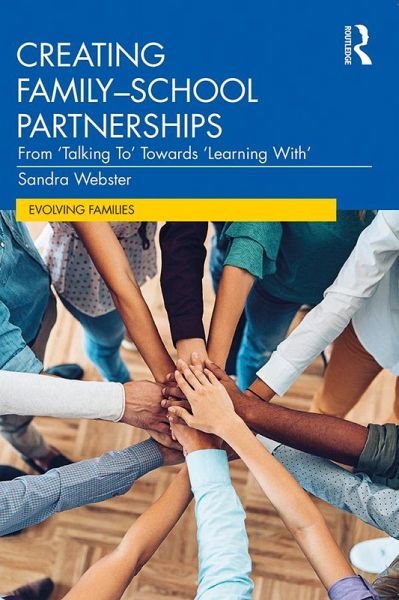
Introducing a new model of family-school partnership, entitled 'Pathways to Partnership', Sandra presents a template to teachers and school leaders for developing authentic, genuine family-school partnerships that reflect contemporary global thinking and practice. She offers a new perspective on the family-school partnership, and provides support and guidance to school leaders to move away from outdated but ingrained approaches to more effective family-school partnerships.
Globally, schools are becoming less an education centre and more of a hub that integrates health and social services. With this change, the way schools regard family involvement has also shifted, with family involvement being viewed as a strategically critical role. This shift has been influenced not just by the recent pandemic, but also by the global trend towards decentralisation and democratisation of the decision-making power in schools, in which parent empowerment is implicit. However, many schools have not followed a modern engagement model in the way they approach partnership with the family, and still espouse approaches that are school centric and outdated in their orientation. Pathways to Partnership helps move leaders from 'talking to', towards 'learning with' parents.
Using case studies and the voices of parents and teachers to bring the content to life, Sandra provides strategies for school leaders and teachers to use to establish contemporary partnerships with families, ones that reflect current thinking that leads schools into authentic collaboration with their most important partners.
Globally, schools are becoming less an education centre and more of a hub that integrates health and social services. With this change, the way schools regard family involvement has also shifted, with family involvement being viewed as a strategically critical role. This shift has been influenced not just by the recent pandemic, but also by the global trend towards decentralisation and democratisation of the decision-making power in schools, in which parent empowerment is implicit. However, many schools have not followed a modern engagement model in the way they approach partnership with the family, and still espouse approaches that are school centric and outdated in their orientation. Pathways to Partnership helps move leaders from 'talking to', towards 'learning with' parents.
Using case studies and the voices of parents and teachers to bring the content to life, Sandra provides strategies for school leaders and teachers to use to establish contemporary partnerships with families, ones that reflect current thinking that leads schools into authentic collaboration with their most important partners.
Dieser Download kann aus rechtlichen Gründen nur mit Rechnungsadresse in A, B, BG, CY, CZ, D, DK, EW, E, FIN, F, GR, HR, H, IRL, I, LT, L, LR, M, NL, PL, P, R, S, SLO, SK ausgeliefert werden.
"Creating Family-School Partnerships From 'Talking To' Towards 'Learning With' provides innovative ways for working in such spaces for families, teachers and school leaders. Through raw and honest examples, authentic reflections around partnerships can be made. At the heart is the creation of the 'Pathways to Partnership' model that supports the sharing of power between families and schools advocating for true practices associated with equal partnerships."
Professor Susanne Garvis, Griffith University, Australia
"Creating Family-School Partnerships From 'Talking To' Towards 'Learning With' describes characteristics of policy and practices that are all too commonly, school centric with the mode of communication being "talked to". On the other hand, and preferably, this book elaborates behaviours and orientations that are focused on student learning and wellbeing, the community "learning with" each other. With confidence, I endorse the book and recommend it to leaders willing to engage families as partners in improving the opportunities for students."
Peter Sullivan, Emeritus Professor of Education, Monash University
"This book is essential reading for all educators who care about their students as richly complex human beings who live and learn within and beyond the classroom. It provides evidence for what we know to be true about the power of good partnership between home and school, and it outlines a model that helps teachers and school leaders navigate the challenges and the fulfilment that come of real connection with all who share in the care of each child."
Justin Garrick, Head of School, Canberra Grammar School
Professor Susanne Garvis, Griffith University, Australia
"Creating Family-School Partnerships From 'Talking To' Towards 'Learning With' describes characteristics of policy and practices that are all too commonly, school centric with the mode of communication being "talked to". On the other hand, and preferably, this book elaborates behaviours and orientations that are focused on student learning and wellbeing, the community "learning with" each other. With confidence, I endorse the book and recommend it to leaders willing to engage families as partners in improving the opportunities for students."
Peter Sullivan, Emeritus Professor of Education, Monash University
"This book is essential reading for all educators who care about their students as richly complex human beings who live and learn within and beyond the classroom. It provides evidence for what we know to be true about the power of good partnership between home and school, and it outlines a model that helps teachers and school leaders navigate the challenges and the fulfilment that come of real connection with all who share in the care of each child."
Justin Garrick, Head of School, Canberra Grammar School