46,95 €
46,95 €
inkl. MwSt.
Sofort per Download lieferbar

23 °P sammeln
46,95 €
Als Download kaufen
46,95 €
inkl. MwSt.
Sofort per Download lieferbar
23 °P sammeln
Jetzt verschenken
Alle Infos zum eBook verschenken
46,95 €
inkl. MwSt.
Sofort per Download lieferbar
Alle Infos zum eBook verschenken
23 °P sammeln

Andere Kunden interessierten sich auch für
") Explorations in Urban and Regional Dynamics (eBook, PDF)21,95 €
Explorations in Urban and Regional Dynamics (eBook, PDF)21,95 €") Higher Education and the Creative Economy (eBook, PDF)43,95 €
Higher Education and the Creative Economy (eBook, PDF)43,95 €") Quality of Life in Cities (eBook, PDF)45,95 €
Quality of Life in Cities (eBook, PDF)45,95 €") The UK Regional-National Economic Problem (eBook, PDF)45,95 €
The UK Regional-National Economic Problem (eBook, PDF)45,95 €") Gender, Asset Accumulation and Just Cities (eBook, PDF)32,95 €
Gender, Asset Accumulation and Just Cities (eBook, PDF)32,95 €") Skills and Cities (eBook, PDF)41,95 €
Skills and Cities (eBook, PDF)41,95 €") The Geography of Scientific Collaboration (eBook, PDF)0,00 €
The Geography of Scientific Collaboration (eBook, PDF)0,00 €







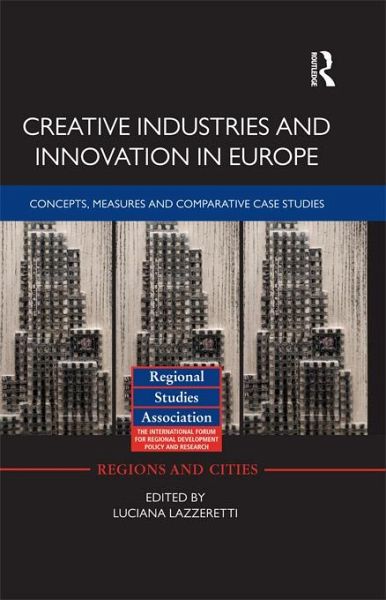
In recent years, the study of creativity has shifted from analysis of culture as an end in itself to one of economic enhancement, and its capability to generate wealth and promote economic development. Increasingly, European cities and regions are using the arts to fuel wellbeing and reinvigorate economies after the comparative demise of more traditional industry and manufacturing. A growing literature is starting to highlight the innovation capacity of cultural and creative industries (CCIs) as they intersect the innovation processes of other manufacturing and services sectors with an innovative and creative output. Culture and creativity may be a strategic weapon to exit the present crisis and redefine an economic model of sustainable development.
This book brings together a set of multidisciplinary contributions to investigate the kaleidoscope of European creativity, focussing on CCIs and the innovations connected with them. The two main questions that this volume aims to address are: How can we identify, map and define CCIs in Europe? And how do they contribute to innovation and sustainable growth?
The volume is split into two parts. The first part deals with the definition, measurement and mapping of the geography of European CCIs according to a local economic approach, focussing on Italy, Spain, the UK, Austria, Denmark and France. This section surveys the different industrial typologies and spatial patterns, which underline a significant dissimilarity between the North and the South of Europe, mainly due to the difference between heritage-driven and technology-driven countries. The section concludes with a case study on a Japanese creative city.
The second part collects some interesting cases of innovation generated in creative spaces such as cities of art or creative clusters and networks. This entails the study of innovations among creative and non-creative sectors (e.g. laser technologies in conservation of works of art and design networks in Italy) and across European and non-European countries (e.g. Spaghetti Western movies in the US or visual artists in New Zealand). Finally, an innovation capacity of culture that can regenerate mature sectors (e.g. the French food supply chain and Swiss watch Valley) or combine the creative and green economics paradigms (e.g. the green creative cities in North Europe) is analyzed.
This book will appeal to academics, scholars and practitioners of urban and regional studies, cultural and creative economics and managerial and organization studies.
This book brings together a set of multidisciplinary contributions to investigate the kaleidoscope of European creativity, focussing on CCIs and the innovations connected with them. The two main questions that this volume aims to address are: How can we identify, map and define CCIs in Europe? And how do they contribute to innovation and sustainable growth?
The volume is split into two parts. The first part deals with the definition, measurement and mapping of the geography of European CCIs according to a local economic approach, focussing on Italy, Spain, the UK, Austria, Denmark and France. This section surveys the different industrial typologies and spatial patterns, which underline a significant dissimilarity between the North and the South of Europe, mainly due to the difference between heritage-driven and technology-driven countries. The section concludes with a case study on a Japanese creative city.
The second part collects some interesting cases of innovation generated in creative spaces such as cities of art or creative clusters and networks. This entails the study of innovations among creative and non-creative sectors (e.g. laser technologies in conservation of works of art and design networks in Italy) and across European and non-European countries (e.g. Spaghetti Western movies in the US or visual artists in New Zealand). Finally, an innovation capacity of culture that can regenerate mature sectors (e.g. the French food supply chain and Swiss watch Valley) or combine the creative and green economics paradigms (e.g. the green creative cities in North Europe) is analyzed.
This book will appeal to academics, scholars and practitioners of urban and regional studies, cultural and creative economics and managerial and organization studies.
Dieser Download kann aus rechtlichen Gründen nur mit Rechnungsadresse in A, B, BG, CY, CZ, D, DK, EW, E, FIN, F, GR, HR, H, IRL, I, LT, L, LR, M, NL, PL, P, R, S, SLO, SK ausgeliefert werden.