48,95 €
48,95 €
inkl. MwSt.
Sofort per Download lieferbar

24 °P sammeln
48,95 €
Als Download kaufen
48,95 €
inkl. MwSt.
Sofort per Download lieferbar
24 °P sammeln
Jetzt verschenken
Alle Infos zum eBook verschenken
48,95 €
inkl. MwSt.
Sofort per Download lieferbar
Alle Infos zum eBook verschenken
24 °P sammeln

Andere Kunden interessierten sich auch für
") The Road To Excellence (eBook, PDF)56,95 €
The Road To Excellence (eBook, PDF)56,95 €") The World of Touch (eBook, PDF)49,95 €
The World of Touch (eBook, PDF)49,95 €") Human Abilities (eBook, PDF)56,95 €
Human Abilities (eBook, PDF)56,95 €") Creativity and Divergent Thinking (eBook, ePUB)48,95 €
Creativity and Divergent Thinking (eBook, ePUB)48,95 €") Advanced Logo (eBook, PDF)52,95 €
Advanced Logo (eBook, PDF)52,95 €") Making Decisions That Matter (eBook, PDF)37,95 €
Making Decisions That Matter (eBook, PDF)37,95 €") Spatial Cognition (eBook, PDF)39,95 €
Spatial Cognition (eBook, PDF)39,95 €


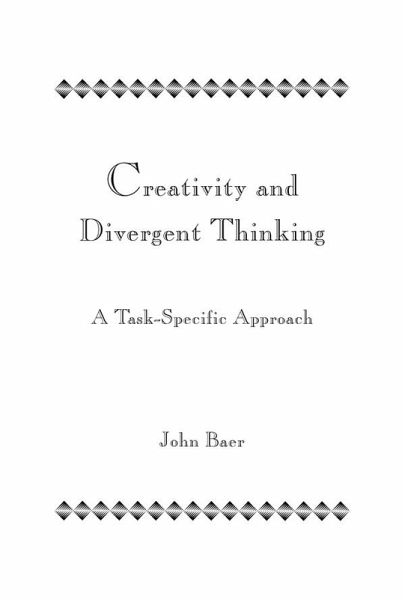
Do general-purpose creative-thinking skills -- skills like divergent thinking, which is touted as an important component of creative thinking no matter what the task domain -- actually make much of a contribution to creative performance? Although much recent research argues against such domain-transcending skills -- including several new studies reported in this book -- the appeal of such general skills remains strong, probably because of the theoretical economy and power such skills would provide. Divergent thinking, in particular, has had an incredible staying power. Despite its many flaws, divergent thinking remains the most frequently used indicator of creativity in both creativity research and educational practice, and divergent thinking theory has a strong hold on everyday conceptions of what it means to be creative.
Reviewing the available research on divergent thinking, this book presents a framework for understanding other major theories of creativity, including Mednick's associative theory and a possible connectionist approach of creativity. It reports a series of studies (including the study that won APA's 1992 Berlyne Prize) that demonstrate the absence of effects of general creative-thinking skills across a range of creativity-relevant tasks, but indicate that training in divergent thinking does in fact improve creative performance across diverse task domains. The book then ties these findings together with a multi-level theory, in which a task-specific approach to creativity is strengthened by recasting some divergent-thinking concepts into domain- and task-specific forms.
This book fills the gap between divergent-thinking theory and more recent, modular conceptions of creativity. Rather than advocate that we simply discard divergent thinking -- an approach that hasn't worked, or at least hasn't happened, because of many attacks on its validity and usefulness -- this book shows how to separate what is useful in divergent-thinking theory and practice from what is not. It shows that divergent-thinking training can be valuable, although often not for the reasons trainers think it works. And it offers specific suggestions about the kinds of creativity research most needed today.
Reviewing the available research on divergent thinking, this book presents a framework for understanding other major theories of creativity, including Mednick's associative theory and a possible connectionist approach of creativity. It reports a series of studies (including the study that won APA's 1992 Berlyne Prize) that demonstrate the absence of effects of general creative-thinking skills across a range of creativity-relevant tasks, but indicate that training in divergent thinking does in fact improve creative performance across diverse task domains. The book then ties these findings together with a multi-level theory, in which a task-specific approach to creativity is strengthened by recasting some divergent-thinking concepts into domain- and task-specific forms.
This book fills the gap between divergent-thinking theory and more recent, modular conceptions of creativity. Rather than advocate that we simply discard divergent thinking -- an approach that hasn't worked, or at least hasn't happened, because of many attacks on its validity and usefulness -- this book shows how to separate what is useful in divergent-thinking theory and practice from what is not. It shows that divergent-thinking training can be valuable, although often not for the reasons trainers think it works. And it offers specific suggestions about the kinds of creativity research most needed today.
Dieser Download kann aus rechtlichen Gründen nur mit Rechnungsadresse in A, B, BG, CY, CZ, D, DK, EW, E, FIN, F, GR, HR, H, IRL, I, LT, L, LR, M, NL, PL, P, R, S, SLO, SK ausgeliefert werden.
"...[the author] has offered a new and potentially profitable direction for studying one of psychology's most significant, but elusive, topics."
Contemporary Psychology
"Baer's book has what monographs in the social and behavioral sciences are supposed to have, namely a clear and progressive message which is supported by sound empirical research. Baer's primary message about a specificity of thinking takes us an important step closer to understanding the creative process. His research involves real creative products, not just solutions to hypothetical problems. At least as important is that these creations are the products of students of various ages. This makes for clear implications in the classroom. This book really has a great deal in its favor, and educators and cognitive scientists alike will find it of interest and value."
Mark A. Runco
California State University, Fullerton, Editor, Creativity Research Journal
Contemporary Psychology
"Baer's book has what monographs in the social and behavioral sciences are supposed to have, namely a clear and progressive message which is supported by sound empirical research. Baer's primary message about a specificity of thinking takes us an important step closer to understanding the creative process. His research involves real creative products, not just solutions to hypothetical problems. At least as important is that these creations are the products of students of various ages. This makes for clear implications in the classroom. This book really has a great deal in its favor, and educators and cognitive scientists alike will find it of interest and value."
Mark A. Runco
California State University, Fullerton, Editor, Creativity Research Journal