Critical Incidents in Journalism (eBook, ePUB)
Pivotal Moments Reshaping Journalism around the World
Redaktion: Tandoc Jr., Edson; Westlund, Oscar; Thomas, Ryan; Jenkins, Joy
Alle Infos zum eBook verschenken
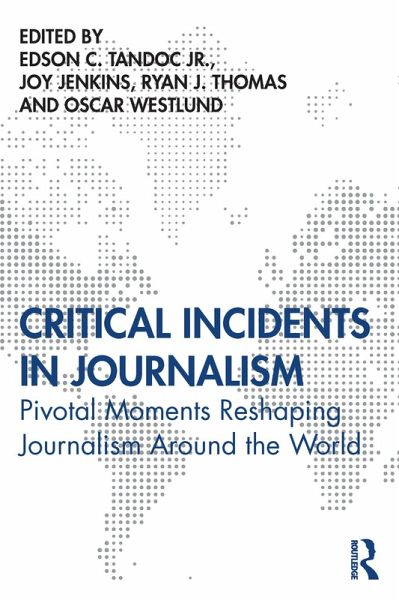
Critical Incidents in Journalism (eBook, ePUB)
Pivotal Moments Reshaping Journalism around the World
Redaktion: Tandoc Jr., Edson; Westlund, Oscar; Thomas, Ryan; Jenkins, Joy
- Format: ePub
- Merkliste
- Auf die Merkliste
- Bewerten Bewerten
- Teilen
- Produkt teilen
- Produkterinnerung
- Produkterinnerung

Hier können Sie sich einloggen

Bitte loggen Sie sich zunächst in Ihr Kundenkonto ein oder registrieren Sie sich bei bücher.de, um das eBook-Abo tolino select nutzen zu können.
This edited collection examines critical incidents journalists have faced across different media contexts, exploring how journalists and other key actors negotiate various aspects of their work.
Ranging from the Rwandan genocide to the News of the World hacking scandal in the UK, this book defines a critical incident as an event that has led journalists to reconsider their routines, roles, and rules. Combining theoretical and practical analysis, the contributors offer a discussion of the key events that journalists cover, such as political turmoil or natural disasters, as well as events…mehr
- Geräte: eReader
- mit Kopierschutz
- eBook Hilfe
Peter EnglishAustralian Sports Journalism (eBook, ePUB)19,95 €
Matt SwaineWriting for Journalists (eBook, ePUB)36,95 €
What Journalists Are Owed (eBook, ePUB)39,95 €
Patrick FerrucciMaking Nonprofit News (eBook, ePUB)19,95 €
Jonathan BakerEssential Journalism (eBook, ePUB)39,95 €
Changing Sports Journalism Practice in the Age of Digital Media (eBook, ePUB)39,95 €
Lily CanterFreelancing for Journalists (eBook, ePUB)36,95 €-
-
-
Ranging from the Rwandan genocide to the News of the World hacking scandal in the UK, this book defines a critical incident as an event that has led journalists to reconsider their routines, roles, and rules. Combining theoretical and practical analysis, the contributors offer a discussion of the key events that journalists cover, such as political turmoil or natural disasters, as well as events that directly involve and affect journalists. Featuring case studies from countries including Australia, Germany, Brazil, Kenya, and the Philippines, the book explores the discourses that critical events have generated, how journalists and other stakeholders have responded to them, and how they have reshaped (or are reshaping) journalistic norms and practices. The book also proposes a roadmap for studying such pivotal moments in journalism.
This one-of-a-kind collection is a valuable resource for students and scholars across journalism studies disciplines, from journalism history, to sociology of news, to digital journalism and political communication.
Dieser Download kann aus rechtlichen Gründen nur mit Rechnungsadresse in A, B, BG, CY, CZ, D, DK, EW, E, FIN, F, GR, HR, H, IRL, I, LT, L, LR, M, NL, PL, P, R, S, SLO, SK ausgeliefert werden.
- Produktdetails
- Verlag: Taylor & Francis eBooks
- Seitenzahl: 282
- Erscheinungstermin: 8. Dezember 2020
- Englisch
- ISBN-13: 9781000296785
- Artikelnr.: 60489760
- Verlag: Taylor & Francis eBooks
- Seitenzahl: 282
- Erscheinungstermin: 8. Dezember 2020
- Englisch
- ISBN-13: 9781000296785
- Artikelnr.: 60489760
- Herstellerkennzeichnung Die Herstellerinformationen sind derzeit nicht verfügbar.
Joy Jenkins, Edson C. Tandoc Jr., Ryan J. Thomas and Oscar Westlund
SECTION I Conceptualizing Critical Incidents
1.1 Critical incident as a construct in journalism studies
Paul D'Angelo
1.2 Journalistic critical incidents as boundary making and the making of
boundaries around critical incidents
Matt Carlson
SECTION II Characteristics of Journalistic Work
2.1 Peeling or plagiarizing? A Danish media scandal as an incident of
re-instating boundaries in the grey zones of "good" journalistic citing
practices
Jannie Møller Hartley, Maria Bendix Wittchen and Mark Blach-Ørsten
2.2 The voices of Aleppo: Re-evaluating US journalistic practices for news
coverage of children during the Syrian Civil War
Jeanna Sybert
2.3 Reporting when the current media system is at stake: Explaining news
coverage about the initiative on the abolition of public service
broadcasting in Switzerland
Linards Udris, Mark Eisenegger, Daniel Vogler, Andrea Häuptli and Lisa
Schwaiger
2.4 "You can't run away from the truth": Journalistic reflections of
enduring injustices that shape news-making in Kenya
Irene Awino
2.5 Mexico's 2006 Drug War and its impacts on newsroom practices: From
violence to anonymity and self-censorship
Manuel Chavez
2.6 (Re)telling the story: Is the Rwanda genocide a critical incident in
journalism?
Florence Madenga
2.7 False accusations in a school: A critical incident in Brazilian
journalism 25 years later
Rafael Grohmann, Felipe Moura de Oliveira and Moreno Osorio
SECTION III Communities Engaging in Interpretation
3.1 Critical incidents and auto-analysis: Photojournalists' introspections
while covering the drug war in the Philippines
Ma. Diosa Labiste
3.2 Boundary work on media freedom after the phone hacking scandal in the
United Kingdom
Binakuromo Ogbebor
3.3 United in protest: Coverage of attacks against journalists in the 2019
Hong Kong demonstrations as a critical incident
James Zhang and Joy Jenkins
3.4 Save the Children UK's #blogladesh campaign and the change in
humanitarian reporting
Glenda Cooper
3.5 Lives and livestreaming: Negotiating social media boundaries in the
Christchurch terror attack in New Zealand
Matthew Chew and Edson C. Tandoc Jr.
SECTION IV: Consequences of Critical Incidents
4.1 Cross-border investigative collaboration on the surviving stories: The
Forbidden Stories
Maria Konow-Lund and Eva-Karin Olsson
4.2 The Spiegel Affair, 1962: The incident that changed German journalism
history and mediatized politics
Thomas Birkner and Sebastian Mallek
4.3 From disruptive power to trapped endurance: Egypt's journalistic agency
after the Tahrir Revolution
Hanan Badr
4.4 An uncritical incident?: Journalism and Indigenous deaths in custody in
Australia
David Nolan and Lisa Waller
5 Critical incidents in journalism: Conceptualization, characteristics,
communities, and consequences
Ryan J. Thomas, Edson C. Tandoc Jr., Oscar Westlund and Joy Jenkins
Index
Joy Jenkins, Edson C. Tandoc Jr., Ryan J. Thomas and Oscar Westlund
SECTION I Conceptualizing Critical Incidents
1.1 Critical incident as a construct in journalism studies
Paul D'Angelo
1.2 Journalistic critical incidents as boundary making and the making of
boundaries around critical incidents
Matt Carlson
SECTION II Characteristics of Journalistic Work
2.1 Peeling or plagiarizing? A Danish media scandal as an incident of
re-instating boundaries in the grey zones of "good" journalistic citing
practices
Jannie Møller Hartley, Maria Bendix Wittchen and Mark Blach-Ørsten
2.2 The voices of Aleppo: Re-evaluating US journalistic practices for news
coverage of children during the Syrian Civil War
Jeanna Sybert
2.3 Reporting when the current media system is at stake: Explaining news
coverage about the initiative on the abolition of public service
broadcasting in Switzerland
Linards Udris, Mark Eisenegger, Daniel Vogler, Andrea Häuptli and Lisa
Schwaiger
2.4 "You can't run away from the truth": Journalistic reflections of
enduring injustices that shape news-making in Kenya
Irene Awino
2.5 Mexico's 2006 Drug War and its impacts on newsroom practices: From
violence to anonymity and self-censorship
Manuel Chavez
2.6 (Re)telling the story: Is the Rwanda genocide a critical incident in
journalism?
Florence Madenga
2.7 False accusations in a school: A critical incident in Brazilian
journalism 25 years later
Rafael Grohmann, Felipe Moura de Oliveira and Moreno Osorio
SECTION III Communities Engaging in Interpretation
3.1 Critical incidents and auto-analysis: Photojournalists' introspections
while covering the drug war in the Philippines
Ma. Diosa Labiste
3.2 Boundary work on media freedom after the phone hacking scandal in the
United Kingdom
Binakuromo Ogbebor
3.3 United in protest: Coverage of attacks against journalists in the 2019
Hong Kong demonstrations as a critical incident
James Zhang and Joy Jenkins
3.4 Save the Children UK's #blogladesh campaign and the change in
humanitarian reporting
Glenda Cooper
3.5 Lives and livestreaming: Negotiating social media boundaries in the
Christchurch terror attack in New Zealand
Matthew Chew and Edson C. Tandoc Jr.
SECTION IV: Consequences of Critical Incidents
4.1 Cross-border investigative collaboration on the surviving stories: The
Forbidden Stories
Maria Konow-Lund and Eva-Karin Olsson
4.2 The Spiegel Affair, 1962: The incident that changed German journalism
history and mediatized politics
Thomas Birkner and Sebastian Mallek
4.3 From disruptive power to trapped endurance: Egypt's journalistic agency
after the Tahrir Revolution
Hanan Badr
4.4 An uncritical incident?: Journalism and Indigenous deaths in custody in
Australia
David Nolan and Lisa Waller
5 Critical incidents in journalism: Conceptualization, characteristics,
communities, and consequences
Ryan J. Thomas, Edson C. Tandoc Jr., Oscar Westlund and Joy Jenkins
Index