103,95 €
103,95 €
inkl. MwSt.
Sofort per Download lieferbar

52 °P sammeln
103,95 €
Als Download kaufen
103,95 €
inkl. MwSt.
Sofort per Download lieferbar
52 °P sammeln
Jetzt verschenken
Alle Infos zum eBook verschenken
103,95 €
inkl. MwSt.
Sofort per Download lieferbar
Alle Infos zum eBook verschenken
52 °P sammeln

Andere Kunden interessierten sich auch für
") Crop Physiology Case Histories for Major Crops (eBook, ePUB)95,95 €
Crop Physiology Case Histories for Major Crops (eBook, ePUB)95,95 €") Genomics, Transcriptomics, Proteomics and Metabolomics of Crop Plants (eBook, ePUB)127,95 €
Genomics, Transcriptomics, Proteomics and Metabolomics of Crop Plants (eBook, ePUB)127,95 €") Crop Physiology (eBook, ePUB)69,95 €
Crop Physiology (eBook, ePUB)69,95 €") The Science of Grapevines (eBook, ePUB)86,95 €
The Science of Grapevines (eBook, ePUB)86,95 €") The Science of Grapevines (eBook, ePUB)119,95 €
The Science of Grapevines (eBook, ePUB)119,95 €") Genetic Engineering and Genome Editing for Zinc Biofortification of Rice (eBook, ePUB)95,95 €
Genetic Engineering and Genome Editing for Zinc Biofortification of Rice (eBook, ePUB)95,95 €") The Science of Grapevines (eBook, ePUB)113,95 €
The Science of Grapevines (eBook, ePUB)113,95 €
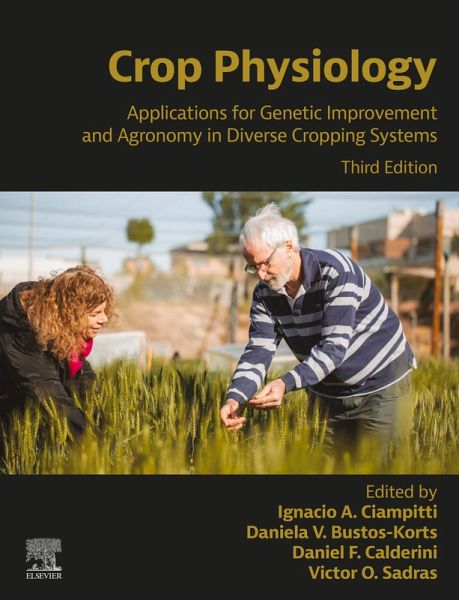
Crop Physiology: Applications for Genetic Improvement and Agronomy in Diverse Cropping Systems, Third Edition, provides updated perspectives on crop science at the interface of plant breeding and agronomy. It builds on the premise that farmers rely on two key sets of tools: varieties (what to grow) and practices (how to grow). Within this context, crop physiology plays a central role in guiding both breeding strategies and agronomic decisions.This edition is designed for researchers and advanced students interested in the fundamentals of crop ecophysiology, including the use and efficiency of water, nitrogen, and carbon, as well as crop adaptation to environmental stresses such as heat, frost, drought, waterlogging, phosphorous, and biological nitrogen fixation. The volume brings together region-specific insights, with detailed chapters on physiological traits and processes that underpin crop performance and productivity in diverse systems. - Features expert insights from a team of editors and authors from North and South America, Europe, Asia, and Australia. - Provides a view of crop physiology as a source of theories and methods to inform genetic improvement and agronomy. New to this Edition: - Introduces rice-based cropping systems of SE Asia, cereal-based and high-value perennial cropping systems in Spain, and crop-livestock-forestry farming in Brazil. - A new section on integration in the context of sustainability.
Dieser Download kann aus rechtlichen Gründen nur mit Rechnungsadresse in A, B, BG, CY, CZ, D, DK, EW, E, FIN, F, GR, HR, H, IRL, I, LT, L, LR, M, NL, PL, P, R, S, SLO, SK ausgeliefert werden.