Sie sind bereits eingeloggt. Klicken Sie auf 2. tolino select Abo, um fortzufahren.
Bitte loggen Sie sich zunächst in Ihr Kundenkonto ein oder registrieren Sie sich bei bücher.de, um das eBook-Abo tolino select nutzen zu können.
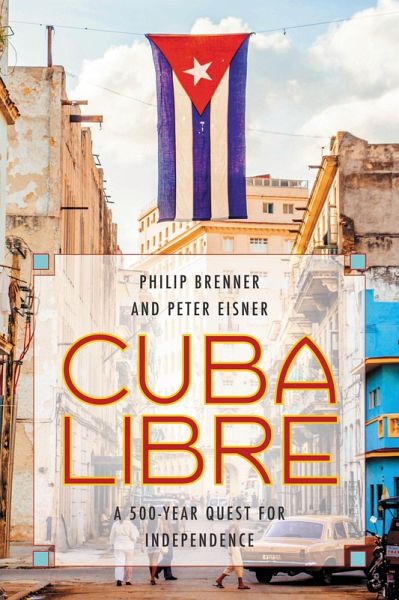
This timely book provides a balanced and deeply knowledgeable introduction to Cuba since Christopher Columbus's first arrival in 1492. With decades of experience studying and reporting on the island, Philip Brenner and Peter Eisner provide an incisive overview for all readers seeking to go beyond stereotypes in their exploration of Cuba's politics, economy, and culture. As Cuba and the United States open their doors to each other, Cuba Libre gives travelers, policy makers, businesspeople, students, and those with an interest in world affairs an opportunity to understand Cuba from a Cuban…mehr
This timely book provides a balanced and deeply knowledgeable introduction to Cuba since Christopher Columbus's first arrival in 1492. With decades of experience studying and reporting on the island, Philip Brenner and Peter Eisner provide an incisive overview for all readers seeking to go beyond stereotypes in their exploration of Cuba's politics, economy, and culture. As Cuba and the United States open their doors to each other, Cuba Libre gives travelers, policy makers, businesspeople, students, and those with an interest in world affairs an opportunity to understand Cuba from a Cuban perspective; to appreciate how Cubans' quest for independence and sovereignty animates their spirit and shapes their worldview and even their identity. In a world ever more closely linked, Cuba Libre provides a compelling model for US citizens and policy makers to empathize with viewpoints far from their own experiences.
Die Herstellerinformationen sind derzeit nicht verfügbar.
Autorenporträt
Philip Brenner is emeritus professor of international relations at American University.
Inhaltsangabe
Preface Part I: 1492-1598 Chapter 1: Columbus Arrives and Spain Colonizes Cuba, 1492-1550 Chapter 2: Sugar and Slavery Chapter 3: Struggle for Independence, 1868-1898 Chapter 4: Cuban Independence War and US Occupation Chapter 5: From Occupation to "Good Neighbor" Chapter 6: Playground of the Western World and the Rise of Batista, 1934-1958 Chapter 7: The Revolutionary Struggle, 1953-1958 Part II: 1959-1989 Chapter 8: The Quest for Sovereignty Chapter 9: Consolidating the Revolution: Culture and Politics Chapter 10: Consolidating the Revolution: Economic Reforms, New Institutions, and Basic Needs Chapter 11: Bay of Pigs/Playa Girón Chapter 12: The Missile Crisis Chapter 13: Foreign Policy in the 1960s: Exporting Revolution, Chinese Flirtations, and Soviet Tensions Chapter 14: Internal Adjustments and Advancing Equality, 1963-1975 Chapter 15: Becoming a Third World Leader, 1970s Chapter 16: Mariel Exodus-A Warning Signal, 1980 Chapter 17: Change and Rectification at Home and Abroad, 1980s Part III: 1990-2016 Chapter 18: The "Special Period" in a Time of Peace, 1990-2000 Chapter 19: The Cuban Diaspora and Racial Inequality Chapter 20: Helms-Burton, US-Cuban Relations, and Terrorism, 1995-1998 Chapter 21: The Pope Goes to Cuba; Elián Goes to Miami, 1998-2000 Chapter 22: The Search for a Viable Strategy, 2001-2006 Chapter 23: The Transition from Fidel to Raúl Castro, 2006-2009 Chapter 24: Securing Cuba's Independence through Economic Change, 2010-2016 Chapter 25: Securing Cuba's Independence through Foreign Policy, 2010-2016 Chapter 26: Change, Continuity, and the Future Appendix: Chronology of Key Events Bibliography Index
Preface Part I: 1492-1598 Chapter 1: Columbus Arrives and Spain Colonizes Cuba, 1492-1550 Chapter 2: Sugar and Slavery Chapter 3: Struggle for Independence, 1868-1898 Chapter 4: Cuban Independence War and US Occupation Chapter 5: From Occupation to "Good Neighbor" Chapter 6: Playground of the Western World and the Rise of Batista, 1934-1958 Chapter 7: The Revolutionary Struggle, 1953-1958 Part II: 1959-1989 Chapter 8: The Quest for Sovereignty Chapter 9: Consolidating the Revolution: Culture and Politics Chapter 10: Consolidating the Revolution: Economic Reforms, New Institutions, and Basic Needs Chapter 11: Bay of Pigs/Playa Girón Chapter 12: The Missile Crisis Chapter 13: Foreign Policy in the 1960s: Exporting Revolution, Chinese Flirtations, and Soviet Tensions Chapter 14: Internal Adjustments and Advancing Equality, 1963-1975 Chapter 15: Becoming a Third World Leader, 1970s Chapter 16: Mariel Exodus-A Warning Signal, 1980 Chapter 17: Change and Rectification at Home and Abroad, 1980s Part III: 1990-2016 Chapter 18: The "Special Period" in a Time of Peace, 1990-2000 Chapter 19: The Cuban Diaspora and Racial Inequality Chapter 20: Helms-Burton, US-Cuban Relations, and Terrorism, 1995-1998 Chapter 21: The Pope Goes to Cuba; Elián Goes to Miami, 1998-2000 Chapter 22: The Search for a Viable Strategy, 2001-2006 Chapter 23: The Transition from Fidel to Raúl Castro, 2006-2009 Chapter 24: Securing Cuba's Independence through Economic Change, 2010-2016 Chapter 25: Securing Cuba's Independence through Foreign Policy, 2010-2016 Chapter 26: Change, Continuity, and the Future Appendix: Chronology of Key Events Bibliography Index
Es gelten unsere Allgemeinen Geschäftsbedingungen: www.buecher.de/agb
Impressum
www.buecher.de ist ein Internetauftritt der buecher.de internetstores GmbH
Geschäftsführung: Monica Sawhney | Roland Kölbl | Günter Hilger
Sitz der Gesellschaft: Batheyer Straße 115 - 117, 58099 Hagen
Postanschrift: Bürgermeister-Wegele-Str. 12, 86167 Augsburg
Amtsgericht Hagen HRB 13257
Steuernummer: 321/5800/1497
USt-IdNr: DE450055826