31,95 €
31,95 €
inkl. MwSt.
Sofort per Download lieferbar

16 °P sammeln
31,95 €
Als Download kaufen
31,95 €
inkl. MwSt.
Sofort per Download lieferbar
16 °P sammeln
Jetzt verschenken
Alle Infos zum eBook verschenken
31,95 €
inkl. MwSt.
Sofort per Download lieferbar
Alle Infos zum eBook verschenken
16 °P sammeln

Andere Kunden interessierten sich auch für
") Reframing Campus Conflict (eBook, ePUB)32,95 €
Reframing Campus Conflict (eBook, ePUB)32,95 €") Educating About Religious Diversity and Interfaith Engagement (eBook, ePUB)33,95 €
Educating About Religious Diversity and Interfaith Engagement (eBook, ePUB)33,95 €") University and College Women's and Gender Equity Centers (eBook, ePUB)42,95 €
University and College Women's and Gender Equity Centers (eBook, ePUB)42,95 €") Islamophobia in Higher Education (eBook, ePUB)28,95 €
Islamophobia in Higher Education (eBook, ePUB)28,95 €") Multiculturalism on Campus (eBook, ePUB)36,95 €
Multiculturalism on Campus (eBook, ePUB)36,95 €") Critical Praxis in Student Affairs (eBook, ePUB)32,95 €
Critical Praxis in Student Affairs (eBook, ePUB)32,95 €") Rethinking College Student Development Theory Using Critical Frameworks (eBook, ePUB)33,95 €
Rethinking College Student Development Theory Using Critical Frameworks (eBook, ePUB)33,95 €






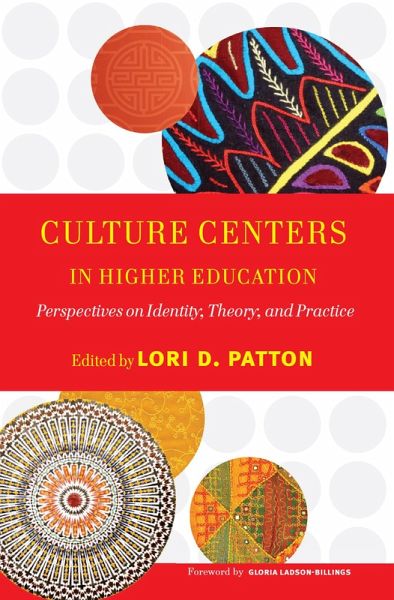
Are cultural centers ethnic enclaves of segregation, or safe havens that provide minority students with social support that promotes persistence and retention?Though Black cultural centers boast a 40-year history, there is much misinformation about them and the ethnic counterparts to which they gave rise. Moreover, little is known about their historical roots, current status, and future prospects. The literature has largely ignored the various culture center models, and the role that such centers play in the experiences of college students. This book fills a significant void in the research on ethnic minority cultural centers, offers the historic background to their establishment and development, considers the circumstances that led to their creation, examines the roles they play on campus, explores their impact on retention and campus climate, and provides guidelines for their management in the light of current issues and future directions.In the first part of this volume, the contributors provide perspectives on culture centers from the point of view of various racial/ethnic identity groups, Latina/o, Asian, American Indian, and African American. Part II offers theoretical perspectives that frame the role of culture centers from the point of view of critical race theory, student development theory, and a social justice framework. Part III focuses specifically on administrative and practice-oriented themes, addressing such issues as the relative merits of full- and part-time staff, of race/ethnic specific as opposed to multicultural centers, relations with the outside community, and integration with academic and student affairs to support the mission of the institution. For administrators and student affairs educators who are unfamiliar with these facilities, and want to support an increasingly diverse student body, this book situates such centers within the overall strategy of improving campus climate, and makes the case for sustaining them. Where none as yet exist, this book offers a rationale and blueprint for creating such centers. For leaders of culture centers this book constitutes a valuable tool for assessing their viability, improving their performance, and ensuring their future relevance - all considerations of increased importance when budgets and resources are strained. This book also provides a foundation for researchers interested in further investigating the role of these centers in higher education.
Dieser Download kann aus rechtlichen Gründen nur mit Rechnungsadresse in A, B, BG, CY, CZ, D, DK, EW, E, FIN, F, GR, HR, H, IRL, I, LT, L, LR, M, NL, PL, P, R, S, SLO, SK ausgeliefert werden.