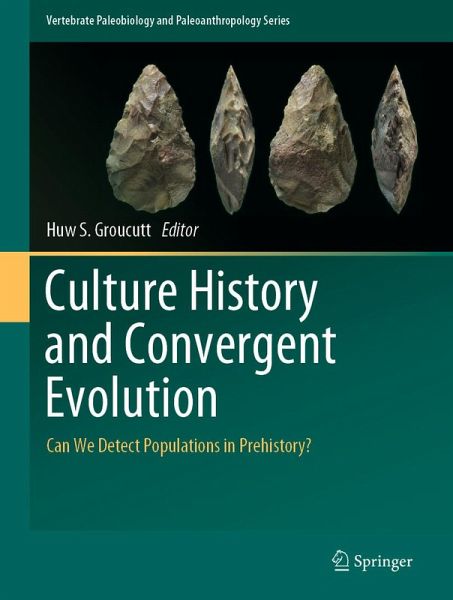
Culture History and Convergent Evolution (eBook, PDF)
Can We Detect Populations in Prehistory?
Redaktion: Groucutt, Huw S.
88,95 €
inkl. MwSt.
Sofort per Download lieferbar

44 °P sammeln

Culture History and Convergent Evolution (eBook, PDF)
Can We Detect Populations in Prehistory?
Redaktion: Groucutt, Huw S.
- Format: PDF
- Merkliste
- Auf die Merkliste
- Bewerten Bewerten
- Teilen
- Produkt teilen
- Produkterinnerung
- Produkterinnerung

Bitte loggen Sie sich zunächst in Ihr Kundenkonto ein oder registrieren Sie sich bei
bücher.de, um das eBook-Abo tolino select nutzen zu können.
Hier können Sie sich einloggen
Sie sind bereits eingeloggt. Klicken Sie auf 2. tolino select Abo, um fortzufahren.

Bitte loggen Sie sich zunächst in Ihr Kundenkonto ein oder registrieren Sie sich bei bücher.de, um das eBook-Abo tolino select nutzen zu können.
Covers various spatial and temporal periods to explore how to distinguish convergent evolution from cultural transmission Determines how to detect ancient populations by analyzing material cultures and comparing them to lithic data Draws on diverse contributions from leading archaeologists and palaeoanthropologists
- Geräte: PC
- ohne Kopierschutz
- eBook Hilfe
- Größe: 12.84MB
Andere Kunden interessierten sich auch für
Sergio MartínezBiogeography of the Quaternary Molluscs of the Southwestern Atlantic Ocean (eBook, PDF)40,95 €
Robert L. CarltonA Concise Dictionary of Paleontology (eBook, PDF)167,95 €
The Nature of Culture (eBook, PDF)40,95 €
American Megafaunal Extinctions at the End of the Pleistocene (eBook, PDF)80,95 €
Multidisciplinary Approaches to the Study of Stone Age Weaponry (eBook, PDF)72,95 €
Plants and Palynomorphs around the Permian-Triassic Boundary of South China (eBook, PDF)128,95 €
Martin UbillaGeology and Paleontology of the Quaternary of Uruguay (eBook, PDF)40,95 €-
-
-
Covers various spatial and temporal periods to explore how to distinguish convergent evolution from cultural transmission
Determines how to detect ancient populations by analyzing material cultures and comparing them to lithic data
Draws on diverse contributions from leading archaeologists and palaeoanthropologists
Dieser Download kann aus rechtlichen Gründen nur mit Rechnungsadresse in A, B, BG, CY, CZ, D, DK, EW, E, FIN, F, GR, HR, H, IRL, I, LT, L, LR, M, NL, PL, P, R, S, SLO, SK ausgeliefert werden.
Produktdetails
- Produktdetails
- Verlag: Springer Nature Switzerland
- Seitenzahl: 302
- Erscheinungstermin: 23. Juli 2020
- Englisch
- ISBN-13: 9783030461263
- Artikelnr.: 59881073
- Verlag: Springer Nature Switzerland
- Seitenzahl: 302
- Erscheinungstermin: 23. Juli 2020
- Englisch
- ISBN-13: 9783030461263
- Artikelnr.: 59881073
- Herstellerkennzeichnung Die Herstellerinformationen sind derzeit nicht verfügbar.
Dr. Huw S. Groucutt is group leader of the Max Planck 'Extreme Events Research Group' in Jena, Germany. He received his Bachelors in Archaeology and Masters in Paleoanthropology at the University of Sheffield in 2007 and 2008 respectively, and his PhD in Archaeological Science at the University of Oxford in 2013. He was then a postdoctoral researcher on the ERC funded Palaeodeserts project (2013-2016) and then a British Academy postdoctoral fellow (2016-2019), both at the University of Oxford. He has co-written over 50 journal articles, and co-edited four books and journal special issues. Dr Groucutt's research interests include human evolution and prehistory, stone tool technologies, human demographic changes in the Saharo-Arabian belt, and the relationship between hominin demography and environmental change.
Chapter 1-Introduction: Into the tangled web of culture-history and convergent evolution.- Chapter 2-The unity of Acheulean culture. Chapter 3-Problems and pitfalls in understanding the Clactonian.- Chapter 4-Culture and convergence: The curious case of the Nubian Complex.- Chapter 5-Lithic variability and cultures in the East African Middle Stone Age.- Chapter 6-A matter of space and time: How frequent is convergence in lithic technology in the African archaeological record over the last 300 kyr?.- Chapter 7-Technology and function of Middle Stone Age points. Insights from a combined approach at Bushman Rock Shelter, South Africa.- Chapter 8-Raw material and regionalization in Stone Age East Africa.- Chapter 9-The Middle-Upper Paleolithic transition: A long-term biocultural effect of anatomically modern human dispersal.- Chapter 10-Threading the weft, testing the warp: Population concepts and the European Upper Palaeolithic chronocultural framework.- Chapter 11-Communities of interaction: Tradition and learning in stone tool production through the lens of the Epipaleolithic of Kharaneh IV, Jordan.- Chapter 12-Toward a theory of the point.- Chapter 13-Learning strategies and population dynamics during the Pleistocene colonization of North America.- Chapter 14-Culture, environmental adaptation or specific problem solving? On convergence and innovation dynamics related to techniques used for stone heat treatment.- Chapter 15-Style, function and cultural transmission.