42,95 €
42,95 €
inkl. MwSt.
Sofort per Download lieferbar

21 °P sammeln
42,95 €
Als Download kaufen
42,95 €
inkl. MwSt.
Sofort per Download lieferbar
21 °P sammeln
Jetzt verschenken
Alle Infos zum eBook verschenken
42,95 €
inkl. MwSt.
Sofort per Download lieferbar
Alle Infos zum eBook verschenken
21 °P sammeln

Andere Kunden interessierten sich auch für
") Law, Social Movements and the Politics of the Commons (eBook, ePUB)39,95 €
Law, Social Movements and the Politics of the Commons (eBook, ePUB)39,95 €") Customary Property and the Rule of Law (eBook, PDF)42,95 €
Customary Property and the Rule of Law (eBook, PDF)42,95 €") Law and the New Urban Agenda (eBook, ePUB)41,95 €
Law and the New Urban Agenda (eBook, ePUB)41,95 €") Bringing the Law Back In (eBook, ePUB)34,95 €
Bringing the Law Back In (eBook, ePUB)34,95 €") Social Justice and Adequate Housing (eBook, ePUB)39,95 €
Social Justice and Adequate Housing (eBook, ePUB)39,95 €") Law and Intangible Cultural Heritage in the City (eBook, ePUB)40,95 €
Law and Intangible Cultural Heritage in the City (eBook, ePUB)40,95 €") Subversive Property (eBook, ePUB)39,95 €
Subversive Property (eBook, ePUB)39,95 €




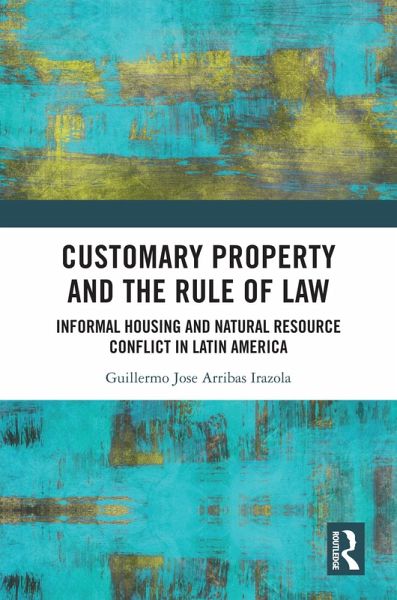
Informal housing and natural resource conflicts are common in Latin America. However, academics have rarely linked these social phenomena. This book proposes customary property (an extralegal entitlement founded in the social norms of a given community) as a common lens to analyze, understand, and potentially solve the struggles that are found in informal housing and mining natural resource conflict. This book shows how land titling policies inspired in De Soto's work have failed in taming the expansion of informal housing. Moreover, this book contests the mainstream explanation for social unrest in developing new mining projects which attributes it to the separation of surface and mining rights. Finally, the book proposes that the tension between customary property and lack of law enforcement by the State can progressively corrode the rule of law. This book proposes a nuanced version of land titling for informal housing, and a social license legal proceeding for the development of new mining projects. Ultimately, the book aadvocates for replacing violence between customary holders and the State with peaceful legal proceedings and negotiation tables. This book is directed to any property scholars and students interested in developing countries, social norms over assets, and natural resource conflicts.
Dieser Download kann aus rechtlichen Gründen nur mit Rechnungsadresse in A, B, BG, CY, CZ, D, DK, EW, E, FIN, F, GR, HR, H, IRL, I, LT, L, LR, M, NL, PL, P, R, S, SLO, SK ausgeliefert werden.