Sie sind bereits eingeloggt. Klicken Sie auf 2. tolino select Abo, um fortzufahren.
Bitte loggen Sie sich zunächst in Ihr Kundenkonto ein oder registrieren Sie sich bei bücher.de, um das eBook-Abo tolino select nutzen zu können.
In an uncertain and complex environment, to ensure secure and stable operations of large-scale power systems is one of the biggest challenges that power engineers have to address today. Traditionally, power system operations and decision-making in controls are based on power system computations of physical models describing the behavior of power systems. Largely, physical models are constructed according to some assumptions and simplifications, and such is the case with power system models. However, the complexity of power system stability problems, along with the system's inherent…mehr
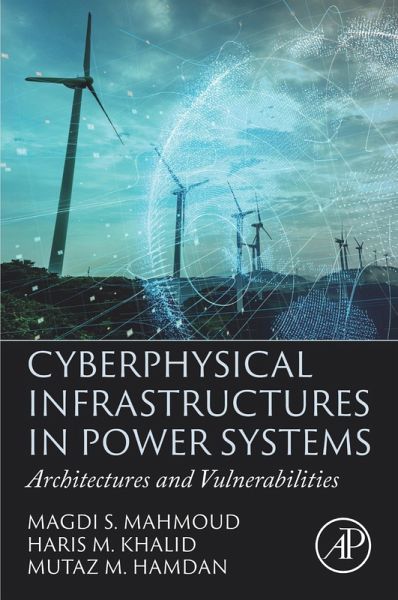
In an uncertain and complex environment, to ensure secure and stable operations of large-scale power systems is one of the biggest challenges that power engineers have to address today. Traditionally, power system operations and decision-making in controls are based on power system computations of physical models describing the behavior of power systems. Largely, physical models are constructed according to some assumptions and simplifications, and such is the case with power system models. However, the complexity of power system stability problems, along with the system's inherent uncertainties and nonlinearities, can result in models that are impractical or inaccurate. This calls for adaptive or deep-learning algorithms to significantly improve current control schemes that solve decision and control problems. Cyberphysical Infrastructures in Power Systems: Architectures and Vulnerabilities provides an extensive overview of CPS concepts and infrastructures in power systems with a focus on the current state-of-the-art research in this field. Detailed classifications are pursued highlighting existing solutions, problems, and developments in this area. - Gathers the theoretical preliminaries and fundamental issues related to CPS architectures. - Provides coherent results in adopting control and communication methodologies to critically examine problems in various units within smart power systems and microgrid systems. - Presents advanced analysis under cyberphysical attacks and develops resilient control strategies to guarantee safe operation at various power levels.
Dieser Download kann aus rechtlichen Gründen nur mit Rechnungsadresse in A, B, BG, CY, CZ, D, DK, EW, E, FIN, F, GR, HR, H, IRL, I, LT, L, LR, M, NL, PL, P, R, S, SLO, SK ausgeliefert werden.
Die Herstellerinformationen sind derzeit nicht verfügbar.
Autorenporträt
Magdi S. Mahmoud is a distinguished professor at King Fahd University of Petroleum and Minerals (KFUPM), Saudi Arabia. He has been faculty member at different universities worldwide including Egypt (CU, AUC), Kuwait (KU), UAE (UAEU), UK (UMIST), USA (Pitt, Case Western), Singapore (Nanyang), and Australia (Adelaide). He lectured in Venezuela (Caracas), Germany (Hanover), UK (Kent), USA (UoSA), Canada (Montreal) and China (BIT, Yanshan). He is the principal author of 51 books, inclusive book-chapters, and author/co-author of more than 610 peer-reviewed papers. He is a fellow of the IEE and a senior member of the IEEE, the CEI (UK). He is currently actively engaged in teaching and research in the development of modern methodologies to distributed control and filtering, networked control systems, fault-tolerant systems, cyberphysical systems, and information technology.Haris M. Khalid received the BSc (Hons.) degree from the University of Engineering and Technology (UET), Lahore, Pakistan, in 2007, and the MSc and PhD degrees from King Fahd University of Petroleum and Minerals (KFUPM), Dhahran, Saudi Arabia, in 2009 and 2012, respectively, all in mechatronics and control systems engineering.From 2023 to the present, he has been an Associate Professor in the College of Engineering and Information Technology at the University of Dubai (UD), Academic City, Dubai, UAE. From 2022 to 2025, he was also a Visiting Senior Researcher with the University of Johannesburg (UJ), South Africa. From 2019 to 2022, he was an Energy Specialist Consultant to the UAE Space Agency (UAESA) and NanoRacks for "Tests in Orbits-themed space projects. From 2016 to 2022, he was an Assistant Professor in the Electrical and Electronics Engineering Department at Higher Colleges of Technology (HCT) - Sharjah campuses. He has also worked as a Postdoctoral Researcher, Visiting Scholar, and Research Fellow with KFUPM, Masdar Institute, and Petroleum Institute from 2012 to 2013, 2013 to 2016, and 2015 to 2016, respectively.Mutaz M. Hamdan obtained a Bachelor of Engineering degree (Honors) in Mechanical Engineering, Mechatronics Engineering Branch from the Palestine Polytechnic University, Hebron, Palestine, in 2006. He received a M.Sc. and a PhD in Systems and Control Engineering from the King Fahd University of Petroleum and Minerals (KFUPM), Dhahran, Saudi Arabia, in 2012 and 2019. He has authored several journal papers. He is currently a post-doctoral fellow at KFUPM, Saudi Arabia. His research interests include linear and nonlinear control systems, networked control systems, distributed control systems, and secure control systems.
Inhaltsangabe
Part I. Background 1. Overview 2. Smart grids: control and cybersecurity
Part II. Control, estimation, and fault detection 3. Safe control methods 4. Event-triggering control of cyberphysical power systems 5. Wide-area monitoring and estimation systems
Part III. Power systems' architectures 6. Future grid architectures 7. Mature industrial functions 8. Secure filtering in power systems 9. Basic mathematical tools
Part I. Background 1. Overview 2. Smart grids: control and cybersecurity
Part II. Control, estimation, and fault detection 3. Safe control methods 4. Event-triggering control of cyberphysical power systems 5. Wide-area monitoring and estimation systems
Part III. Power systems' architectures 6. Future grid architectures 7. Mature industrial functions 8. Secure filtering in power systems 9. Basic mathematical tools
Es gelten unsere Allgemeinen Geschäftsbedingungen: www.buecher.de/agb
Impressum
www.buecher.de ist ein Internetauftritt der buecher.de internetstores GmbH
Geschäftsführung: Monica Sawhney | Roland Kölbl | Günter Hilger
Sitz der Gesellschaft: Batheyer Straße 115 - 117, 58099 Hagen
Postanschrift: Bürgermeister-Wegele-Str. 12, 86167 Augsburg
Amtsgericht Hagen HRB 13257
Steuernummer: 321/5800/1497
USt-IdNr: DE450055826