0,00 €
0,00 €
inkl. MwSt.
Sofort per Download lieferbar

0 °P sammeln
0,00 €
Als Download kaufen
0,00 €
inkl. MwSt.
Sofort per Download lieferbar
0 °P sammeln
Jetzt verschenken
Alle Infos zum eBook verschenken
0,00 €
inkl. MwSt.
Sofort per Download lieferbar
Alle Infos zum eBook verschenken
0 °P sammeln

Andere Kunden interessierten sich auch für
") Ethics, Law and Natural Hazards (eBook, ePUB)41,95 €
Ethics, Law and Natural Hazards (eBook, ePUB)41,95 €") The Protection of Cultural Heritage During Armed Conflict (eBook, ePUB)22,95 €
The Protection of Cultural Heritage During Armed Conflict (eBook, ePUB)22,95 €") Disarmament Law (eBook, ePUB)41,95 €
Disarmament Law (eBook, ePUB)41,95 €") Protection of Civilians in UN Peacekeeping Operations (eBook, ePUB)42,95 €
Protection of Civilians in UN Peacekeeping Operations (eBook, ePUB)42,95 €") Protection of Civilians and Individual Accountability (eBook, ePUB)41,95 €
Protection of Civilians and Individual Accountability (eBook, ePUB)41,95 €") Terrorism and State Surveillance of Communications (eBook, ePUB)22,95 €
Terrorism and State Surveillance of Communications (eBook, ePUB)22,95 €") Ukraine and the Legal Accountability of Russia (eBook, ePUB)48,95 €
Ukraine and the Legal Accountability of Russia (eBook, ePUB)48,95 €







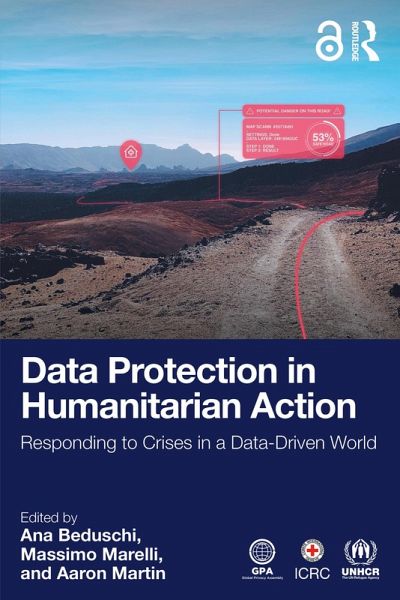
This book is the product of a collaboration between the data protection offices of the ICRC and UNHCR, alongside the Global Privacy Assembly, to reflect on a decade of progress in data protection in humanitarian contexts. Through practitioner perspectives, empirical research, and conceptual reflections, it examines how data protection underpins trust, accountability, and respect for affected populations, serving as a crucial enabler for ethical and effective humanitarian action in the digital age.
The volume explores critical topics including digital transformation, operational complexities such as those linked to data breaches and data sharing, regulatory developments and international cooperation, legal frameworks and capacity-building. At the same time, it looks ahead, addressing the challenges and opportunities posed by emerging technologies and considering how the humanitarian sector may anticipate and prepare for them.
This book is intended for policymakers, practitioners, authorities, academics, and other experts working in data protection, international organisations, and humanitarian action and adjacent fields. It offers a compass to help navigate complex operational and legal challenges in an increasingly digital and data-driven landscape. By positioning data protection as a foundational element of humanitarian action, the book provides timely, forward-looking insights into the sector's preparedness for technological and regulatory change, with the aim of helping those most in need.
The Open Access version of this book, available at www.taylorfrancis.com, has been made available under a Creative Commons Attribution-Non Commercial-No Derivatives (CC-BY-NC-ND) 4.0 International license.
The volume explores critical topics including digital transformation, operational complexities such as those linked to data breaches and data sharing, regulatory developments and international cooperation, legal frameworks and capacity-building. At the same time, it looks ahead, addressing the challenges and opportunities posed by emerging technologies and considering how the humanitarian sector may anticipate and prepare for them.
This book is intended for policymakers, practitioners, authorities, academics, and other experts working in data protection, international organisations, and humanitarian action and adjacent fields. It offers a compass to help navigate complex operational and legal challenges in an increasingly digital and data-driven landscape. By positioning data protection as a foundational element of humanitarian action, the book provides timely, forward-looking insights into the sector's preparedness for technological and regulatory change, with the aim of helping those most in need.
The Open Access version of this book, available at www.taylorfrancis.com, has been made available under a Creative Commons Attribution-Non Commercial-No Derivatives (CC-BY-NC-ND) 4.0 International license.
Dieser Download kann aus rechtlichen Gründen nur mit Rechnungsadresse in A, B, BG, CY, CZ, D, DK, EW, E, FIN, F, GR, HR, H, IRL, I, LT, L, LR, M, NL, PL, P, R, S, SLO, SK ausgeliefert werden.