25,95 €
25,95 €
inkl. MwSt.
Erscheint vor. 13.01.26

13 °P sammeln
25,95 €
Als Download kaufen
25,95 €
inkl. MwSt.
Erscheint vor. 13.01.26
13 °P sammeln
Jetzt verschenken
Alle Infos zum eBook verschenken
25,95 €
inkl. MwSt.
Erscheint vor. 13.01.26
Alle Infos zum eBook verschenken
13 °P sammeln

Andere Kunden interessierten sich auch für
") Politics in a Time of Crisis (eBook, ePUB)11,95 €
Politics in a Time of Crisis (eBook, ePUB)11,95 €") The Enlarged European Union (eBook, ePUB)45,95 €
The Enlarged European Union (eBook, ePUB)45,95 €") Austerity (eBook, ePUB)6,99 €
Austerity (eBook, ePUB)6,99 €") The Political System of the European Union (eBook, ePUB)27,95 €
The Political System of the European Union (eBook, ePUB)27,95 €") Beyond Collective Action Problems (eBook, ePUB)40,95 €
Beyond Collective Action Problems (eBook, ePUB)40,95 €") The Dynamics Of Foreign-policy Decisionmaking In China (eBook, ePUB)45,95 €
The Dynamics Of Foreign-policy Decisionmaking In China (eBook, ePUB)45,95 € A Book Report on "Europe as Empire - The Nature of the Enlarged European Union" (eBook, ePUB)2,99 €






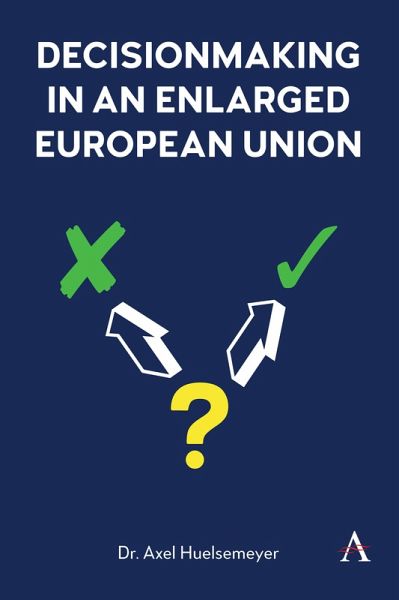
This book discusses several EU intuitions based upon how they vote. Two of the seven official EU institutions represent only the member states: they are the European Council (27 heads of state or government) and the Council of the European Union (government ministers from the member states, e.g., 27 agricultural ministers). First, the so-called European Council exclusively decides by unanimity. The extant literature holds that this slows down the decisionmaking process considerably, as the number of member states increases. This is the case because any given member country could take all others "hostage" by refusing to consent without extracting concessions.
On the other end of the spectrum, the so-called Council of the European Union takes the vast majority of its decisions by what is termed qualified majority-55% of the members (i.e., with the current 27 countries, this means 15) representing at least 65% of the total EU population. In this case, the former hostage holders can now simply be outvoted. Hence, the latter European Union institution could be a likely candidate for a practical solution to the unanimity-voting quagmire.
On the other end of the spectrum, the so-called Council of the European Union takes the vast majority of its decisions by what is termed qualified majority-55% of the members (i.e., with the current 27 countries, this means 15) representing at least 65% of the total EU population. In this case, the former hostage holders can now simply be outvoted. Hence, the latter European Union institution could be a likely candidate for a practical solution to the unanimity-voting quagmire.
Dieser Download kann aus rechtlichen Gründen nur mit Rechnungsadresse in A, D ausgeliefert werden.