40,95 €
inkl. MwSt.
Sofort per Download lieferbar
20 °P sammeln

Andere Kunden interessierten sich auch für
") Greek Culture After the Financial Crisis and the Covid-19 Crisis (eBook, PDF)48,95 €
Greek Culture After the Financial Crisis and the Covid-19 Crisis (eBook, PDF)48,95 €") Early Utilitarians (eBook, PDF)26,95 €
Early Utilitarians (eBook, PDF)26,95 €") Workbook for Principles of Microeconomics (eBook, PDF)32,95 €
Workbook for Principles of Microeconomics (eBook, PDF)32,95 €") Principles of Microeconomics (eBook, PDF)64,95 €
Principles of Microeconomics (eBook, PDF)64,95 €") The Psychology Behind Design (eBook, PDF)120,95 €
The Psychology Behind Design (eBook, PDF)120,95 €") Behavioural Business (eBook, PDF)96,95 €
Behavioural Business (eBook, PDF)96,95 €") Ergonomics and Nudging for Health, Safety and Happiness (eBook, PDF)160,95 €
Ergonomics and Nudging for Health, Safety and Happiness (eBook, PDF)160,95 €




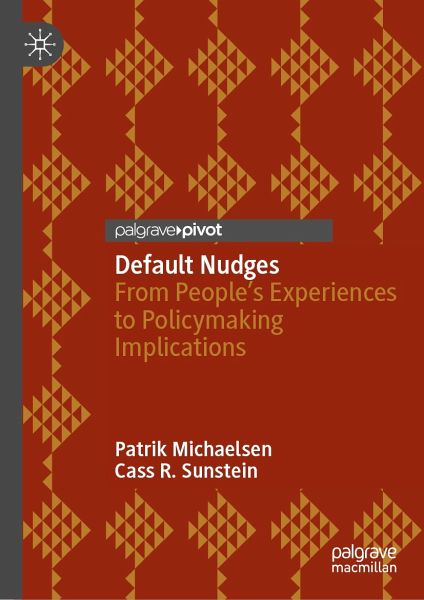
All over the world, private and public institutions have been attracted to "nudges," understood as interventions that preserve freedom of choice, but that steer people in particular directions. The most effective nudges are often "defaults," which establish what happens if people do nothing. For example, automatic enrollment in savings plans is a default nudge, as is automatic enrollment in green energy.
Default rules are in widespread use, but we have very little information about how people experience them, whether they see themselves as manipulated by them, and whether they approve of them in practice. In this book, Patrik Michaelsen and Cass R. Sunstein offer a wealth of new evidence about people's experiences and perceptions with respect to default rules. They argue that this evidence can help us to answer important questions about the effectiveness and ethics of nudging.
The evidence offers a generally positive picture of how default nudges are perceived and experienced. The central conclusion is simple: empirical findings strongly support the conclusion that, taken as such, default nudges are both ethical and effective. These findings, and the accompanying discussion, have significant implications for policymakers in many nations, and also for the private sector.
Default rules are in widespread use, but we have very little information about how people experience them, whether they see themselves as manipulated by them, and whether they approve of them in practice. In this book, Patrik Michaelsen and Cass R. Sunstein offer a wealth of new evidence about people's experiences and perceptions with respect to default rules. They argue that this evidence can help us to answer important questions about the effectiveness and ethics of nudging.
The evidence offers a generally positive picture of how default nudges are perceived and experienced. The central conclusion is simple: empirical findings strongly support the conclusion that, taken as such, default nudges are both ethical and effective. These findings, and the accompanying discussion, have significant implications for policymakers in many nations, and also for the private sector.
Dieser Download kann aus rechtlichen Gründen nur mit Rechnungsadresse in A, B, BG, CY, CZ, D, DK, EW, E, FIN, F, GR, HR, H, IRL, I, LT, L, LR, M, NL, PL, P, R, S, SLO, SK ausgeliefert werden.