23,95 €
23,95 €
inkl. MwSt.
Sofort per Download lieferbar

12 °P sammeln
23,95 €
Als Download kaufen
23,95 €
inkl. MwSt.
Sofort per Download lieferbar
12 °P sammeln
Jetzt verschenken
Alle Infos zum eBook verschenken
23,95 €
inkl. MwSt.
Sofort per Download lieferbar
Alle Infos zum eBook verschenken
12 °P sammeln

Andere Kunden interessierten sich auch für
") Ethics and Accountability on the US Supreme Court (eBook, ePUB)25,95 €
Ethics and Accountability on the US Supreme Court (eBook, ePUB)25,95 €") When at Times the Mob Is Swayed (eBook, ePUB)14,95 €
When at Times the Mob Is Swayed (eBook, ePUB)14,95 €") Concurring Opinion Writing on the U.S. Supreme Court (eBook, ePUB)25,95 €
Concurring Opinion Writing on the U.S. Supreme Court (eBook, ePUB)25,95 €") Justice on the Brink (eBook, ePUB)3,99 €
Justice on the Brink (eBook, ePUB)3,99 €") Restoring the Global Judiciary (eBook, ePUB)19,95 €
Restoring the Global Judiciary (eBook, ePUB)19,95 €") States of Exception (eBook, ePUB)43,95 €
States of Exception (eBook, ePUB)43,95 €") Courts and Congress (eBook, ePUB)15,95 €
Courts and Congress (eBook, ePUB)15,95 €
Examines the critical role assumed by the U. S. judiciary in balancing concerns about national security with the protection of liberty after the terrorist attacks of September 11, 2001.
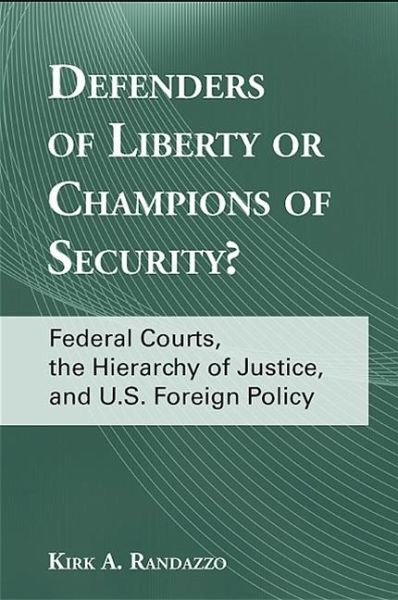
The terrorist attacks of September 11, 2001, and the subsequent responses by the U.S. federal government have raised fundamental questions about civil liberties in both domestic and international laws. As a result, the U.S. judiciary, out of its responsibility for interpreting the Constitution, has assumed a crucial role in defining boundaries of domestic and foreign policy, and in balancing concerns about security with the protection of liberty. Utilizing a sophisticated blend of quantitative and qualitative analysis, Kirk A. Randazzo examines two main questions: To what extent do federal judges defend liberty or champion security when adjudicating disputes? And to what extent does the hierarchal structure of the federal judiciary influence decisions by lower court judges? There are, he argues, disturbing indications that the federal judiciary as a whole are not defenders of liberty. Furthermore, lower court judges strategically anticipate the decisions of higher courts and constrain their behavior to avoid reversal.
The terrorist attacks of September 11, 2001, and the subsequent responses by the U.S. federal government have raised fundamental questions about civil liberties in both domestic and international laws. As a result, the U.S. judiciary, out of its responsibility for interpreting the Constitution, has assumed a crucial role in defining boundaries of domestic and foreign policy, and in balancing concerns about security with the protection of liberty. Utilizing a sophisticated blend of quantitative and qualitative analysis, Kirk A. Randazzo examines two main questions: To what extent do federal judges defend liberty or champion security when adjudicating disputes? And to what extent does the hierarchal structure of the federal judiciary influence decisions by lower court judges? There are, he argues, disturbing indications that the federal judiciary as a whole are not defenders of liberty. Furthermore, lower court judges strategically anticipate the decisions of higher courts and constrain their behavior to avoid reversal.
Dieser Download kann aus rechtlichen Gründen nur mit Rechnungsadresse in A, D ausgeliefert werden.