112,95 €
112,95 €
inkl. MwSt.
Sofort per Download lieferbar

56 °P sammeln
112,95 €
Als Download kaufen
112,95 €
inkl. MwSt.
Sofort per Download lieferbar
56 °P sammeln
Jetzt verschenken
Alle Infos zum eBook verschenken
112,95 €
inkl. MwSt.
Sofort per Download lieferbar
Alle Infos zum eBook verschenken
56 °P sammeln

Andere Kunden interessierten sich auch für
") The Routledge Guidebook to Galileo's Dialogue (eBook, PDF)24,95 €
The Routledge Guidebook to Galileo's Dialogue (eBook, PDF)24,95 €") Experiment and Natural Philosophy in Seventeenth-Century Tuscany (eBook, PDF)175,95 €
Experiment and Natural Philosophy in Seventeenth-Century Tuscany (eBook, PDF)175,95 €") Scientific Progress (eBook, PDF)112,95 €
Scientific Progress (eBook, PDF)112,95 €") The Scientist's Atom and the Philosopher's Stone (eBook, PDF)72,95 €
The Scientist's Atom and the Philosopher's Stone (eBook, PDF)72,95 €") Scientific Progress (eBook, PDF)64,95 €
Scientific Progress (eBook, PDF)64,95 €") Galileo and the Almagest, c.1589-1592 (eBook, PDF)32,95 €
Galileo and the Almagest, c.1589-1592 (eBook, PDF)32,95 €") Scientific Progress (eBook, PDF)40,95 €
Scientific Progress (eBook, PDF)40,95 €

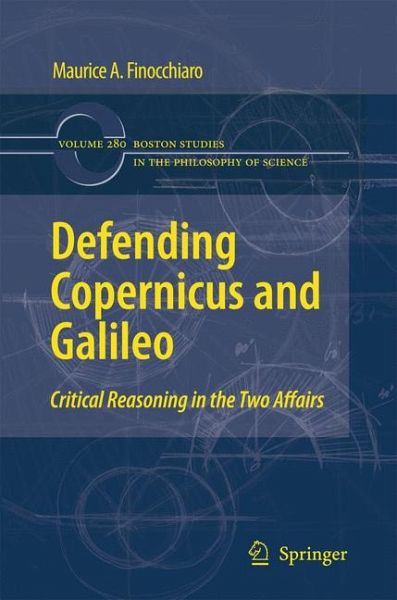
Although recent works on Galileo's trial have reached new heights of erudition, documentation, and sophistication, they often exhibit inflated complexities, neglect 400 years of historiography, or make little effort to learn from Galileo. This book strives to avoid such lacunae by judiciously comparing and contrasting the two Galileo affairs, that is, the original controversy over the earth's motion ending with his condemnation by the Inquisition in 1633, and the subsequent controversy over the rightness of that condemnation continuing to our day. The book argues that the Copernican Revolution required that the hypothesis of the earth's motion be not only constructively supported with new reasons and evidence, but also critically defended from numerous old and new objections. This defense in turn required not only the destructive refutation, but also the appreciative understanding of those objections in all their strength. A major Galilean accomplishment was to elaborate such a reasoned, critical, and fair-minded defense of Copernicanism. Galileo's trial can be interpreted as a series of ecclesiastic attempts to stop him from so defending Copernicus. And an essential thread of the subsequent controversy has been the emergence of many arguments claiming that his condemnation was right, as well as defenses of Galileo from such criticisms. The book's particular yet overarching thesis is that today the proper defense of Galileo can and should have the reasoned, critical, and fair-minded character which his own defense of Copernicus had.
Dieser Download kann aus rechtlichen Gründen nur mit Rechnungsadresse in A, B, BG, CY, CZ, D, DK, EW, E, FIN, F, GR, HR, H, IRL, I, LT, L, LR, M, NL, PL, P, R, S, SLO, SK ausgeliefert werden.
From the reviews:
"Defending Copernicus and Galileo is an important addition to Maurice Finocchiaro's significant corpus of writings, translations and edited works dealing with Galileo ... . the book is primarily about Galileo and his defense of Copernicus. ... this apparatus of fine distinctions serves not only as an expository device, but also an evaluative or advocacy purpose." (Peter Slezak, Science and Education, Vol. 20, 2011)
"The book is aimed at presenting and defending a tentative interpretation and evaluation of the two Galileo affaires ... . Overall, the book is very well-written, very well-documented, and it consists of very lucid explanations of the many different positions, arguments and criticisms that can and have been put forward during the period of four hundred years in which the two Galileo affairs have developed so far. ... it is a true Fundgrube for further research on the subject ... ." (Jean H. M. Wagemans, Argumentation, Vol. 25, 2011)
"The meritof this work is that it approaches the whole affair by attempting to offer a defense of Galileo by employing the same critical reasoning that Galileo himself used in defending Copernicus. ... it makes an important contribution to the very meaning of science by studying the origins of modern science in Galileo's research techniques. ... It will be very helpful to Galileo scholars." (George V. Coyne, The Catholic Historical Review, Vol. 98 (2), April, 2012)
"Defending Copernicus and Galileo is an important addition to Maurice Finocchiaro's significant corpus of writings, translations and edited works dealing with Galileo ... . the book is primarily about Galileo and his defense of Copernicus. ... this apparatus of fine distinctions serves not only as an expository device, but also an evaluative or advocacy purpose." (Peter Slezak, Science and Education, Vol. 20, 2011)
"The book is aimed at presenting and defending a tentative interpretation and evaluation of the two Galileo affaires ... . Overall, the book is very well-written, very well-documented, and it consists of very lucid explanations of the many different positions, arguments and criticisms that can and have been put forward during the period of four hundred years in which the two Galileo affairs have developed so far. ... it is a true Fundgrube for further research on the subject ... ." (Jean H. M. Wagemans, Argumentation, Vol. 25, 2011)
"The meritof this work is that it approaches the whole affair by attempting to offer a defense of Galileo by employing the same critical reasoning that Galileo himself used in defending Copernicus. ... it makes an important contribution to the very meaning of science by studying the origins of modern science in Galileo's research techniques. ... It will be very helpful to Galileo scholars." (George V. Coyne, The Catholic Historical Review, Vol. 98 (2), April, 2012)