39,95 €
39,95 €
inkl. MwSt.
Sofort per Download lieferbar

20 °P sammeln
39,95 €
Als Download kaufen
39,95 €
inkl. MwSt.
Sofort per Download lieferbar
20 °P sammeln
Jetzt verschenken
Alle Infos zum eBook verschenken
39,95 €
inkl. MwSt.
Sofort per Download lieferbar
Alle Infos zum eBook verschenken
20 °P sammeln

Andere Kunden interessierten sich auch für
") Degrowth and Tourism (eBook, ePUB)39,95 €
Degrowth and Tourism (eBook, ePUB)39,95 €") Tourism and Degrowth (eBook, PDF)41,95 €
Tourism and Degrowth (eBook, PDF)41,95 €") Managing Sustainable Tourism (eBook, PDF)54,95 €
Managing Sustainable Tourism (eBook, PDF)54,95 €") Routledge Handbook of Trends and Issues in Tourism Sustainability, Planning and Development, Management, and Technology (eBook, PDF)47,95 €
Routledge Handbook of Trends and Issues in Tourism Sustainability, Planning and Development, Management, and Technology (eBook, PDF)47,95 €") Marketing in Travel and Tourism (eBook, PDF)56,95 €
Marketing in Travel and Tourism (eBook, PDF)56,95 €") The Economics of Tourism Destinations (eBook, PDF)52,95 €
The Economics of Tourism Destinations (eBook, PDF)52,95 €") Routledge Handbook of Tourism in Africa (eBook, PDF)45,95 €
Routledge Handbook of Tourism in Africa (eBook, PDF)45,95 €
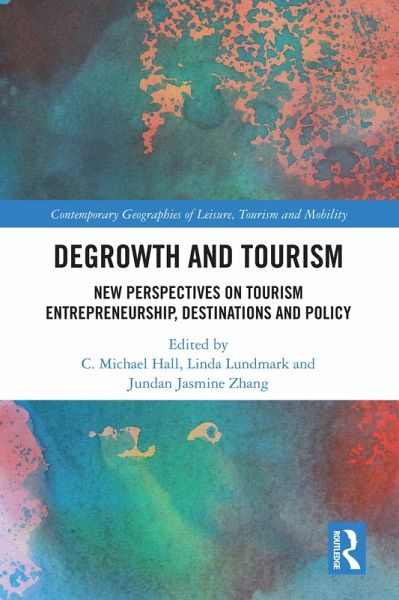
The sustainability of tourism is increasingly under question given the challenges of overtourism, COVID-19 and the contribution of tourism to climate and environmental change. Degrowth and Tourism provides an original response to the central problem of growth in tourism, an imperative that has been intrinsic within tourism practice, and directs the reader to rethink the impacts of tourism and possible alternatives beyond the sustainable growth discourse.
Using a multi-scaled approach to investigate degrowth's macro effects and micro indications in tourism, this book frames degrowth in tourism in terms of business, destination and policy initiatives. It uses a combination of empirical research, case studies and theory to offer new perspectives and approaches to analyse issues related to overtourism, COVID-19, small-scale tourism operations and entrepreneurship, mobility and climate change in tourism. Interdisciplinary chapters provide studies on animal-based tourism, nature-based tourism, domestic tourism, developing community-centric tourism and many other areas, within the paradigm of degrowth.
This book offers significant insight on both the implications of degrowth paradigm in tourism studies and practices, as well as tourism's potential contributions to the degrowth paradigm, and will be essential reading for all those interested in sustainable tourism and transformations through tourism.
Using a multi-scaled approach to investigate degrowth's macro effects and micro indications in tourism, this book frames degrowth in tourism in terms of business, destination and policy initiatives. It uses a combination of empirical research, case studies and theory to offer new perspectives and approaches to analyse issues related to overtourism, COVID-19, small-scale tourism operations and entrepreneurship, mobility and climate change in tourism. Interdisciplinary chapters provide studies on animal-based tourism, nature-based tourism, domestic tourism, developing community-centric tourism and many other areas, within the paradigm of degrowth.
This book offers significant insight on both the implications of degrowth paradigm in tourism studies and practices, as well as tourism's potential contributions to the degrowth paradigm, and will be essential reading for all those interested in sustainable tourism and transformations through tourism.
Dieser Download kann aus rechtlichen Gründen nur mit Rechnungsadresse in A, B, BG, CY, CZ, D, DK, EW, E, FIN, F, GR, HR, H, IRL, I, LT, L, LR, M, NL, PL, P, R, S, SLO, SK ausgeliefert werden.
'Tourism mobilities have faced crisis after crisis and it is arguably time to refocus our attention on fundamental discourses of wellbeing, equity, and sustainability in relation to degrowing tourism. This already overdue reconceptualisation of tourism-related phenomena in a 2020s context cannot take place without a new wave of critical reflection on the theory and practice of degrowth perspectives. Such reflection needs a solid axis from which to spin and effectively, this book can readily fill those shoes. With their landmark volume, Hall, Lundmark, and Zhang eloquently offer us the wake up / shake up call that tourism scholarship has long been waiting for. Failure to engage with the debates on the degrowth-tourism nexus skillfully crafted therein would almost be tantamount to academic irresponsibility. Read now, absorb and reflect.'
Dr Julie Wilson, Faculty of Economics and Business Studies, Universitat Oberta de Catalunya / Open University of Catalonia.
'This book is essential for an up-to-date understanding of tourism and its challenges. It offers an urgent alternative to mainstream expansionist agendas and naïve approaches to mobility and development. Based on ecological realism, the book's perspective and many informative cases provide a basis for policy makers, industry actors, and researchers who want to embrace qualitative dimensions of development, adopt proactive strategies to climate change, or just increase their understanding of possible roles and shapes of tourism in a post-fossil society.'
Karl Johan Bonnedahl, Editor of 'Strongly sustainable societies: organising human activities on a hot and full Earth'
'More and more places around the world have been struggling with the negative effects of overtourism. Meanwhile, discovering solutions for how to cope with being loved to death has proven elusive for most localities. With this backdrop in mind, this edited collection Degrowth and Tourism has made a timely appearance. Through a rich collection of contributions, this volume explores several issues revolving around degrowth, which are competently grouped into three sections. These are Degrowth and Tourism Entrepreneurship; Degrowth and Tourism Destinations, and; Degrowth and Tourism Policy. The timing of the release of this volume could not be better. During the midst of a global pandemic, when tourism has almost ground to a standstill, there has been much speculation as to whether this is the perfect time to reset the sector in a more sustainable manner. Tourism Degrowth and Tourism certainly provides much useful food for thought both for academics but also decision-makers who seek to find effective solutions to combat overtourism.'
Dimitri Ioannides, Mid-Sweden University
Dr Julie Wilson, Faculty of Economics and Business Studies, Universitat Oberta de Catalunya / Open University of Catalonia.
'This book is essential for an up-to-date understanding of tourism and its challenges. It offers an urgent alternative to mainstream expansionist agendas and naïve approaches to mobility and development. Based on ecological realism, the book's perspective and many informative cases provide a basis for policy makers, industry actors, and researchers who want to embrace qualitative dimensions of development, adopt proactive strategies to climate change, or just increase their understanding of possible roles and shapes of tourism in a post-fossil society.'
Karl Johan Bonnedahl, Editor of 'Strongly sustainable societies: organising human activities on a hot and full Earth'
'More and more places around the world have been struggling with the negative effects of overtourism. Meanwhile, discovering solutions for how to cope with being loved to death has proven elusive for most localities. With this backdrop in mind, this edited collection Degrowth and Tourism has made a timely appearance. Through a rich collection of contributions, this volume explores several issues revolving around degrowth, which are competently grouped into three sections. These are Degrowth and Tourism Entrepreneurship; Degrowth and Tourism Destinations, and; Degrowth and Tourism Policy. The timing of the release of this volume could not be better. During the midst of a global pandemic, when tourism has almost ground to a standstill, there has been much speculation as to whether this is the perfect time to reset the sector in a more sustainable manner. Tourism Degrowth and Tourism certainly provides much useful food for thought both for academics but also decision-makers who seek to find effective solutions to combat overtourism.'
Dimitri Ioannides, Mid-Sweden University