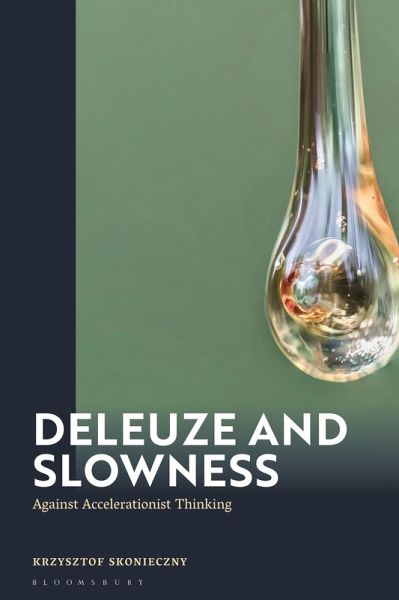
70,95 €
inkl. MwSt.
Sofort per Download lieferbar
35 °P sammeln

Andere Kunden interessierten sich auch für
") Deleuze and Slowness (eBook, PDF)70,95 €
Deleuze and Slowness (eBook, PDF)70,95 €") Logics of Worlds (eBook, ePUB)21,95 €
Logics of Worlds (eBook, ePUB)21,95 €") Proust, Photography, and the Time of Life (eBook, ePUB)21,95 €
Proust, Photography, and the Time of Life (eBook, ePUB)21,95 €") Deleuze and Ethology (eBook, ePUB)25,95 €
Deleuze and Ethology (eBook, ePUB)25,95 €") Poetics of Relation (eBook, ePUB)9,49 €
Poetics of Relation (eBook, ePUB)9,49 €") Deleuze and Guattari's 'A Thousand Plateaus' (eBook, ePUB)20,95 €
Deleuze and Guattari's 'A Thousand Plateaus' (eBook, ePUB)20,95 €") Philosophy of Modern Music (eBook, ePUB)18,95 €
Philosophy of Modern Music (eBook, ePUB)18,95 €


This book diverges from the conventional interpretation of Deleuze as a philosopher of speed or even accelerationism, delving instead into the minor but critical themes of slowness - from idiocy to catatonia - in his works.
Advocating for a pragmatic reading of Deleuze source material, Deleuze and Slowness utilises his thought to address urgent challenges in contemporary political and social philosophy, particularly the issue of acceleration in its subjective, socio-political, and ecological dimensions. The first part discusses the significance of "slowness" and introduces the problem of social acceleration, exploring the relationship of Deleuze's thought with theorists rarely invoked in Deleuzian scholarship, such as Martha Nussbaum and Hartmut Rosa. Using a wide range of examples and sources including Heinrich von Kleist and Madame de La Fayette, the second part of the book delves deeper into the three manifestations of slowness in Deleuze's philosophy: the conceptual personae of the idiot, the animal, and the catatonic. These personae and the concepts they help develop are explored as potential strategies of active resistance against the facets of social acceleration.
Radically opposing enamourment with speed and efficiency that characterises the present day, Krzysztof Skonieczny shows how a Deleuzian theory of slowness can inspire productive resistance in the three areas that have been most vulnerable to omnipresent acceleration: our subjectivity, profoundly changed by the accelerating pace of life; our socio-political milieu, ruled by corporate efficiency; and our relationship to the environment, quickly heading towards catastrophe.
Advocating for a pragmatic reading of Deleuze source material, Deleuze and Slowness utilises his thought to address urgent challenges in contemporary political and social philosophy, particularly the issue of acceleration in its subjective, socio-political, and ecological dimensions. The first part discusses the significance of "slowness" and introduces the problem of social acceleration, exploring the relationship of Deleuze's thought with theorists rarely invoked in Deleuzian scholarship, such as Martha Nussbaum and Hartmut Rosa. Using a wide range of examples and sources including Heinrich von Kleist and Madame de La Fayette, the second part of the book delves deeper into the three manifestations of slowness in Deleuze's philosophy: the conceptual personae of the idiot, the animal, and the catatonic. These personae and the concepts they help develop are explored as potential strategies of active resistance against the facets of social acceleration.
Radically opposing enamourment with speed and efficiency that characterises the present day, Krzysztof Skonieczny shows how a Deleuzian theory of slowness can inspire productive resistance in the three areas that have been most vulnerable to omnipresent acceleration: our subjectivity, profoundly changed by the accelerating pace of life; our socio-political milieu, ruled by corporate efficiency; and our relationship to the environment, quickly heading towards catastrophe.