Sie sind bereits eingeloggt. Klicken Sie auf 2. tolino select Abo, um fortzufahren.
Bitte loggen Sie sich zunächst in Ihr Kundenkonto ein oder registrieren Sie sich bei bücher.de, um das eBook-Abo tolino select nutzen zu können.
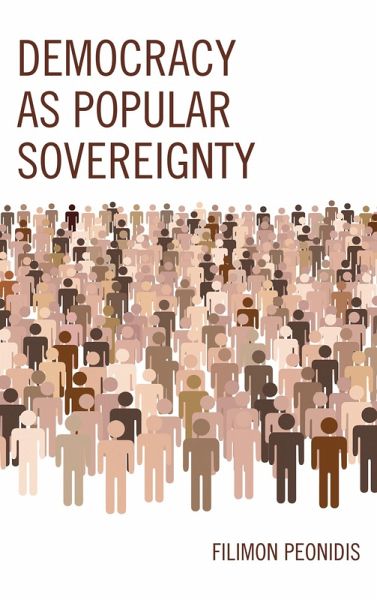
Although democracy is in principle associated with popular rule, in practice it is best described as rule by elected elites. This form of government is not only wanting from a theoretical point of view, but it also no longer seems to meet the expectations of large segments of the citizenry. This book offers a blueprint for an alternative democratic model, democracy as popular sovereignty. Starting with the idea that the people, generously defined, are sovereign when they rule as equally valuable and fully participating members of a self-governing collectivity, this model tries to describe the…mehr
Although democracy is in principle associated with popular rule, in practice it is best described as rule by elected elites. This form of government is not only wanting from a theoretical point of view, but it also no longer seems to meet the expectations of large segments of the citizenry. This book offers a blueprint for an alternative democratic model, democracy as popular sovereignty. Starting with the idea that the people, generously defined, are sovereign when they rule as equally valuable and fully participating members of a self-governing collectivity, this model tries to describe the constitutional and institutional arrangements necessary to achieve a workable version of this idea in advanced democratic states. This implies among other changes a greater dose of direct democracy, the use of sortition and a different conception of representation. The overall argument developed combines insights, facts, and findings from normative political theory, empirical political science, democracy's long history as well as from the recent burgeoning literature on participatory and deliberative democracy.
Die Herstellerinformationen sind derzeit nicht verfügbar.
Autorenporträt
Filimon Peonidis is associate professor of moral and political philosophy and head of the graduate philosophy program at the Aristotle University of Thessaloniki. His publications in English include Autonomy and Sympathy: A Post-Kantian Moral Image (2005), (co-edited with Nicos Avgelis) Aristotle on Language, Logic and Science (1999) and articles in journals such as Australian Journal of Legal Philosophy, History of European Ideas, History of Political Thought, Journal of Social Philosophy, Journal of Bentham Studies, Journal of Philosophical Research, Journal of Value Inquiry and Law and Philosophy.
Inhaltsangabe
Preface Chapter 1: Democracy as Popular Sovereignty 1.1 A historical model of democracy and some common justifications 1.2 The model applied 1.3 Rule by the people but without the people 1.4 Democracy as popular sovereignty 1.5 Are the people capable of being sovereign? 1.6 Does the majority principle undermine popular sovereignty? Chapter 2: The Institutions of Popular Sovereignty 2.1 Introductory remarks 2.2 Direct universal participation 2.3 Direct participation through sortition 2.4 Indirect participation through representation I: Electoral systems 2.5 Indirect participation through representation II: The constituent-representative relationship Chapter 3: A Democratic Constitution 3.1 Setting the stage 3.2 The lifetime of the constitution 3.3 Democratic rights 3.4 Popular sovereignty and excessive wealth 3.5 The separation of powers 3.5.1 The legislative-higher executive continuum 3.5.2 The lower executive 3.5.3 The judiciary 3.6 Constitutional review Bibliography Index About the author
Es gelten unsere Allgemeinen Geschäftsbedingungen: www.buecher.de/agb
Impressum
www.buecher.de ist ein Internetauftritt der buecher.de internetstores GmbH
Geschäftsführung: Monica Sawhney | Roland Kölbl | Günter Hilger
Sitz der Gesellschaft: Batheyer Straße 115 - 117, 58099 Hagen
Postanschrift: Bürgermeister-Wegele-Str. 12, 86167 Augsburg
Amtsgericht Hagen HRB 13257
Steuernummer: 321/5800/1497
USt-IdNr: DE450055826