43,95 €
43,95 €
inkl. MwSt.
Sofort per Download lieferbar

22 °P sammeln
43,95 €
Als Download kaufen
43,95 €
inkl. MwSt.
Sofort per Download lieferbar
22 °P sammeln
Jetzt verschenken
Alle Infos zum eBook verschenken
43,95 €
inkl. MwSt.
Sofort per Download lieferbar
Alle Infos zum eBook verschenken
22 °P sammeln

Andere Kunden interessierten sich auch für
") Democratic Decline in Hungary (eBook, ePUB)43,95 €
Democratic Decline in Hungary (eBook, ePUB)43,95 €") Hate Speech and Human Rights in Eastern Europe (eBook, PDF)41,95 €
Hate Speech and Human Rights in Eastern Europe (eBook, PDF)41,95 €") Domestic Judicial Treatment of European Court of Human Rights Case Law (eBook, PDF)41,95 €
Domestic Judicial Treatment of European Court of Human Rights Case Law (eBook, PDF)41,95 €") Hate Speech and Human Rights in Eastern Europe (eBook, ePUB)41,95 €
Hate Speech and Human Rights in Eastern Europe (eBook, ePUB)41,95 €") Law, Populism, and the Political in Central and Eastern Europe (eBook, PDF)42,95 €
Law, Populism, and the Political in Central and Eastern Europe (eBook, PDF)42,95 €") Terrorism, Criminal Law and Politics (eBook, PDF)0,00 €
Terrorism, Criminal Law and Politics (eBook, PDF)0,00 €") Human Rights and America's War on Terror (eBook, PDF)41,95 €
Human Rights and America's War on Terror (eBook, PDF)41,95 €







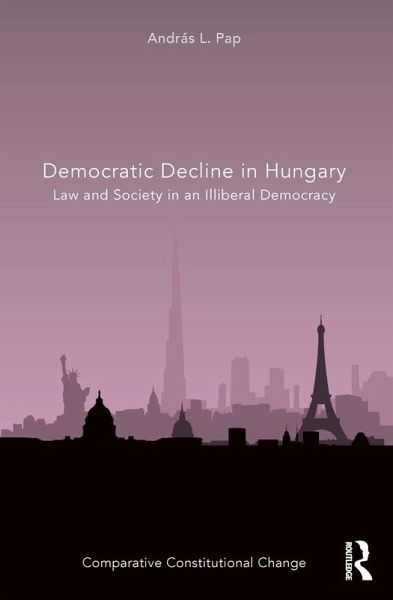
This book shows the rise and morphology of a self-identified `illiberal democracy', the first 21st century illiberal political regime arising in the European Union. Since 2010, Viktor Orbán's governments in Hungary have convincingly offered an anti-modernist and anti-cosmopolitan/anti-European Unionist rhetoric, discourse and constitutional identity to challenge neo-liberal democracy. The Hungarian case provides unique observation points for students of transitology, especially those who are interested in states which are to abandon pathways of liberal democracy.
The author demonstrates how illiberalism is present both in `how' and `what' is being done: the style, format and procedure of legislation; as well as the substance: the dismantling of institutional rule of law guarantees and the weakening of checks and balances. The book also discusses the ideological commitments and constitutionally framed and cemented value preferences, and a reconstituted and re-conceptualized relationship between the state and its citizens, which is not evidently supported by Hungarians' value system and life-style choices.
The author demonstrates how illiberalism is present both in `how' and `what' is being done: the style, format and procedure of legislation; as well as the substance: the dismantling of institutional rule of law guarantees and the weakening of checks and balances. The book also discusses the ideological commitments and constitutionally framed and cemented value preferences, and a reconstituted and re-conceptualized relationship between the state and its citizens, which is not evidently supported by Hungarians' value system and life-style choices.
Dieser Download kann aus rechtlichen Gründen nur mit Rechnungsadresse in A, B, BG, CY, CZ, D, DK, EW, E, FIN, F, GR, HR, H, IRL, I, LT, L, LR, M, NL, PL, P, R, S, SLO, SK ausgeliefert werden.