52,95 €
inkl. MwSt.
Sofort per Download lieferbar
26 °P sammeln

Andere Kunden interessierten sich auch für
") Economic Neoliberalism and International Development (eBook, ePUB)41,95 €
Economic Neoliberalism and International Development (eBook, ePUB)41,95 €") Xi Jinping (eBook, ePUB)38,95 €
Xi Jinping (eBook, ePUB)38,95 €") Authoritarian Consolidation in Times of Crisis (eBook, ePUB)41,95 €
Authoritarian Consolidation in Times of Crisis (eBook, ePUB)41,95 €") Structural Change in Africa (eBook, ePUB)41,95 €
Structural Change in Africa (eBook, ePUB)41,95 €") The Consolidation of Democracy (eBook, ePUB)45,95 €
The Consolidation of Democracy (eBook, ePUB)45,95 €") Africa and the Global System of Capital Accumulation (eBook, ePUB)41,95 €
Africa and the Global System of Capital Accumulation (eBook, ePUB)41,95 €") International Aid and Democracy Promotion (eBook, ePUB)0,00 €
International Aid and Democracy Promotion (eBook, ePUB)0,00 €




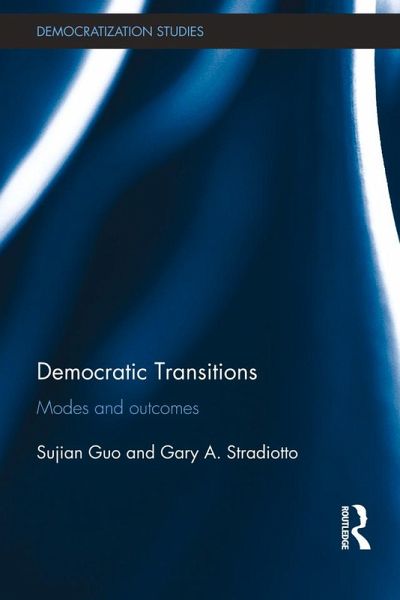
Democratic transitions have occurred in many countries in various regions across the globe, such as Southern Europe, Latin America, Africa, East and Southeast Asia, Eastern Europe and the Middle East, and these nations have undergone simuntaneously political, economic and social transformations. Yet, the patterns and characteristics of transitions have varied significantly, and different modes of transition have resulted in different outcomes.
This book offers cross-national comparisons of democratic transition since the turn of the twentieth century and asks what makes democracies succeed or fail. In doing so it explores the influence the mode of transition has on the longevity or durability of the democracy, by theoretically examining and quantitatively testing this relationship. The authors argue that the mode of transition directly impacts the success and failure of democracy, and suggest that cooperative transitions, where opposition groups work together with incumbent elites to peacefully transition the state, result in democracies that last longer and are associated with higher measures of democratic quality.
Based on a cross-national dataset of all democratic transitioning states since 1900, this book will be of great interest to students and scholars of international politics, comparative politics and democracy, and democratization studies.
This book offers cross-national comparisons of democratic transition since the turn of the twentieth century and asks what makes democracies succeed or fail. In doing so it explores the influence the mode of transition has on the longevity or durability of the democracy, by theoretically examining and quantitatively testing this relationship. The authors argue that the mode of transition directly impacts the success and failure of democracy, and suggest that cooperative transitions, where opposition groups work together with incumbent elites to peacefully transition the state, result in democracies that last longer and are associated with higher measures of democratic quality.
Based on a cross-national dataset of all democratic transitioning states since 1900, this book will be of great interest to students and scholars of international politics, comparative politics and democracy, and democratization studies.
Dieser Download kann aus rechtlichen Gründen nur mit Rechnungsadresse in A, B, BG, CY, CZ, D, DK, EW, E, FIN, F, GR, HR, H, IRL, I, LT, L, LR, M, NL, PL, P, R, S, SLO, SK ausgeliefert werden.