3,49 €
inkl. MwSt.
Sofort per Download lieferbar
0 °P sammeln

BOOK DESCRIPTION
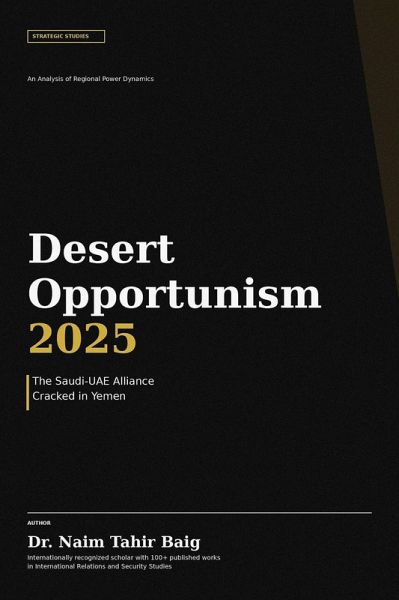
DESERT OPPORTUNISM 2025 : The Saudi-UAE Alliance Cracked in Yemen
When Saudi Arabia launched Operation Decisive Storm in March 2015, the United Arab Emirates stood as its most steadfast partner in a coalition determined to restore Yemen's internationally recognized government. Yet within a decade, this alliance would shatter spectacularlyculminating in December 2025 with Saudi warplanes striking UAE-supplied weapons in Yemen's Mukalla port, followed by Riyadh's demand for complete Emirati military withdrawal within 24 hours. How did two of the world's closest allies, united in purpose and bound by Gulf Cooperation Council solidarity, reach such a dramatic rupture?
In DESERT OPPORTUNISM, Dr Naim Tahir Baigauthor of over 56 internationally published works on geopolitics and international relationsdelivers the first comprehensive examination of the strategic divergence between Saudi Arabia and the UAE within the crucible of the Yemen conflict. Drawing on extensive research, real-time analysis of the December 2025 crisis, and verified sources including UN reports, think tank analyses, and coalition documents, this meticulously documented study exposes how the Saudi-UAE partnership was never truly strategic but fundamentally opportunistic from its inception.
Through twelve comprehensive chapters, DESERT OPPORTUNISM examines the failed Riyadh Agreement of 2019, the proliferation of proxy militias serving competing masters, the ideological battleground over the Muslim Brotherhood-affiliated Islah party, and the December 2025 flashpoint when STC forces seized 90-95% of former South Yemen territoryincluding control of 80% of Yemen's oil reservestriggering the most severe Saudi-UAE crisis in Gulf Cooperation Council history. The analysis extends beyond military operations to explore humanitarian catastrophe as collateral damage, the Houthi factor as both common enemy and complicating variable, and the broader implications for regional order, great power interests, and international relations theory.
DESERT OPPORTUNISM challenges conventional narratives that portray the Yemen intervention as a well-intentioned humanitarian mission gone awry. Instead, Dr Baig's "desert opportunism" framework reveals how both Saudi Arabia and the UAE pursued strategic and economic opportunities under the justification of restoring legitimate government and countering Iranian influence. Neither nation prioritized Yemeni interests; both used the conflict to advance competing visions of regional order, with devastating consequences for Yemen's 30+ million people caught in between.
As Yemen faces an uncertain futurefragmented between Houthi control in the north, STC dominance in the south, and weakened government forces in betweenunderstanding how we arrived at this moment becomes essential. Dr Baig demonstrates that the Saudi-UAE rift is not an aberration but the logical outcome of divergent national interests masked by temporary tactical alignment. The implications extend beyond Yemen to questions of Gulf security architecture, the future of the GCC, Iran's regional opportunities, and the limits of American influence in shaping Middle Eastern outcomes.
DESERT OPPORTUNISM: The Saudi-UAE Alliance Cracked in Yemen stands as the definitive account of how opportunism, not strategy, characterized the decade-long intervention that transformed Yemen into a humanitarian catastrophe and exposed the fragility of Gulf Arab unity. Essential reading for anyone seeking to understand contemporary Middle Eastern geopolitics, the hidden dynamics of the Yemen conflict, and the enduring lessons about alliances, proxy warfare, and the human costs when great powers pursue their interests with little regard for those caught in the crossfire.
DESERT OPPORTUNISM 2025 : The Saudi-UAE Alliance Cracked in Yemen
When Saudi Arabia launched Operation Decisive Storm in March 2015, the United Arab Emirates stood as its most steadfast partner in a coalition determined to restore Yemen's internationally recognized government. Yet within a decade, this alliance would shatter spectacularlyculminating in December 2025 with Saudi warplanes striking UAE-supplied weapons in Yemen's Mukalla port, followed by Riyadh's demand for complete Emirati military withdrawal within 24 hours. How did two of the world's closest allies, united in purpose and bound by Gulf Cooperation Council solidarity, reach such a dramatic rupture?
In DESERT OPPORTUNISM, Dr Naim Tahir Baigauthor of over 56 internationally published works on geopolitics and international relationsdelivers the first comprehensive examination of the strategic divergence between Saudi Arabia and the UAE within the crucible of the Yemen conflict. Drawing on extensive research, real-time analysis of the December 2025 crisis, and verified sources including UN reports, think tank analyses, and coalition documents, this meticulously documented study exposes how the Saudi-UAE partnership was never truly strategic but fundamentally opportunistic from its inception.
Through twelve comprehensive chapters, DESERT OPPORTUNISM examines the failed Riyadh Agreement of 2019, the proliferation of proxy militias serving competing masters, the ideological battleground over the Muslim Brotherhood-affiliated Islah party, and the December 2025 flashpoint when STC forces seized 90-95% of former South Yemen territoryincluding control of 80% of Yemen's oil reservestriggering the most severe Saudi-UAE crisis in Gulf Cooperation Council history. The analysis extends beyond military operations to explore humanitarian catastrophe as collateral damage, the Houthi factor as both common enemy and complicating variable, and the broader implications for regional order, great power interests, and international relations theory.
DESERT OPPORTUNISM challenges conventional narratives that portray the Yemen intervention as a well-intentioned humanitarian mission gone awry. Instead, Dr Baig's "desert opportunism" framework reveals how both Saudi Arabia and the UAE pursued strategic and economic opportunities under the justification of restoring legitimate government and countering Iranian influence. Neither nation prioritized Yemeni interests; both used the conflict to advance competing visions of regional order, with devastating consequences for Yemen's 30+ million people caught in between.
As Yemen faces an uncertain futurefragmented between Houthi control in the north, STC dominance in the south, and weakened government forces in betweenunderstanding how we arrived at this moment becomes essential. Dr Baig demonstrates that the Saudi-UAE rift is not an aberration but the logical outcome of divergent national interests masked by temporary tactical alignment. The implications extend beyond Yemen to questions of Gulf security architecture, the future of the GCC, Iran's regional opportunities, and the limits of American influence in shaping Middle Eastern outcomes.
DESERT OPPORTUNISM: The Saudi-UAE Alliance Cracked in Yemen stands as the definitive account of how opportunism, not strategy, characterized the decade-long intervention that transformed Yemen into a humanitarian catastrophe and exposed the fragility of Gulf Arab unity. Essential reading for anyone seeking to understand contemporary Middle Eastern geopolitics, the hidden dynamics of the Yemen conflict, and the enduring lessons about alliances, proxy warfare, and the human costs when great powers pursue their interests with little regard for those caught in the crossfire.
Dieser Download kann aus rechtlichen Gründen nur mit Rechnungsadresse in A, B, CY, CZ, D, DK, EW, E, FIN, F, GR, H, IRL, I, LT, L, LR, M, NL, PL, P, R, S, SLO, SK ausgeliefert werden.