39,95 €
39,95 €
inkl. MwSt.
Sofort per Download lieferbar

20 °P sammeln
39,95 €
Als Download kaufen
39,95 €
inkl. MwSt.
Sofort per Download lieferbar
20 °P sammeln
Jetzt verschenken
Alle Infos zum eBook verschenken
39,95 €
inkl. MwSt.
Sofort per Download lieferbar
Alle Infos zum eBook verschenken
20 °P sammeln

Andere Kunden interessierten sich auch für
") Design Thinking in Technical Communication (eBook, ePUB)38,95 €
Design Thinking in Technical Communication (eBook, ePUB)38,95 €") Designing for User Engagement on the Web (eBook, ePUB)39,95 €
Designing for User Engagement on the Web (eBook, ePUB)39,95 €") Designing Technical and Professional Communication (eBook, ePUB)52,95 €
Designing Technical and Professional Communication (eBook, ePUB)52,95 €") The Multimediated Rhetoric of the Internet (eBook, ePUB)48,95 €
The Multimediated Rhetoric of the Internet (eBook, ePUB)48,95 €") Ethos, Technology, and AI in Contemporary Society (eBook, ePUB)36,95 €
Ethos, Technology, and AI in Contemporary Society (eBook, ePUB)36,95 €") Radical Reporting (eBook, ePUB)29,95 €
Radical Reporting (eBook, ePUB)29,95 €") Software Evangelism and the Rhetoric of Morality (eBook, ePUB)34,95 €
Software Evangelism and the Rhetoric of Morality (eBook, ePUB)34,95 €







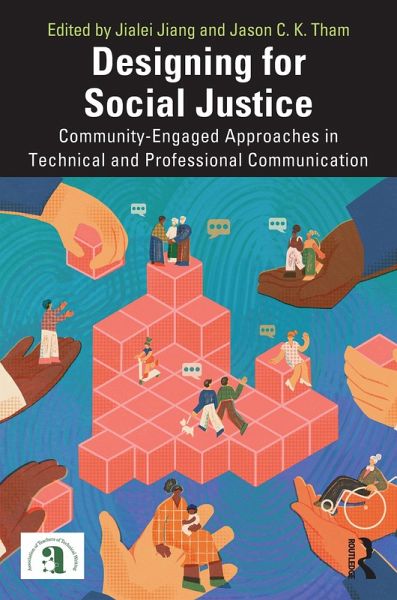
Exploring the intersection of design research and community engagement, this book highlights the ways in which design and design theories can be used to address social justice issues and promote positive change in communities.
Contributors illuminate the theoretical, ethical, and pedagogical dimensions of design-driven methods in community-engaged projects, exploring their potential to address critical social justice issues such as ethnic and racial justice, gender equality, disability justice, cultural diversity, equity, and environmental justice. Chapters examine various aspects of community-engaged practices, including the use of design theories to fuel social justice work in community partnerships, ethical issues surrounding the use of multimodal resources and new media technologies, and pedagogies for promoting social change. Addressing the opportunities and challenges of design and design methods in community engagement, this collection offers suggestions for promoting social justice through technical and professional communication activities and pedagogies.
Investigating the design of community-engaged projects from a critical standpoint, this book will appeal to scholars and students in the fields of Technical and Professional Communication, Writing and Composition Studies, and Rhetoric. It will also be of interest to administrators, community partners, and professionals working in service-learning contexts.
Contributors illuminate the theoretical, ethical, and pedagogical dimensions of design-driven methods in community-engaged projects, exploring their potential to address critical social justice issues such as ethnic and racial justice, gender equality, disability justice, cultural diversity, equity, and environmental justice. Chapters examine various aspects of community-engaged practices, including the use of design theories to fuel social justice work in community partnerships, ethical issues surrounding the use of multimodal resources and new media technologies, and pedagogies for promoting social change. Addressing the opportunities and challenges of design and design methods in community engagement, this collection offers suggestions for promoting social justice through technical and professional communication activities and pedagogies.
Investigating the design of community-engaged projects from a critical standpoint, this book will appeal to scholars and students in the fields of Technical and Professional Communication, Writing and Composition Studies, and Rhetoric. It will also be of interest to administrators, community partners, and professionals working in service-learning contexts.
Dieser Download kann aus rechtlichen Gründen nur mit Rechnungsadresse in A, B, BG, CY, CZ, D, DK, EW, E, FIN, F, GR, HR, H, IRL, I, LT, L, LR, M, NL, PL, P, R, S, SLO, SK ausgeliefert werden.
"Designing for Social Justice is an insightful edited collection that highlights the transformative power of designing projects in collaboration with community partners. Jiang and Tham have assembled an essential resource that invites readers to engage deeply with communities, to design with empathy and intention, and to create ethical work that resonates with the lived experiences of those it aims to serve."
Nora Rivera, Chapman University, USA
"Continuing to push the field of Technical and Professional Communication, Designing for Social Justice advances the important work of imagining how social justice can be a central component of TPC work. Jiang and Tham have curated an excellent collection that is doing the important work of bridging our academic spaces to the communities we aim to connect with and serve."
Victor Del Hierro, University of Florida, USA
"Designing for Social Justice foregrounds the vital role that communities must play when designing justice-oriented approaches to wicked problems. Whether seeking to expand their knowledge of theories and concepts encircling design and justice or searching for methodological or pedagogical practices they might adapt for research and learning in professional, public, educational, and design settings, audiences will find chapters that enrich their understanding of ethical, sustainable, reciprocal, and just community-engagement. That is, most importantly, Jiang and Tham have offered us a book that might steer our field toward more critical praxis with communities."
Timothy Amidon, Colorado State University, USA
Nora Rivera, Chapman University, USA
"Continuing to push the field of Technical and Professional Communication, Designing for Social Justice advances the important work of imagining how social justice can be a central component of TPC work. Jiang and Tham have curated an excellent collection that is doing the important work of bridging our academic spaces to the communities we aim to connect with and serve."
Victor Del Hierro, University of Florida, USA
"Designing for Social Justice foregrounds the vital role that communities must play when designing justice-oriented approaches to wicked problems. Whether seeking to expand their knowledge of theories and concepts encircling design and justice or searching for methodological or pedagogical practices they might adapt for research and learning in professional, public, educational, and design settings, audiences will find chapters that enrich their understanding of ethical, sustainable, reciprocal, and just community-engagement. That is, most importantly, Jiang and Tham have offered us a book that might steer our field toward more critical praxis with communities."
Timothy Amidon, Colorado State University, USA