35,95 €
35,95 €
inkl. MwSt.
Sofort per Download lieferbar

18 °P sammeln
35,95 €
Als Download kaufen
35,95 €
inkl. MwSt.
Sofort per Download lieferbar
18 °P sammeln
Jetzt verschenken
Alle Infos zum eBook verschenken
35,95 €
inkl. MwSt.
Sofort per Download lieferbar
Alle Infos zum eBook verschenken
18 °P sammeln

Andere Kunden interessierten sich auch für
") Digital Learning in High-Needs Schools (eBook, ePUB)41,95 €
Digital Learning in High-Needs Schools (eBook, ePUB)41,95 €") Culture, Learning, and Technology (eBook, ePUB)44,95 €
Culture, Learning, and Technology (eBook, ePUB)44,95 €") Culturally Inclusive Instructional Design (eBook, ePUB)41,95 €
Culturally Inclusive Instructional Design (eBook, ePUB)41,95 €") ICT and International Learning Ecologies (eBook, ePUB)39,95 €
ICT and International Learning Ecologies (eBook, ePUB)39,95 €") Technology's Challenges and Solutions in K-16 Education during a Worldwide Pandemic (eBook, ePUB)38,95 €
Technology's Challenges and Solutions in K-16 Education during a Worldwide Pandemic (eBook, ePUB)38,95 €") Designing Courses with Digital Technologies (eBook, ePUB)35,95 €
Designing Courses with Digital Technologies (eBook, ePUB)35,95 €") Designing Effective Digital Badges (eBook, ePUB)35,95 €
Designing Effective Digital Badges (eBook, ePUB)35,95 €

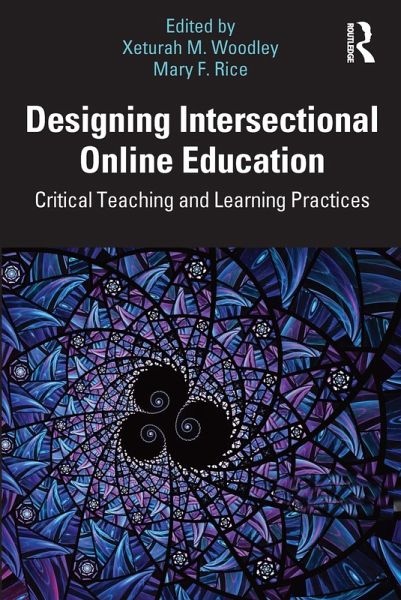
Designing Intersectional Online Education provides expansive yet accessible examples and discussion about the intentional creation of online teaching and learning experiences that critically center identity, social systems, and other important ideas in design and pedagogy. Instructors are increasingly tasked with designing their own online courses, curricula, and activities but lack information to support their attention to the ever-shifting, overlapping contexts and constructs that inform students' positions within knowledge and schooling. This book infuses today's technology-enhanced education environments with practices derived from critical race theory, culturally responsive pedagogy, disability studies, feminist/womanist studies, queer theory, and other essential foundations for humanized and socially just education. Faculty, scholars, technologists, and other experts across higher education, K-12, and teacher training offer fresh, robust insights into how actively engaging with intersectionality can inspire designs for online teaching and learning that are inclusive, intergenerational, anti-oppressive, and emancipatory.
Dieser Download kann aus rechtlichen Gründen nur mit Rechnungsadresse in A, B, BG, CY, CZ, D, DK, EW, E, FIN, F, GR, HR, H, IRL, I, LT, L, LR, M, NL, PL, P, R, S, SLO, SK ausgeliefert werden.
"Recent events have highlighted the ways in which society has systematically excluded and disregarded all but the privileged in almost every aspect of life, not the least of which being research and education systems. As we evolve into a more just world that builds and examines evidence for and with each and every individual, this book is centered at the crossroads of two of the most important issues in this evolution: critical pedagogy and digital learning. It could not have come at a better time and will have tremendous impact for the learners whom we readers will serve in the years to come."
-Sarojani Mohammed, Founder and Principal at Ed Research Works
"Increasing interest in online education, mostly as a response to the COVID-19 pandemic but also as a result of widening and improving access to technology and connectivity, is spotlighting numerous challenges, including consideration of a raft of critical social and cultural issues. This book comprises a rare examination of these crosscutting issues, and how they manifest in online educational contexts. Its contributions comprise a rich collection of experiences and insights on the design of these critical considerations in educational contexts where learners are physically separated by time and space from their peers, teachers, and the educational institution."
-Som Naidu, Executive Editor of Distance Education and Associate Professor and Head of Research and Evaluation in the Department of Teaching, Learning, and Research Support at the University of Melbourne, Australia
"Designing Intersectional Online Education brings multiple lenses to the practice and theory driving online learning across varied contexts. By introducing theoretical constructs toward such issues as race, culture, language, disability, sexuality, gender, and diversity overall, the text provides the tools needed to ground the design and application of online learning and pedagogy in critical theory to promote and realize social justice. With the resurgence of social demands for justice across the globe, this is the text that instructors, practitioners, and the stakeholders and decision-makers driving learning need to be a part of the solution."
-Sunnie Lee Watson, Associate Professor of Learning Design and Technology in the Department of Curriculum and Instruction at Purdue University, USA
"This volume takes seriously Marshall McLuhan's adage, 'the medium is the message.' With the proliferation of online and hybrid learning in both K-12 and higher education spaces of learning, it is crucial that educators and researchers are cognizant of how intersectional oppressions are perpetuated through technological applications, curriculum content, pedagogy, and student-teacher and student-student interactions in online teaching and learning environments. This text provides necessary and timely insights for educators striving for equity and social justice for diverse learners in all learning spaces, especially virtual ones."
-Tricia Kress, Associate Professor of Education at Molloy College, USA
-Sarojani Mohammed, Founder and Principal at Ed Research Works
"Increasing interest in online education, mostly as a response to the COVID-19 pandemic but also as a result of widening and improving access to technology and connectivity, is spotlighting numerous challenges, including consideration of a raft of critical social and cultural issues. This book comprises a rare examination of these crosscutting issues, and how they manifest in online educational contexts. Its contributions comprise a rich collection of experiences and insights on the design of these critical considerations in educational contexts where learners are physically separated by time and space from their peers, teachers, and the educational institution."
-Som Naidu, Executive Editor of Distance Education and Associate Professor and Head of Research and Evaluation in the Department of Teaching, Learning, and Research Support at the University of Melbourne, Australia
"Designing Intersectional Online Education brings multiple lenses to the practice and theory driving online learning across varied contexts. By introducing theoretical constructs toward such issues as race, culture, language, disability, sexuality, gender, and diversity overall, the text provides the tools needed to ground the design and application of online learning and pedagogy in critical theory to promote and realize social justice. With the resurgence of social demands for justice across the globe, this is the text that instructors, practitioners, and the stakeholders and decision-makers driving learning need to be a part of the solution."
-Sunnie Lee Watson, Associate Professor of Learning Design and Technology in the Department of Curriculum and Instruction at Purdue University, USA
"This volume takes seriously Marshall McLuhan's adage, 'the medium is the message.' With the proliferation of online and hybrid learning in both K-12 and higher education spaces of learning, it is crucial that educators and researchers are cognizant of how intersectional oppressions are perpetuated through technological applications, curriculum content, pedagogy, and student-teacher and student-student interactions in online teaching and learning environments. This text provides necessary and timely insights for educators striving for equity and social justice for diverse learners in all learning spaces, especially virtual ones."
-Tricia Kress, Associate Professor of Education at Molloy College, USA