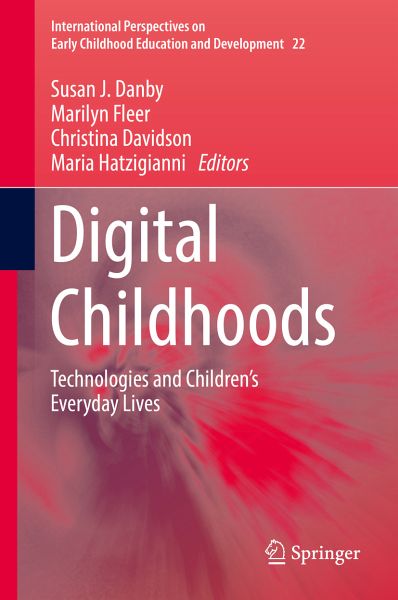
Digital Childhoods (eBook, PDF)
Technologies and Children's Everyday Lives
Redaktion: Danby, Susan J.; Hatzigianni, Maria; Davidson, Christina; Fleer, Marilyn
120,95 €
inkl. MwSt.
Sofort per Download lieferbar

60 °P sammeln

Digital Childhoods (eBook, PDF)
Technologies and Children's Everyday Lives
Redaktion: Danby, Susan J.; Hatzigianni, Maria; Davidson, Christina; Fleer, Marilyn
- Format: PDF
- Merkliste
- Auf die Merkliste
- Bewerten Bewerten
- Teilen
- Produkt teilen
- Produkterinnerung
- Produkterinnerung

Bitte loggen Sie sich zunächst in Ihr Kundenkonto ein oder registrieren Sie sich bei
bücher.de, um das eBook-Abo tolino select nutzen zu können.
Hier können Sie sich einloggen
Sie sind bereits eingeloggt. Klicken Sie auf 2. tolino select Abo, um fortzufahren.

Bitte loggen Sie sich zunächst in Ihr Kundenkonto ein oder registrieren Sie sich bei bücher.de, um das eBook-Abo tolino select nutzen zu können.
Conceptualises how childhood is being constructed in the digital era
Provides case studies on the ways that young children are currently experiencing their digital childhoods
Presents a diversity of chapters where different theoretical approaches and a broad range of countries are represented, showing how children engage with a diverse range of digital technologies
- Geräte: PC
- ohne Kopierschutz
- eBook Hilfe
- Größe: 5.25MB
Andere Kunden interessierten sich auch für
Xinyi WuEducational Journeys, Struggles and Ethnic Identity (eBook, PDF)40,95 €
Social, Material and Political Constructs of Arctic Childhoods (eBook, PDF)88,95 €
Assisting Young Children Caught in Disasters (eBook, PDF)96,95 €
Common Characteristics and Unique Qualities in Preschool Programs (eBook, PDF)72,95 €
Malin IdelandThe Eco-Certified Child (eBook, PDF)48,95 €
Jeannie Hill BulmanChildren's Reading of Film and Visual Literacy in the Primary Curriculum (eBook, PDF)64,95 €
Teresa LehmannDemokratiebildung und Rituale in Kindertageseinrichtungen (eBook, PDF)59,99 €-
-
-
Conceptualises how childhood is being constructed in the digital era
Provides case studies on the ways that young children are currently experiencing their digital childhoods
Presents a diversity of chapters where different theoretical approaches and a broad range of countries are represented, showing how children engage with a diverse range of digital technologies
Provides case studies on the ways that young children are currently experiencing their digital childhoods
Presents a diversity of chapters where different theoretical approaches and a broad range of countries are represented, showing how children engage with a diverse range of digital technologies
Dieser Download kann aus rechtlichen Gründen nur mit Rechnungsadresse in A, B, BG, CY, CZ, D, DK, EW, E, FIN, F, GR, HR, H, IRL, I, LT, L, LR, M, NL, PL, P, R, S, SLO, SK ausgeliefert werden.
Produktdetails
- Produktdetails
- Verlag: Springer Nature Singapore
- Seitenzahl: 287
- Erscheinungstermin: 3. April 2018
- Englisch
- ISBN-13: 9789811064845
- Artikelnr.: 52943829
- Verlag: Springer Nature Singapore
- Seitenzahl: 287
- Erscheinungstermin: 3. April 2018
- Englisch
- ISBN-13: 9789811064845
- Artikelnr.: 52943829
- Herstellerkennzeichnung Die Herstellerinformationen sind derzeit nicht verfügbar.
Susan Danby is a Professor of Early Childhood and Inclusive Education at Queensland University of Technology, Australia. She researches social interaction and communication in institutional contexts that include educational and family settings, helplines and clinical contexts. Recent projects include investigating how young children engage with digital technologies in home and school. Marilyn Fleer holds the Foundation Chair of Early Childhood Education at Monash University, Australia, and is the immediate past President of the International Society for Cultural Activity Research (ISCAR). Her research interests focus on early years learning and development, with special attention to pedagogy, culture, science, and design and technology. Christina Davidson is a Senior Lecturer at the School of Education, Charles Sturt University. Her research focuses on the social aspects of young children's activities at home, preschool and in the early years of formal schooling. DrDavidson employs ethnomethodology/conversation analysis and mostly works with other conversation analysts to investigate the social interactions that shape young children's online activity. Maria Hatzigianni is a Lecturer in Early Childhood and Primary Education at Macquarie University. She worked as a kindergarten teacher and director in Australia and Greece for more than 15 years (1996-2012). Her main research interests include: integrating technology in early childhood and primary education; training early childhood and primary teachers in new technologies; bilingual and multicultural education; and social justice in education. She is currently investigating the use of new technologies with very young children (under 3 years of age).
Introduction.- 1 Digital childhoods across contexts and countries.- Section 1 Social affordances across time and space in digital contexts.- 2 How families use of video communication technologies during intergenerational SKYPE.- 3 Digital bridges between home and preschool: Theorising conceptually inclusive practice in digital environments.- 4 Digital participation among children in rural areas.- 5 Producing contexts for young children's digital technology use: Web searching during Adult-Child interactions at home and preschool.- Section 2 Emotionality, play and digital engagement.- 6 Electronic Gaming: Associations with self-regulation, emotional difficulties and academic performances.- 7 Children's collaborative learning in science scaffolded by iPads.- 8 Digital play and learning in the home: Families' perspective.- 9 Rules of Engagement: Family rules on young children's access to and use of technologies.- 10 Hacking Toys and Remixing Media: Integrating maker literacies into early childhood.- Section 3 Societal tools for thinking, learning and communicating differently.- 11 Supporting whole child development in the digital age.- 12 Digital narratives and young children.- 13 Teaching visual arts with digital technologies.- 14 Learning literacy: Engaging with print and digital texts in the first year of school.- 15 Digital tools to support children's speech and language skill.- 16 Digital games in the early childhood classroom: Theoretical and practical considerations.- 17 From play to interplay: A young child's use of multiple technologies in the social organisation of a pretend telephone conversation.