
0,00 €
0,00 €
inkl. MwSt.
Sofort per Download lieferbar

0 °P sammeln
0,00 €
Als Download kaufen
0,00 €
inkl. MwSt.
Sofort per Download lieferbar
0 °P sammeln
Jetzt verschenken
Alle Infos zum eBook verschenken
0,00 €
inkl. MwSt.
Sofort per Download lieferbar
Alle Infos zum eBook verschenken
0 °P sammeln

Andere Kunden interessierten sich auch für
") Digital Constitutionalism (eBook, ePUB)0,00 €
Digital Constitutionalism (eBook, ePUB)0,00 €") Technology (eBook, PDF)18,95 €
Technology (eBook, PDF)18,95 €") Social Justice and Adequate Housing (eBook, PDF)39,95 €
Social Justice and Adequate Housing (eBook, PDF)39,95 €") Global Technology and Legal Theory (eBook, PDF)41,95 €
Global Technology and Legal Theory (eBook, PDF)41,95 €") Routledge Handbook of Financial Technology and Law (eBook, PDF)43,95 €
Routledge Handbook of Financial Technology and Law (eBook, PDF)43,95 €") The Transition of Religion to Culture in Law and Public Discourse (eBook, PDF)41,95 €
The Transition of Religion to Culture in Law and Public Discourse (eBook, PDF)41,95 €") Routledge Handbook of Social Media, Law and Society (eBook, PDF)47,95 €
Routledge Handbook of Social Media, Law and Society (eBook, PDF)47,95 €
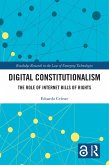






Investigating the impact of digital technology on contemporary constitutionalism, this book offers an overview of the transformations that are currently occurring at constitutional level, highlighting their link with ongoing societal changes. It reconstructs the multiple ways in which constitutional law is reacting to these challenges and explores the role of one original response to this phenomenon: the emergence of Internet bills of rights.
Over the past few years, a significant number of Internet bills of rights have emerged around the world. These documents represent non-legally binding declarations promoted mostly by individuals and civil society groups that articulate rights and principles for the digital society. This book argues that these initiatives reflect a change in the constitutional ecosystem. The transformations prompted by the digital revolution in our society ferment under a vault of constitutional norms shaped for 'analogue' communities. Constitutional law struggles to address all the challenges of the digital environment. In this context, Internet bills of rights, by emerging outside traditional institutional processes, represent a unique response to suggest new constitutional solutions for the digital age.
Explaining how constitutional law is reacting to the advent of the digital revolution and analysing the constitutional function of Internet Bills of Rights in this context, this book offers a global comparative investigation of the latest transformations that digital technology is generating in the constitutional ecosystem and highlights the plural and multilevel process that is contributing to shape constitutional norms for the Internet age.
Over the past few years, a significant number of Internet bills of rights have emerged around the world. These documents represent non-legally binding declarations promoted mostly by individuals and civil society groups that articulate rights and principles for the digital society. This book argues that these initiatives reflect a change in the constitutional ecosystem. The transformations prompted by the digital revolution in our society ferment under a vault of constitutional norms shaped for 'analogue' communities. Constitutional law struggles to address all the challenges of the digital environment. In this context, Internet bills of rights, by emerging outside traditional institutional processes, represent a unique response to suggest new constitutional solutions for the digital age.
Explaining how constitutional law is reacting to the advent of the digital revolution and analysing the constitutional function of Internet Bills of Rights in this context, this book offers a global comparative investigation of the latest transformations that digital technology is generating in the constitutional ecosystem and highlights the plural and multilevel process that is contributing to shape constitutional norms for the Internet age.
Dieser Download kann aus rechtlichen Gründen nur mit Rechnungsadresse in A, B, BG, CY, CZ, D, DK, EW, E, FIN, F, GR, HR, H, IRL, I, LT, L, LR, M, NL, PL, P, R, S, SLO, SK ausgeliefert werden.