Sie sind bereits eingeloggt. Klicken Sie auf 2. tolino select Abo, um fortzufahren.
Bitte loggen Sie sich zunächst in Ihr Kundenkonto ein oder registrieren Sie sich bei bücher.de, um das eBook-Abo tolino select nutzen zu können.
This book addresses the digital twinning of manufacturing processes, cells, and systems and attempts to bring in the basic characteristics of the Fourth Industrial Revolution along with an emphasis on cyber-physical systems. Digital Twinning for Discrete Manufacturing discusses how to maximize the use of the pillars of Industry 4.0 and 5.0 in discrete manufacturing. It presents how digital twinning has a very special characteristic that can be applied in the training of novice workers on expensive equipment. The book explains how digital twinning of laboratory industrial equipment is cheap…mehr
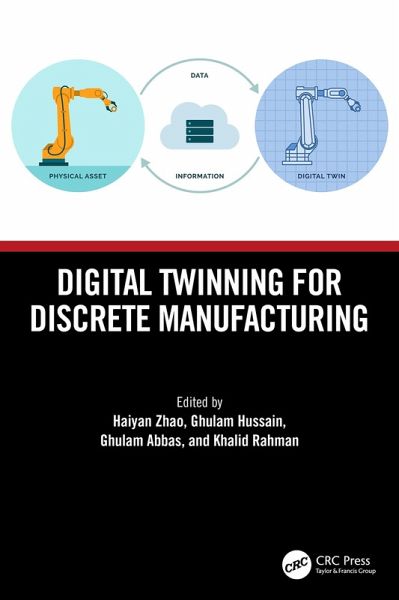
This book addresses the digital twinning of manufacturing processes, cells, and systems and attempts to bring in the basic characteristics of the Fourth Industrial Revolution along with an emphasis on cyber-physical systems.
Digital Twinning for Discrete Manufacturing discusses how to maximize the use of the pillars of Industry 4.0 and 5.0 in discrete manufacturing. It presents how digital twinning has a very special characteristic that can be applied in the training of novice workers on expensive equipment. The book explains how digital twinning of laboratory industrial equipment is cheap to build and can be used to train workers on intricate machinery with real involvement, without any injury to workers or damage to the machines. The book also portrays the full scope of digital twinning based on AR/VR with a physical interface to real machinery.
Digital twinning is currently an advanced topic that is of interest to researchers, postgraduates, graduates, senior undergraduates, as well as professionals.
Dieser Download kann aus rechtlichen Gründen nur mit Rechnungsadresse in A, B, BG, CY, CZ, D, DK, EW, E, FIN, F, GR, HR, H, IRL, I, LT, L, LR, M, NL, PL, P, R, S, SLO, SK ausgeliefert werden.
Die Herstellerinformationen sind derzeit nicht verfügbar.
Autorenporträt
Haiyan Zhao obtained his Ph.D. from the Department of Mechanical Engineering (Materials Science and Engineering), Xi'an Jiaotong University, in 1997. Earlier, he obtained his B.S. in Welding and Joining from the same University in 1992. He worked in the Department of Mechanical Engineering, Tsinghua University, as Assistant Professor, Associate Professor, and full Professor sequentially, 2000-Present. He was also a visiting professor at RWTH Aachen University, Germany, during 2004-2005. His research interests include Welding and Joining, Manufacturing by Materials Processing, Theory and Application of Modeling and Simulation, Structure Integrity, Service Life Prediction and Performance Evaluation, Prediction and Control of Residual Stress and Deformation, and Bio-Sensor based on Graphene. He was awarded the "New Century Excellent Talents" from the Ministry of Education, P.R. China in 2007, and "Excellent Teaching Achievement Award (the first prize)" from Tsinghua University in 2008. He also has numerous books, conference papers, and journal publications to his credit. Ghulam Hussain is a professor of mechanical engineering at the University of Bahrain, Bahrain. He has rich experience in both academia and industry. He is an expert in manufacturing technologies with expertise in plasticity, sustainability, and advanced processes, including 3D printing, incremental forming, friction welding, and hybridization. He is the author of over 100 top-notch journal articles and an editor of several books. He is recognized among the top 10 leading researchers at the international as well as the national level. He has been ranked as the world's top 2% scientist by Stanford University, USA. He is the winner of many research and teaching awards/prizes. He is actively involved with several reputed international universities as a foreign expert and external researcher. Ghulam Abbas received the B.S. degree in computer science from the University of Peshawar, Pakistan, in 2003, and the M.S. degree in distributed systems and the Ph.D. degree in computer networks from the University of Liverpool, U.K., in 2005 and 2010, respectively. From 2006 to 2010, he was a Research Associate with Liverpool Hope University, U.K., where he was associated with the Intelligent & Distributed Systems Laboratory. Since 2011, he has been with the Faculty of Computer Sciences & Engineering, GIK Institute of Engineering Sciences and Technology, Pakistan. He is currently working as Professor and Director of the Huawei ICT Academy. Dr. Abbas is a Co-Founding Member of the Telecommunications and Networking Research Center at GIK Institute. He is a Fellow of the Institute of Science & Technology, U.K., a Fellow of the British Computer Society, and a Senior Member of the IEEE. His research interests include computer networks and wireless and mobile communications. Khalid Rahman is a Professor in the Faculty of Mechanical Engineering at Ghulam Ishaq Khan Institute of Engineering Sciences and Technology, where he has been a faculty member since 2012. He received his B.S. in Mechanical Engineering from Ghulam Ishaq Khan Institute of Engineering Sciences and Technology, MS and PhD degrees from Jeju National University, South Korea in 2012. He also has industrial experience of seven years in design and manufacturing. His research interests include printing technologies, and he is currently working on Direct Ink Write and Electrohydrodynamic inkjet printing for the fabrication of electronic devices, sensors, and applications.
Inhaltsangabe
1. Digital Twinning: Origin, Basics and Standards. 2. Optimizing the dependability of cyber-physical systems using Digital Twinning. 3. Digital Twinning: Paradigm shift from Industry 4.0 to 5.0. 4. The Role of Cybersecurity and Big Data in Digital Twinning: A Review, Challenges, and Opportunities. 5. Mastering Machine Tools in the Digital Age: The Role of Digital Twin in Modern Machine Tool Operations. 6. A Framework for Autonomous Feedback Control from Digital Twin to Six Degree of Freedom Machining Bed. 7. Process Design and Simulation for Digital Twinning of Thixoforming. 8. Development of a Surface Sensing Tool for Normal Measurement for Robotic Machining Tasks. 9. Digital Twin-Driven Approach to Predict Cutting Forces and Temperature in Turning of Ti 6246 Alloy. 10. Predictive Maintenance of Machine Tools Using Digital Twin. 11. Exploring Contemporary Approaches to Machine Tool Maintenance: Leveraging Digital Twins. 12. Benchmarking Sim2Real Gap: High-fidelity Digital Twinning of Agile Manufacturing. 13. Roles of Digital Twin in Wireless Networks. 14. Quantum Computing Digital Twin and Applications. 15. Schemes for Cyber-secure manufacturing.
1. Digital Twinning: Origin, Basics and Standards. 2. Optimizing the dependability of cyber-physical systems using Digital Twinning. 3. Digital Twinning: Paradigm shift from Industry 4.0 to 5.0. 4. The Role of Cybersecurity and Big Data in Digital Twinning: A Review, Challenges, and Opportunities. 5. Mastering Machine Tools in the Digital Age: The Role of Digital Twin in Modern Machine Tool Operations. 6. A Framework for Autonomous Feedback Control from Digital Twin to Six Degree of Freedom Machining Bed. 7. Process Design and Simulation for Digital Twinning of Thixoforming. 8. Development of a Surface Sensing Tool for Normal Measurement for Robotic Machining Tasks. 9. Digital Twin-Driven Approach to Predict Cutting Forces and Temperature in Turning of Ti 6246 Alloy. 10. Predictive Maintenance of Machine Tools Using Digital Twin. 11. Exploring Contemporary Approaches to Machine Tool Maintenance: Leveraging Digital Twins. 12. Benchmarking Sim2Real Gap: High-fidelity Digital Twinning of Agile Manufacturing. 13. Roles of Digital Twin in Wireless Networks. 14. Quantum Computing Digital Twin and Applications. 15. Schemes for Cyber-secure manufacturing.
Es gelten unsere Allgemeinen Geschäftsbedingungen: www.buecher.de/agb
Impressum
www.buecher.de ist ein Internetauftritt der buecher.de internetstores GmbH
Geschäftsführung: Monica Sawhney | Roland Kölbl | Günter Hilger
Sitz der Gesellschaft: Batheyer Straße 115 - 117, 58099 Hagen
Postanschrift: Bürgermeister-Wegele-Str. 12, 86167 Augsburg
Amtsgericht Hagen HRB 13257
Steuernummer: 321/5800/1497
USt-IdNr: DE450055826