Sie sind bereits eingeloggt. Klicken Sie auf 2. tolino select Abo, um fortzufahren.
Bitte loggen Sie sich zunächst in Ihr Kundenkonto ein oder registrieren Sie sich bei bücher.de, um das eBook-Abo tolino select nutzen zu können.
Dissensus: On Politics and Aesthetics brings together some of Jacques Rancière's most recent writings on art and politics to show the critical potential of two of his most important concepts: the aesthetics of politics and the politics of aesthetics. In this fascinating collection, Rancière engages in a radical critique of some of his major contemporaries on questions of art and politics: Gilles Deleuze, Antonio Negri, Giorgio Agamben, Alain Badiou and Jacques Derrida. The essays show how Rancière's ideas can be used to analyse contemporary trends in both art and politics, including the events…mehr
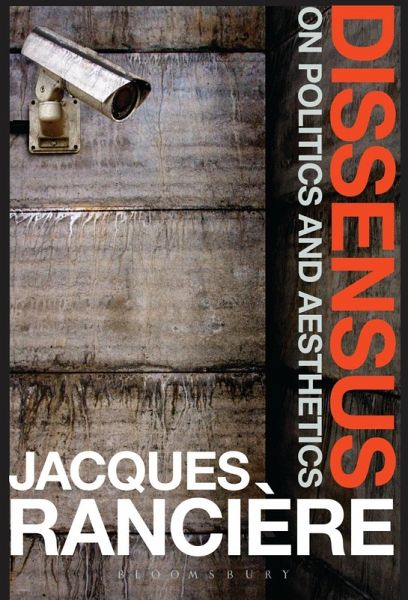
Dissensus: On Politics and Aesthetics brings together some of Jacques Rancière's most recent writings on art and politics to show the critical potential of two of his most important concepts: the aesthetics of politics and the politics of aesthetics. In this fascinating collection, Rancière engages in a radical critique of some of his major contemporaries on questions of art and politics: Gilles Deleuze, Antonio Negri, Giorgio Agamben, Alain Badiou and Jacques Derrida. The essays show how Rancière's ideas can be used to analyse contemporary trends in both art and politics, including the events surrounding 9/11, war in the contemporary consensual age, and the ethical turn of aesthetics and politics. Rancière elaborates new directions for the concepts of politics and communism, as well as the notion of what a 'politics of art' might be. This important collection includes several essays that have never previously been published in English, as well as a brand new afterword. Together these essays serve as a superb introduction to the work of one of the world's most influential contemporary thinkers.
Die Herstellerinformationen sind derzeit nicht verfügbar.
Autorenporträt
Jacques Rancière taught at the University of Paris VIII, France, from 1969 to 2000, occupying the Chair of Aesthetics and Politics from 1990 until his retirement.
Inhaltsangabe
Translator's Introduction \ Preface \ Part I: The Aesthetics of Politics \ 1. Ten Theses on Politics \ 2. Does Democracy Mean Something? \ 3. Who is the Subject of the Rights of Man? \ 4. Communism: From Actuality to Inactuality \ 5. The People or the Multitudes? \ 6. Biopolitics or Politics? \ 7. September 11 and Afterwards: A Rupture in the Symbolic Order? \ 8. Of War as the Supreme Form of Advanced Plutocratic Consensus \ Part II: The Politics of Aesthetics \ 9. The Aesthetic Revolution and its Outcomes \ 10. The Paradoxes of Political Art \ 11. The Politics of Literature \ 12. The Monument and its Confidences, or Deleuze and Art's Capacity for 'Resistance' \ 13. The Ethical Turn of Aesthetics and Politics \ Part III: Response to Critics \ 14. The Usage of Distinctions \ Index.
Acknowledgements Editor's Introduction Part I: The Aesthetics of Politics 1. Ten Theses on Politics 2. Does Democracy Mean Something? 3. Who is the Subject of the Rights of Man? 4. Communism: From Actuality to Inactuality 5. The People or the Multitudes? 6. Biopolitics or Politics? 7. September 11 and Afterwards: A Rupture in the Symbolic Order? 8. Of War as the Supreme Form of Advanced Plutocratic Consensus Part II: The Politics of Aesthetics 9. The Aesthetic Revolution and its Outcomes 10. The Paradoxes of Political Art 11. The Politics of Literature 12. The Monument and its Confidences; or Deleuze and Art's Capacity of 'Resistance' 13. The Ethical Turn of Aesthetics and Politics Part III: Response to Critics 14. The Use of Distinctions Notes Index
Translator's Introduction \ Preface \ Part I: The Aesthetics of Politics \ 1. Ten Theses on Politics \ 2. Does Democracy Mean Something? \ 3. Who is the Subject of the Rights of Man? \ 4. Communism: From Actuality to Inactuality \ 5. The People or the Multitudes? \ 6. Biopolitics or Politics? \ 7. September 11 and Afterwards: A Rupture in the Symbolic Order? \ 8. Of War as the Supreme Form of Advanced Plutocratic Consensus \ Part II: The Politics of Aesthetics \ 9. The Aesthetic Revolution and its Outcomes \ 10. The Paradoxes of Political Art \ 11. The Politics of Literature \ 12. The Monument and its Confidences, or Deleuze and Art's Capacity for 'Resistance' \ 13. The Ethical Turn of Aesthetics and Politics \ Part III: Response to Critics \ 14. The Usage of Distinctions \ Index.
Acknowledgements Editor's Introduction Part I: The Aesthetics of Politics 1. Ten Theses on Politics 2. Does Democracy Mean Something? 3. Who is the Subject of the Rights of Man? 4. Communism: From Actuality to Inactuality 5. The People or the Multitudes? 6. Biopolitics or Politics? 7. September 11 and Afterwards: A Rupture in the Symbolic Order? 8. Of War as the Supreme Form of Advanced Plutocratic Consensus Part II: The Politics of Aesthetics 9. The Aesthetic Revolution and its Outcomes 10. The Paradoxes of Political Art 11. The Politics of Literature 12. The Monument and its Confidences; or Deleuze and Art's Capacity of 'Resistance' 13. The Ethical Turn of Aesthetics and Politics Part III: Response to Critics 14. The Use of Distinctions Notes Index
Rezensionen
Rewarding in its scholarly engagement with Derrida, Arendt, Lyotard et al ... [Rancière] has a certain sardonic precision. The Guardian
Es gelten unsere Allgemeinen Geschäftsbedingungen: www.buecher.de/agb
Impressum
www.buecher.de ist ein Internetauftritt der buecher.de internetstores GmbH
Geschäftsführung: Monica Sawhney | Roland Kölbl | Günter Hilger
Sitz der Gesellschaft: Batheyer Straße 115 - 117, 58099 Hagen
Postanschrift: Bürgermeister-Wegele-Str. 12, 86167 Augsburg
Amtsgericht Hagen HRB 13257
Steuernummer: 321/5800/1497
USt-IdNr: DE450055826