69,95 €
69,95 €
inkl. MwSt.
Sofort per Download lieferbar

35 °P sammeln
69,95 €
Als Download kaufen
69,95 €
inkl. MwSt.
Sofort per Download lieferbar
35 °P sammeln
Jetzt verschenken
Alle Infos zum eBook verschenken
69,95 €
inkl. MwSt.
Sofort per Download lieferbar
Alle Infos zum eBook verschenken
35 °P sammeln

Andere Kunden interessierten sich auch für
") Dissent, Discourse, and Democracy (eBook, ePUB)69,95 €
Dissent, Discourse, and Democracy (eBook, ePUB)69,95 €") An Invitation to Debate (eBook, PDF)19,95 €
An Invitation to Debate (eBook, PDF)19,95 €") Ethos, Technology, and AI in Contemporary Society (eBook, PDF)36,95 €
Ethos, Technology, and AI in Contemporary Society (eBook, PDF)36,95 €") Theorizing Digital Rhetoric (eBook, PDF)46,95 €
Theorizing Digital Rhetoric (eBook, PDF)46,95 €") Neurorhetorics (eBook, PDF)51,95 €
Neurorhetorics (eBook, PDF)51,95 €") Faith, Media, and Persuasion (eBook, PDF)68,95 €
Faith, Media, and Persuasion (eBook, PDF)68,95 €") The Dynamics of Political Communication (eBook, PDF)81,95 €
The Dynamics of Political Communication (eBook, PDF)81,95 €





Awarded the 2022 James Madison Prize for Outstanding Research in First Amendment Studies by the Southern States Communication Association (SSCA)
Government whistleblowers contest authoritarian power. Yet, critical scholars have only minimally examined whistleblower discourses and hesitate to substantively interrogate the ideology of statism.
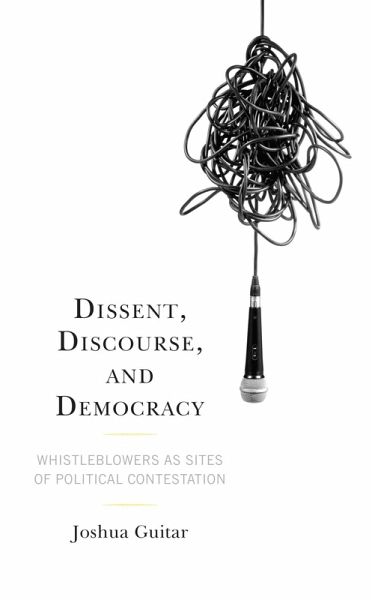
In Dissent, Discourse, and Democracy: Whistleblowers as Sites of Political Contestation, Joshua Guitar addresses this exigency and critiques government whistleblowing discourses through an Anarchist lens, reifying a pattern of discursive statist behaviors. Upon exposing government malfeasance, whistleblowers and their corresponding symbolic designations endure an erasure of agency via abstraction.
Guitar conceptualizes the totality of abstruction, identifying it both as a rhetorical manifestation of ideology and a method of critical rhetorical inquiry. The author reveals how whistleblowing, a quintessential tool of dissent within democracy, has been systematically constrained within the public forum and weaponized for statist interests. Scholars of political communication and rhetoric will find this book particularly interesting.
Government whistleblowers contest authoritarian power. Yet, critical scholars have only minimally examined whistleblower discourses and hesitate to substantively interrogate the ideology of statism.
In Dissent, Discourse, and Democracy: Whistleblowers as Sites of Political Contestation, Joshua Guitar addresses this exigency and critiques government whistleblowing discourses through an Anarchist lens, reifying a pattern of discursive statist behaviors. Upon exposing government malfeasance, whistleblowers and their corresponding symbolic designations endure an erasure of agency via abstraction.
Guitar conceptualizes the totality of abstruction, identifying it both as a rhetorical manifestation of ideology and a method of critical rhetorical inquiry. The author reveals how whistleblowing, a quintessential tool of dissent within democracy, has been systematically constrained within the public forum and weaponized for statist interests. Scholars of political communication and rhetoric will find this book particularly interesting.