112,95 €
inkl. MwSt.
Sofort per Download lieferbar
56 °P sammeln

Andere Kunden interessierten sich auch für
") DNA Repair Protocols (eBook, PDF)112,95 €
DNA Repair Protocols (eBook, PDF)112,95 €") DNA Damage and Repair (eBook, PDF)112,95 €
DNA Damage and Repair (eBook, PDF)112,95 €") PCR Cloning Protocols (eBook, PDF)112,95 €
PCR Cloning Protocols (eBook, PDF)112,95 €") DNA Damage and Repair (eBook, PDF)160,95 €
DNA Damage and Repair (eBook, PDF)160,95 €") Post-Transcriptional Gene Regulation (eBook, PDF)72,95 €
Post-Transcriptional Gene Regulation (eBook, PDF)72,95 €") Introduction to Bioinformatics (eBook, PDF)175,95 €
Introduction to Bioinformatics (eBook, PDF)175,95 €") RNA-Protein Interaction Protocols (eBook, PDF)72,95 €
RNA-Protein Interaction Protocols (eBook, PDF)72,95 €
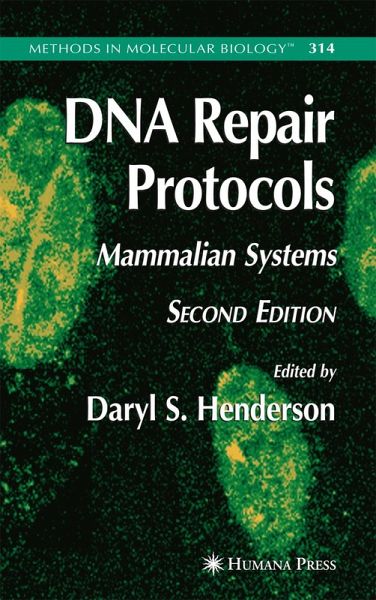
The first edition of this book, published in 1999 and called DNA Repair Protocols: Eukaryotic Systems, brought together laboratory-based methods for studying DNA damage and repair in diverse eukaryotes: namely, two kinds of yeast, a nematode, a fruit fly, a toad, three different plants, and human and murine cells. This second edition of DNA Repair Protocols covers mammalian cells only and hence its new subtitle, Mammalian Systems. There are two reasons for this fresh emphasis, both of them pragmatic: to cater to the interests of what is now a largely mammalocentric DNA repair field, and to expedite editing and prod- tion of this volume. Although DNA Repair Protocols: Mammalian Systems is a smaller book than its predecessor, it actually contains a greater variety of methods. Fourteen of the book's thirty-two chapters are entirely new and areas of redundancy present in the first edition have been eliminated here (for example, now just two chapters describe assays for nucleotide excision repair [NER], rather than seven). All eighteen returning chapters have been revised, many of them ext- sively. In order to maintain a coherent arrangement of topics, the four-part p- titioning seen in the first edition was dispensed with and chapters concerned with ionizing radiation damage and DNA strand breakage and repair were re- cated to near the front of the book. Finally, an abstract now heads each chapter.
Dieser Download kann aus rechtlichen Gründen nur mit Rechnungsadresse in A, B, BG, CY, CZ, D, DK, EW, E, FIN, F, GR, HR, H, IRL, I, LT, L, LR, M, NL, PL, P, R, S, SLO, SK ausgeliefert werden.
"...a comprehensive series of technique-oriented chapters focusing on eukaryotic DNA repair methodology. ...this text succeeds admirably...The scope of the text is fairly broad and encompasses not only in vitro biochemistry and enzymology, but also cell biology and genetics and even signal transduction....In vitro biochemical assays are well covered,...A particularly nice feature of the book is that the chapters have undergone uniform editing and formatting. All provide a nice overview of the topic, including a brief review of the pertinent literature, followed by step-by-step methods sections. The methods are clearly presented in annotated outline form with cross referencing and high level of detail. Each chapter has a particularly valuable section at the end, called "Notes" in which the authors present some of the nitty-gritty details and tricks of the trade needed to make the techniques work....Overall, this book should provide a valuable laboratory companion for researchers in the area of DNA repair. It serves to provide useful and readable introductions to various topics, along with techniques protocols sufficient for reproducibility....this text will have substantial appeal to the readers of Radiation Research."-Radiation Research
"The list of authors contains many of the leading scientists within the field...Protocols for most experimental eukaryotic organisms are described, from yeast through plants, worms, flies and frogs to mammals. Another laudable quality of this book is the standardization of the descriptions in Materials and methods. Since (almost) all articles are organized similarly, it is relatively easy to find what you want. Also, technical details have been standardized....At the end of each article , there is a 'Notes' section with detailed explanation of specific technical points. For a novice it is good to be reminded that ethidium bromide is a mutagen and that lids should be loosened before putting flasks in the microwaveoven. Iparticularly liked the description, written by the editor, of how to squash Drosophila larvae on a microscope slide by"standing on it with the ball of your foot or your heel. If using the foot method, place the slide (sandwiched in 3 MED MER) on a hard clean floor, cover it carefully with a piece of wood, and stand on that". ...this book keeps up the reputation of the 'Methods in Molecular Biology' series and I would recommend if for labs working with DNA repair, in particular for use by students and technicians."-FEBS Letters
"The list of authors contains many of the leading scientists within the field...Protocols for most experimental eukaryotic organisms are described, from yeast through plants, worms, flies and frogs to mammals. Another laudable quality of this book is the standardization of the descriptions in Materials and methods. Since (almost) all articles are organized similarly, it is relatively easy to find what you want. Also, technical details have been standardized....At the end of each article , there is a 'Notes' section with detailed explanation of specific technical points. For a novice it is good to be reminded that ethidium bromide is a mutagen and that lids should be loosened before putting flasks in the microwaveoven. Iparticularly liked the description, written by the editor, of how to squash Drosophila larvae on a microscope slide by"standing on it with the ball of your foot or your heel. If using the foot method, place the slide (sandwiched in 3 MED MER) on a hard clean floor, cover it carefully with a piece of wood, and stand on that". ...this book keeps up the reputation of the 'Methods in Molecular Biology' series and I would recommend if for labs working with DNA repair, in particular for use by students and technicians."-FEBS Letters