Sie sind bereits eingeloggt. Klicken Sie auf 2. tolino select Abo, um fortzufahren.
Bitte loggen Sie sich zunächst in Ihr Kundenkonto ein oder registrieren Sie sich bei bücher.de, um das eBook-Abo tolino select nutzen zu können.
Numerous publications have examined the challenges faced by non-native (often Western) academics conducting research in repressive countries. However, discussions of the unique security risks experienced by native scholars seem to be largely absent. While native academics face many of the challenges highlighted in existing publications, such as data security, access to informants, and personal safety, they also face additional risks and distinct obstacles, including weight of local identity markers, governmental pressure on family, legal threats from local authorities, and exploitation by…mehr
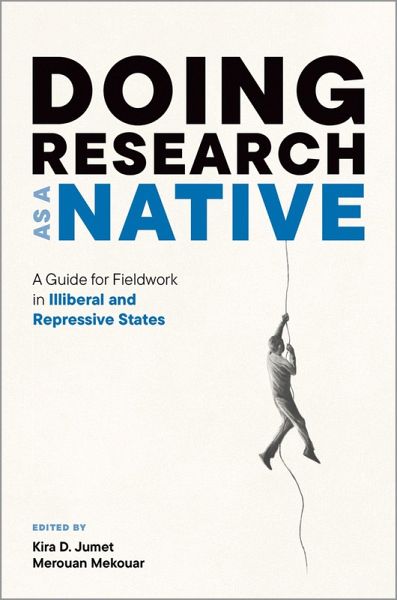
Numerous publications have examined the challenges faced by non-native (often Western) academics conducting research in repressive countries. However, discussions of the unique security risks experienced by native scholars seem to be largely absent. While native academics face many of the challenges highlighted in existing publications, such as data security, access to informants, and personal safety, they also face additional risks and distinct obstacles, including weight of local identity markers, governmental pressure on family, legal threats from local authorities, and exploitation by non-native colleagues. Doing Research as a Native addresses this critical gap in the literature through fieldwork accounts from 19 social science and humanities researchers who conducted fieldwork in their 15 repressive and/or illiberal home countries and faced challenges directly related to their position as native scholars. The book identifies the risks and obstacles faced by these scholars and also provides practical guidance for the preparation and carrying out of fieldwork, including methodological suggestions and coping strategies.
Dieser Download kann aus rechtlichen Gründen nur mit Rechnungsadresse in A, B, BG, CY, CZ, D, DK, EW, E, FIN, F, GR, HR, H, IRL, I, LT, L, LR, M, NL, PL, P, R, S, SLO, SK ausgeliefert werden.
Die Herstellerinformationen sind derzeit nicht verfügbar.
Autorenporträt
Kira D. Jumet is Associate Professor of Government and Director of the Middle East/Islamicate Worlds Studies Program at Hamilton College. Her research focuses on social movements, authoritarianism, and national identity in the Middle East and North Africa. With an academic backround in Political Science and Middle East Studies, Jumet takes an interdisciplinary approach to her scholarship. She is the author of Contesting the Repressive State: Why Ordinary Egyptians Protested During the Arab Spring (2018) and has also published on violent Islamism and repression in Egypt. Jumet has conducted fieldwork in Morocco for her current work on nation-building in the country. Merouan Mekouar is Associate Professor of Social Science at York University and specializes in norm diffusion, social movements, and authoritarian practices in North Africa and the Middle East. Originally trained in political science, Mekouar draws upon a wide range of disciplines--including comparative politics, international relations, political sociology, development studies, and behavioral economics--to examine diverse political phenomena ranging from the emergence and adoption of new authoritarian practices and means of contention to regime learning and stress contamination in security organizations. In recent years, he has expanded his scholarship to include critical fieldwork methodologies in illiberal and authoritarian countries.
Inhaltsangabe
* Introduction * Part 1: Gender and Societal Expectations * Chapter 1: "But Where Is Your Grandmother Really From?" Negotiating Ethnicity, Gender, and Belonging After War (Bosnia and Herzegovina and Serbia) * Chapter 2: Discomfort in the Field: Navigating Family Politics, the Streets, and the State in Algeria (Algeria) * Chapter 3: Doing Research on the "Margins": Fieldwork as a Pashtun in Pakistan (Pakistan) * Chapter 4: Suspicion, Surveillance, and Survival in Kashmir (Indian-controlled Kashmir) * Chapter 5: Gender and Societal Expectations: A Provisional Guide * Part 2: Race, Ethnicity, and Belonging * Chapter 6: Ethnicity as a Liability: Fieldwork as a Mixed Ethnic Researcher in Ethiopia (Ethiopia) * Chapter 7: "Racial Democracy" as a Fallacy: Art, Research, and Identity in Brazil (Brazil) * Chapter 8: "Come Back as a Piece, not Pieces": Risks, Experiences, and Practices of Researching "Sensitive" Topics in One's Home Country - A Note from Northern Nigeria (Nigeria) * Chapter 9: Guardians of the Archives: The Bishop and the Bureaucrat in Socialist Cuba (Cuba) * Chapter 10: Race, Ethnicity, and Belonging: A Provisional Guide * Part 3: Legal Threats and Red Lines * Chapter 11: Lacan in Vietnam: Managing Anxiety and Minimizing Surveillance (Vietnam) * Chapter 12: Nowhere to Hide: An Egyptian Researcher, Between Forced Exile and Arrest (Egypt) * Chapter 13: Walking a Fine Line: Institutional Ambiguities and Ethical Dilemmas in Tajikistan (Tajikistan) * Chapter 14: What Does One Do with the Nightmares? Are They Ethnographic Data or Material for a Psychoanalyst? (Nicaragua) * Chapter 15: Legal Threats and Red Lines: A Provisional Guide * Part 4: Exploitation * Chapter 16: Impossible Return? Vulnerability for Iranian Dual-National Researchers in the Field (Iran) * Chapter 17: Questionable Solicitations and Regime Restrictions: Protecting Family, Colleagues, and Oneself while Researching in Nicaragua (Nicaragua) * Chapter 18: Navigating Dangerous Fields: Storytelling, Waiting, and Ethnography without Fieldnotes (Turkey) * Chapter 19: Exploitation: A Provisional Guide * Conclusion
* Introduction * Part 1: Gender and Societal Expectations * Chapter 1: "But Where Is Your Grandmother Really From?" Negotiating Ethnicity, Gender, and Belonging After War (Bosnia and Herzegovina and Serbia) * Chapter 2: Discomfort in the Field: Navigating Family Politics, the Streets, and the State in Algeria (Algeria) * Chapter 3: Doing Research on the "Margins": Fieldwork as a Pashtun in Pakistan (Pakistan) * Chapter 4: Suspicion, Surveillance, and Survival in Kashmir (Indian-controlled Kashmir) * Chapter 5: Gender and Societal Expectations: A Provisional Guide * Part 2: Race, Ethnicity, and Belonging * Chapter 6: Ethnicity as a Liability: Fieldwork as a Mixed Ethnic Researcher in Ethiopia (Ethiopia) * Chapter 7: "Racial Democracy" as a Fallacy: Art, Research, and Identity in Brazil (Brazil) * Chapter 8: "Come Back as a Piece, not Pieces": Risks, Experiences, and Practices of Researching "Sensitive" Topics in One's Home Country - A Note from Northern Nigeria (Nigeria) * Chapter 9: Guardians of the Archives: The Bishop and the Bureaucrat in Socialist Cuba (Cuba) * Chapter 10: Race, Ethnicity, and Belonging: A Provisional Guide * Part 3: Legal Threats and Red Lines * Chapter 11: Lacan in Vietnam: Managing Anxiety and Minimizing Surveillance (Vietnam) * Chapter 12: Nowhere to Hide: An Egyptian Researcher, Between Forced Exile and Arrest (Egypt) * Chapter 13: Walking a Fine Line: Institutional Ambiguities and Ethical Dilemmas in Tajikistan (Tajikistan) * Chapter 14: What Does One Do with the Nightmares? Are They Ethnographic Data or Material for a Psychoanalyst? (Nicaragua) * Chapter 15: Legal Threats and Red Lines: A Provisional Guide * Part 4: Exploitation * Chapter 16: Impossible Return? Vulnerability for Iranian Dual-National Researchers in the Field (Iran) * Chapter 17: Questionable Solicitations and Regime Restrictions: Protecting Family, Colleagues, and Oneself while Researching in Nicaragua (Nicaragua) * Chapter 18: Navigating Dangerous Fields: Storytelling, Waiting, and Ethnography without Fieldnotes (Turkey) * Chapter 19: Exploitation: A Provisional Guide * Conclusion
Es gelten unsere Allgemeinen Geschäftsbedingungen: www.buecher.de/agb
Impressum
www.buecher.de ist ein Internetauftritt der buecher.de internetstores GmbH
Geschäftsführung: Monica Sawhney | Roland Kölbl | Günter Hilger
Sitz der Gesellschaft: Batheyer Straße 115 - 117, 58099 Hagen
Postanschrift: Bürgermeister-Wegele-Str. 12, 86167 Augsburg
Amtsgericht Hagen HRB 13257
Steuernummer: 321/5800/1497
USt-IdNr: DE450055826