112,95 €
112,95 €
inkl. MwSt.
Sofort per Download lieferbar

56 °P sammeln
112,95 €
Als Download kaufen
112,95 €
inkl. MwSt.
Sofort per Download lieferbar
56 °P sammeln
Jetzt verschenken
Alle Infos zum eBook verschenken
112,95 €
inkl. MwSt.
Sofort per Download lieferbar
Alle Infos zum eBook verschenken
56 °P sammeln

Andere Kunden interessierten sich auch für
") Bioactive Ceramides in Health and Disease (eBook, PDF)72,95 €
Bioactive Ceramides in Health and Disease (eBook, PDF)72,95 €") Mammalian Sterols (eBook, PDF)72,95 €
Mammalian Sterols (eBook, PDF)72,95 €") Role of Signaling Pathways in Brain Tumorigenesis (eBook, PDF)112,95 €
Role of Signaling Pathways in Brain Tumorigenesis (eBook, PDF)112,95 €") Biomedical Translational Research (eBook, PDF)160,95 €
Biomedical Translational Research (eBook, PDF)160,95 €") microRNA: Cancer (eBook, PDF)72,95 €
microRNA: Cancer (eBook, PDF)72,95 €") Lipidomics in Health & Disease (eBook, PDF)72,95 €
Lipidomics in Health & Disease (eBook, PDF)72,95 €") Basic Organic Chemistry for the Life Sciences (eBook, PDF)46,95 €
Basic Organic Chemistry for the Life Sciences (eBook, PDF)46,95 €


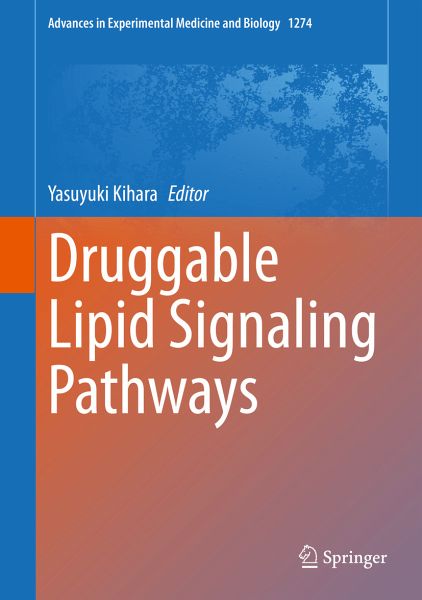
Lipids are responsible not just for constituting cellular membrane but also for storing energy, transducing signaling, and modifying proteins. Bioactive lipids, or lipid mediators, transduce signaling as intracellular messenger like phosphoinoitides, and also regulate cell-cell communication through G protein-coupled receptors (GPCRs) that are potentially valuable drug targets in many diseases. Until now, about 40 GPCRs within ~300 rhodopsin-like (class A) GPCRs, are identified as lipid GPCRs. Advances of lipid research have enabled to develop novel small molecules targeting lipid GPCRs for several diseases. Most notably, fingolimod (FTY720), a sphingosine 1-phosphate (S1P) receptor modulator, became the first FDA-approved medicine as an orally bioavailable drug for treating relapsing forms of multiple sclerosis (MS). In addition to fingolimod, other drugs targeting lipid GPCRs had been developed such as latanoprost (prostaglandin F2a analogue, used for ocular hypertension and glaucoma), epoprostenol and treprostinil (prostaglandin I2 analogue, used for pulmonary arterial hypertension), montelukast and pranlukast (cysteinyl leukotriene receptor antagonist, used for asthma and allergies), etc. Novel drugs are also expected like lysophosphatidic acid (LPA) receptor antagonist for treatment of pulmonary fibrosis.
Drug development targeting lipid signalling pathways are backdated to more than a century, when aspirin was synthesized and selling by Bayer, while the basic mechanism of aspirin's effects (block prostanoid synthesis by inhibiting cyclooxygenases) had not been discovered until 1970s. Nowadays, non-steroidal anti-inflammatory drugs (NSAIDs) like aspirin and ibuprophen are commonly used as antipyretic analgesics and available readily over-the-counter oral drugs. Both upstream and downstream enzymes, such as phospholipase A2s and prostaglandin E synthases, respectively, are also potential therapeutic targets for inflammatory diseases.
Recent studies of lipid metabolism expand the lipid biology field from pro-inflammatory lipid mediators to anti-inflammatory epoxy fatty acids (epoxyeicosatrienoic acids), and also omega-3 fatty acid-derived pro-resolving lipid mediators (lipoxin, resolvin, and neuroprotectin). These bioactive lipids, their metabolic pathways and receptors are of great interest in developing next-generation anti-inflammatory and pro-resolving drugs for a wide variety of diseases including.
This book summarizes not only historical overview of lipid signaling pathways but also provides summary of cutting-edge studies that may provide some hints of novel "druggable" lipid signaling targets.
Drug development targeting lipid signalling pathways are backdated to more than a century, when aspirin was synthesized and selling by Bayer, while the basic mechanism of aspirin's effects (block prostanoid synthesis by inhibiting cyclooxygenases) had not been discovered until 1970s. Nowadays, non-steroidal anti-inflammatory drugs (NSAIDs) like aspirin and ibuprophen are commonly used as antipyretic analgesics and available readily over-the-counter oral drugs. Both upstream and downstream enzymes, such as phospholipase A2s and prostaglandin E synthases, respectively, are also potential therapeutic targets for inflammatory diseases.
Recent studies of lipid metabolism expand the lipid biology field from pro-inflammatory lipid mediators to anti-inflammatory epoxy fatty acids (epoxyeicosatrienoic acids), and also omega-3 fatty acid-derived pro-resolving lipid mediators (lipoxin, resolvin, and neuroprotectin). These bioactive lipids, their metabolic pathways and receptors are of great interest in developing next-generation anti-inflammatory and pro-resolving drugs for a wide variety of diseases including.
This book summarizes not only historical overview of lipid signaling pathways but also provides summary of cutting-edge studies that may provide some hints of novel "druggable" lipid signaling targets.
Dieser Download kann aus rechtlichen Gründen nur mit Rechnungsadresse in A, B, BG, CY, CZ, D, DK, EW, E, FIN, F, GR, HR, H, IRL, I, LT, L, LR, M, NL, PL, P, R, S, SLO, SK ausgeliefert werden.