41,95 €
41,95 €
inkl. MwSt.
Sofort per Download lieferbar

21 °P sammeln
41,95 €
Als Download kaufen
41,95 €
inkl. MwSt.
Sofort per Download lieferbar
21 °P sammeln
Jetzt verschenken
Alle Infos zum eBook verschenken
41,95 €
inkl. MwSt.
Sofort per Download lieferbar
Alle Infos zum eBook verschenken
21 °P sammeln

Andere Kunden interessierten sich auch für
") Dynamic Federalism (eBook, PDF)41,95 €
Dynamic Federalism (eBook, PDF)41,95 €") Routledge Handbook of Comparative Constitutional Change (eBook, ePUB)45,95 €
Routledge Handbook of Comparative Constitutional Change (eBook, ePUB)45,95 €") The Law of Deliberative Democracy (eBook, ePUB)49,95 €
The Law of Deliberative Democracy (eBook, ePUB)49,95 €") The Internal Law of Religions (eBook, ePUB)41,95 €
The Internal Law of Religions (eBook, ePUB)41,95 €") Quasi-Constitutionality and Constitutional Statutes (eBook, ePUB)43,95 €
Quasi-Constitutionality and Constitutional Statutes (eBook, ePUB)43,95 €") The Philosophy of Legal Change (eBook, ePUB)43,95 €
The Philosophy of Legal Change (eBook, ePUB)43,95 €") Dictatorship (eBook, ePUB)21,95 €
Dictatorship (eBook, ePUB)21,95 €






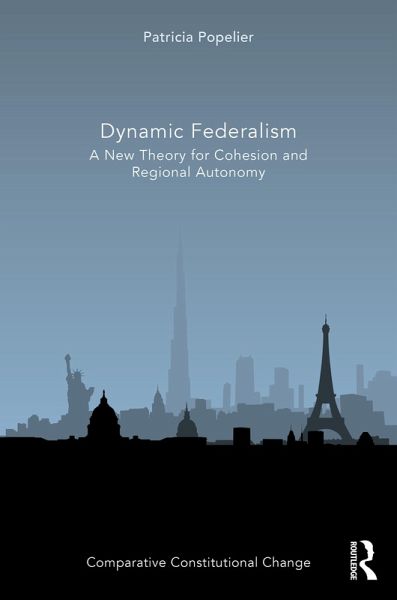
This book offers a new theory of federalism.
The work critically discusses traditional federal theories and builds on theories that focus on the dynamics of federalism. It offers a definition of federalism and federal organizations that encompasses both new and old types of multi-tiered system. Unlike traditional federal theory, it is well-suited to research both multinational and mononational systems. It also takes into account the complexity of these systems, with bodies of governance at the local, regional, national, and supranational level. The book is divided into three parts: the first part outlines the contours of dynamic federalism, based on a critical overview of traditional federal theory; the second part develops comprehensive indexes to measure autonomy and cohesion of multi-tiered systems; and the third part focuses on the dynamics of federal organizations, with a special focus on institutional hubs for change.
Dynamic Federalism will be an essential resource for legal, social, economic, and political scholars interested in federalism, regionalism, and de/centralization.
The work critically discusses traditional federal theories and builds on theories that focus on the dynamics of federalism. It offers a definition of federalism and federal organizations that encompasses both new and old types of multi-tiered system. Unlike traditional federal theory, it is well-suited to research both multinational and mononational systems. It also takes into account the complexity of these systems, with bodies of governance at the local, regional, national, and supranational level. The book is divided into three parts: the first part outlines the contours of dynamic federalism, based on a critical overview of traditional federal theory; the second part develops comprehensive indexes to measure autonomy and cohesion of multi-tiered systems; and the third part focuses on the dynamics of federal organizations, with a special focus on institutional hubs for change.
Dynamic Federalism will be an essential resource for legal, social, economic, and political scholars interested in federalism, regionalism, and de/centralization.
Dieser Download kann aus rechtlichen Gründen nur mit Rechnungsadresse in A, B, BG, CY, CZ, D, DK, EW, E, FIN, F, GR, HR, H, IRL, I, LT, L, LR, M, NL, PL, P, R, S, SLO, SK ausgeliefert werden.
"Popelier aims at laying the foundations for a new, dynamic theory of federalism, overcoming some key weaknesses of traditional federal theory, and testing such theory on a series of conditions: universality, specificity, and flexibility... the author's endeavors in trying to overcome the theoretical weaknesses of traditional federal scholarship, doing so from a legal perspective, is certainly fascinating... the book also offers a peculiar opportunity for comparative constitutional law scholarship to reflect on the importance of method and the definition of concepts to advance research."
Lidia Bonifati, Diritti Comparati, 27 May 2021
"Dynamic Federalism is one of the rare books that attempt to develop a holistic theory. One that not only describes but also explains and predicts how federal structures come about, remain in place, contribute to stability or fuel fragmentation, and eventually dissolve. Written by a constitutional lawyer and drawing on the Belgian case to measure its various dimensions and indicators, there is much to be learned from several of the book's core postulates both in the theoretical and in the empirical realms."
Sean Mueller (2021): Dynamic federalism: a new theory for cohesion and regional autonomy, Regional & Federal Studies, DOI: 10.1080/13597566.2021.1939691
`...the book is not only greatly informative, but thought-provoking and inspiring. It offers illuminating paths into the worlds of federalism-not all of them yet unknown, but superbly nuanced and analyzed.'
Anna Gamper University of Innsbruck, Austria; doi:10.1093/publius/pjab034
Lidia Bonifati, Diritti Comparati, 27 May 2021
"Dynamic Federalism is one of the rare books that attempt to develop a holistic theory. One that not only describes but also explains and predicts how federal structures come about, remain in place, contribute to stability or fuel fragmentation, and eventually dissolve. Written by a constitutional lawyer and drawing on the Belgian case to measure its various dimensions and indicators, there is much to be learned from several of the book's core postulates both in the theoretical and in the empirical realms."
Sean Mueller (2021): Dynamic federalism: a new theory for cohesion and regional autonomy, Regional & Federal Studies, DOI: 10.1080/13597566.2021.1939691
`...the book is not only greatly informative, but thought-provoking and inspiring. It offers illuminating paths into the worlds of federalism-not all of them yet unknown, but superbly nuanced and analyzed.'
Anna Gamper University of Innsbruck, Austria; doi:10.1093/publius/pjab034