45,95 €
45,95 €
inkl. MwSt.
Sofort per Download lieferbar

23 °P sammeln
45,95 €
Als Download kaufen
45,95 €
inkl. MwSt.
Sofort per Download lieferbar
23 °P sammeln
Jetzt verschenken
Alle Infos zum eBook verschenken
45,95 €
inkl. MwSt.
Sofort per Download lieferbar
Alle Infos zum eBook verschenken
23 °P sammeln

Andere Kunden interessierten sich auch für
") India as an Asia Pacific Power (eBook, PDF)32,95 €
India as an Asia Pacific Power (eBook, PDF)32,95 €") China-India Relations in the Contemporary World (eBook, PDF)27,95 €
China-India Relations in the Contemporary World (eBook, PDF)27,95 €") Northeast India (eBook, PDF)40,95 €
Northeast India (eBook, PDF)40,95 €") Anglo-Indians and Minority Politics in South Asia (eBook, PDF)41,95 €
Anglo-Indians and Minority Politics in South Asia (eBook, PDF)41,95 €") India in South Asia (eBook, PDF)45,95 €
India in South Asia (eBook, PDF)45,95 €") Pakistan's Security and the India-US Strategic Partnership (eBook, PDF)41,95 €
Pakistan's Security and the India-US Strategic Partnership (eBook, PDF)41,95 €") The Indian Farmers' Protest of 2020-2021 (eBook, PDF)42,95 €
The Indian Farmers' Protest of 2020-2021 (eBook, PDF)42,95 €




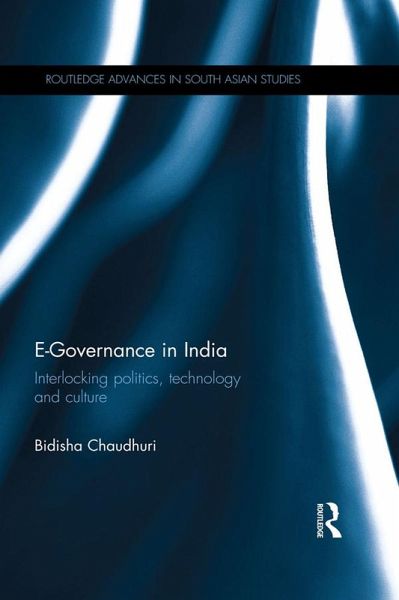
E-Governance has been one of the strategic sectors of reform in India since late 1990s under the rubric of 'good governance' agenda promoted by International Organizations. As India's policy focus changed towards economic liberalization, deregulation and privatization proliferating domestic and foreign investment, ICT (Information Communication Technology) has been one of the leading areas for such heightened investment. Consequently, there has been a burgeoning interest in deploying ICT, in revamping the public service delivery and eventually the overall system of governance.
This book analyses e-Governance in India and argues that such initiatives did not take place in isolation but followed in the footsteps of broader governance reform agenda that has already made considerable impact on the discourses and practices of governance in India. Employing interdisciplinary methodology by combining approaches from the Political Sciences, Sociology and Postcolonial/ transcultural studies, this book presents a qualitative account of the policies and practices of e-Governance reform in India along with a detailed case study of the Common Services Centres (CSCs) Scheme under the National e-Governance Plan of the Government of India and its resultant impact on the overall system of governance. It unfolds general theoretical issues in terms of the relationship between technology and governance and the entanglement of politics, technology and culture in the complex whole of governance. This furthers our understanding of the impact of the transnational governance reform agenda on post-colonial and post-communist societies of the developing world.
Making an important and original contribution to the emerging field of e-Governance and to the existing body of research on governance in general, this book will be of interest to students and scholars of Political Science, Political Sociology, South Asian Politics and Governance.
This book analyses e-Governance in India and argues that such initiatives did not take place in isolation but followed in the footsteps of broader governance reform agenda that has already made considerable impact on the discourses and practices of governance in India. Employing interdisciplinary methodology by combining approaches from the Political Sciences, Sociology and Postcolonial/ transcultural studies, this book presents a qualitative account of the policies and practices of e-Governance reform in India along with a detailed case study of the Common Services Centres (CSCs) Scheme under the National e-Governance Plan of the Government of India and its resultant impact on the overall system of governance. It unfolds general theoretical issues in terms of the relationship between technology and governance and the entanglement of politics, technology and culture in the complex whole of governance. This furthers our understanding of the impact of the transnational governance reform agenda on post-colonial and post-communist societies of the developing world.
Making an important and original contribution to the emerging field of e-Governance and to the existing body of research on governance in general, this book will be of interest to students and scholars of Political Science, Political Sociology, South Asian Politics and Governance.
Dieser Download kann aus rechtlichen Gründen nur mit Rechnungsadresse in A, B, BG, CY, CZ, D, DK, EW, E, FIN, F, GR, HR, H, IRL, I, LT, L, LR, M, NL, PL, P, R, S, SLO, SK ausgeliefert werden.