Sie sind bereits eingeloggt. Klicken Sie auf 2. tolino select Abo, um fortzufahren.
Bitte loggen Sie sich zunächst in Ihr Kundenkonto ein oder registrieren Sie sich bei bücher.de, um das eBook-Abo tolino select nutzen zu können.
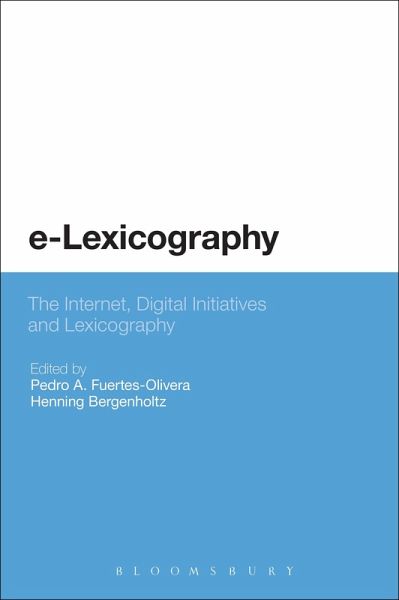
This book looks at current research and future directions in e-lexicography. Online dictionaries and reference tools are increasingly prevalent in a digitized and internet-led era in language study that has embraced computational linguistics. This book responds with theoretical and practical analysis of key topics, from a global range of contributors. Since COBUILD in the 1980s, lexicographers have found it essential to engage with and utilize electronic computational tools. Internet dictionaries, online reference tools and even search engine optimization demand a knowledge of electronic…mehr
This book looks at current research and future directions in e-lexicography. Online dictionaries and reference tools are increasingly prevalent in a digitized and internet-led era in language study that has embraced computational linguistics. This book responds with theoretical and practical analysis of key topics, from a global range of contributors. Since COBUILD in the 1980s, lexicographers have found it essential to engage with and utilize electronic computational tools. Internet dictionaries, online reference tools and even search engine optimization demand a knowledge of electronic lexicography and force a reassessment of the field. This volume looks at, amongst other topics: . Polyfunctional versus monofunctional dictionary tools . Developing theories of lexicography for electronic mediums . Distinguishing between the database and the dictionary . Online dictionaries not as data repositories but as sophisticated search engines This volume will appeal to scholars in lexicography and to practicing lexicographers.
Die Herstellerinformationen sind derzeit nicht verfügbar.
Autorenporträt
Pedro A. Fuertes-Olivera is an Associate Professor at the University of Valladolid, Spain. Henning Bergenholtz is a Full Professor at the University of Aarhus, Denmark.
Inhaltsangabe
Preface Notes on Contributors Introduction: The Construction of Internet Dictionaries Pedro A. Fuertes-Olivera and Henning Bergenholtz 1. Learning, Unlearning and Innovation in the Planning of Electronic Dictionaries Rufus H. Gouws 2. Access to and Presentation of Needs-Adapted Data in Monofunctional Internet Dictionaries Henning Bergenholtz 3. Lexicographical and Other e-Tools for Consultation Purposes: Towards the Individualization of Needs Satisfaction Sven Tarp 4. Filtering and Adapting Data and Information in the Online Environment in Response to User Needs Theo Bothma 5. A Multi-layer Architecture for "Pluri-Monofunctional" Dictionaries Dennis Spohr 6. Change of Paradigm: From Linguistics to Information Science and from Dictionaries to Lexicographic Information Tools Patrick Leroyer 7. From Data to Dictionary Sandro Nielsen and Richard Almind 8. Internet Dictionaries for Cognitive and Communicative Functions: El Diccionario Inglés-Español de Contabilidad, Pedro A. Fuertes-Olivera and Marta Niño-Amo 9. A Dictionary is a Tool, a Good Dictionary is a Monofunctional Tool Henning Bergenholtz amd Inger Bergenholtz 10. The Technical Realization of Three Monofunctional Phrasal Verb Dictionaries Birger Andersen and Richard Almind 11. Online Dictionaries of English Robert Lew 12. E-Dictionaries in the Information Age: The Lexical Constellation Model (LCM) and the Definitional Construct, Aquilino Sánchez and Pascual Cantos 13. Modelling Interactive Reading, Translation and Writing Assistants Serge Verlinde 14. Electronic Dictionaries as Tools: Towards an Assessment of Usability Ulrich Heid 15. Conclusions: Ten Key Issues in e-Lexicography for the Future, Eva Samaniego Fernández and Beatriz Pérez Cabello de Alba References Index
Preface Notes on Contributors Introduction: The Construction of Internet Dictionaries Pedro A. Fuertes-Olivera and Henning Bergenholtz 1. Learning, Unlearning and Innovation in the Planning of Electronic Dictionaries Rufus H. Gouws 2. Access to and Presentation of Needs-Adapted Data in Monofunctional Internet Dictionaries Henning Bergenholtz 3. Lexicographical and Other e-Tools for Consultation Purposes: Towards the Individualization of Needs Satisfaction Sven Tarp 4. Filtering and Adapting Data and Information in the Online Environment in Response to User Needs Theo Bothma 5. A Multi-layer Architecture for "Pluri-Monofunctional" Dictionaries Dennis Spohr 6. Change of Paradigm: From Linguistics to Information Science and from Dictionaries to Lexicographic Information Tools Patrick Leroyer 7. From Data to Dictionary Sandro Nielsen and Richard Almind 8. Internet Dictionaries for Cognitive and Communicative Functions: El Diccionario Inglés-Español de Contabilidad, Pedro A. Fuertes-Olivera and Marta Niño-Amo 9. A Dictionary is a Tool, a Good Dictionary is a Monofunctional Tool Henning Bergenholtz amd Inger Bergenholtz 10. The Technical Realization of Three Monofunctional Phrasal Verb Dictionaries Birger Andersen and Richard Almind 11. Online Dictionaries of English Robert Lew 12. E-Dictionaries in the Information Age: The Lexical Constellation Model (LCM) and the Definitional Construct, Aquilino Sánchez and Pascual Cantos 13. Modelling Interactive Reading, Translation and Writing Assistants Serge Verlinde 14. Electronic Dictionaries as Tools: Towards an Assessment of Usability Ulrich Heid 15. Conclusions: Ten Key Issues in e-Lexicography for the Future, Eva Samaniego Fernández and Beatriz Pérez Cabello de Alba References Index
Es gelten unsere Allgemeinen Geschäftsbedingungen: www.buecher.de/agb
Impressum
www.buecher.de ist ein Internetauftritt der buecher.de internetstores GmbH
Geschäftsführung: Monica Sawhney | Roland Kölbl | Günter Hilger
Sitz der Gesellschaft: Batheyer Straße 115 - 117, 58099 Hagen
Postanschrift: Bürgermeister-Wegele-Str. 12, 86167 Augsburg
Amtsgericht Hagen HRB 13257
Steuernummer: 321/5800/1497
USt-IdNr: DE450055826