88,95 €
inkl. MwSt.
Sofort per Download lieferbar
44 °P sammeln

Andere Kunden interessierten sich auch für
") Gender and Representations of the Female Subject in Early Modern England (eBook, PDF)40,95 €
Gender and Representations of the Female Subject in Early Modern England (eBook, PDF)40,95 €") Women Writing Fancy (eBook, PDF)72,95 €
Women Writing Fancy (eBook, PDF)72,95 €") Women, Food Exchange, and Governance in Early Modern England (eBook, PDF)72,95 €
Women, Food Exchange, and Governance in Early Modern England (eBook, PDF)72,95 €") Women Writing the Neo-Victorian Novel (eBook, PDF)68,95 €
Women Writing the Neo-Victorian Novel (eBook, PDF)68,95 €") Gender, Authorship, and Early Modern Women's Collaboration (eBook, PDF)80,95 €
Gender, Authorship, and Early Modern Women's Collaboration (eBook, PDF)80,95 €") Maternal Abandonment and Queer Resistance in Twenty-First-Century Swedish Literature (eBook, PDF)96,95 €
Maternal Abandonment and Queer Resistance in Twenty-First-Century Swedish Literature (eBook, PDF)96,95 €") English National Identity and the Image of the Dutch (eBook, PDF)88,95 €
English National Identity and the Image of the Dutch (eBook, PDF)88,95 €







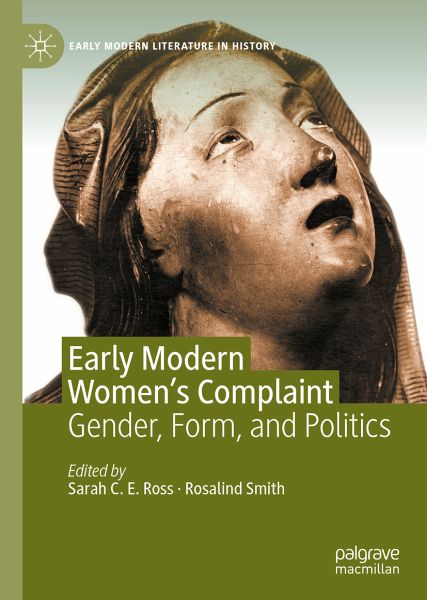
This collection examines early modern women's contribution to the culturally central mode of complaint. Complaint has largely been understood as male-authored, yet, as this collection shows, early modern women used complaint across a surprising variety of forms from the early-Tudor period to the late-seventeenth century. They were some of the mode's first writers, most influential patrons, and most innovative contributors. Together, these new essays illuminate early modern women's participation in one of the most powerful rhetorical modes in the English Renaissance, one which gave voice to political, religious and erotic protest and loss across a diverse range of texts.
This volume interrogates new texts (closet drama, song, manuscript-based religious and political lyrics), new authors (Dorothy Shirley, Scots satirical writers, Hester Pulter, Mary Rowlandson), and new versions of complaint (biblical, satirical, legal, and vernacular). Its essays pay specific attention to politics, form, and transmission from complaint's first circulation up to recent digital representations of its texts. Bringing together an international group of experts in early modern women's writing and in complaint literature more broadly, this collection explores women's role in the formation of the mode and in doing so reconfigures our understanding of complaint in Renaissance culture and thought.
Dieser Download kann aus rechtlichen Gründen nur mit Rechnungsadresse in A, B, BG, CY, CZ, D, DK, EW, E, FIN, F, GR, HR, H, IRL, I, LT, L, LR, M, NL, PL, P, R, S, SLO, SK ausgeliefert werden.
"This rich and in many ways groundbreaking collection addresses a crucial gap in our knowledge of early modern women's writing by recovering their multifaceted, often surprising, engagements ... . The present volume provides an important corrective to the idea of women's exclusion from complaint writing as well as to the singularity of focus on love. ... while further work on recovery, description, and interpretation of these texts awaits, the present volume is a remarkably impressive opening gambit." (Danila Sokolov, Early Modern Women Journal, Vol. 17 (2), 2023)
"Early Modern Women's Complaint therefore opens up opportunities for assessing more deeply the networks of education and influence between Tudor boys and girls, and between public institutions and domestic pedagogical practices." (Bonnie Lander Johnson, The Review of English Studies, October 28, 2021)
"Early Modern Women's Complaint therefore opens up opportunities for assessing more deeply the networks of education and influence between Tudor boys and girls, and between public institutions and domestic pedagogical practices." (Bonnie Lander Johnson, The Review of English Studies, October 28, 2021)
Es gelten unsere Allgemeinen Geschäftsbedingungen: www.buecher.de/agb
Impressum
www.buecher.de ist ein Internetauftritt der buecher.de internetstores GmbH
Geschäftsführung: Monica Sawhney | Roland Kölbl | Günter Hilger
Sitz der Gesellschaft: Batheyer Straße 115 - 117, 58099 Hagen
Postanschrift: Bürgermeister-Wegele-Str. 12, 86167 Augsburg
Amtsgericht Hagen HRB 13257
Steuernummer: 321/5800/1497
USt-IdNr: DE450055826
Bitte wählen Sie Ihr Anliegen aus.
Rechnungen
Retourenschein anfordern
Bestellstatus
Storno