Sie sind bereits eingeloggt. Klicken Sie auf 2. tolino select Abo, um fortzufahren.
Bitte loggen Sie sich zunächst in Ihr Kundenkonto ein oder registrieren Sie sich bei bücher.de, um das eBook-Abo tolino select nutzen zu können.
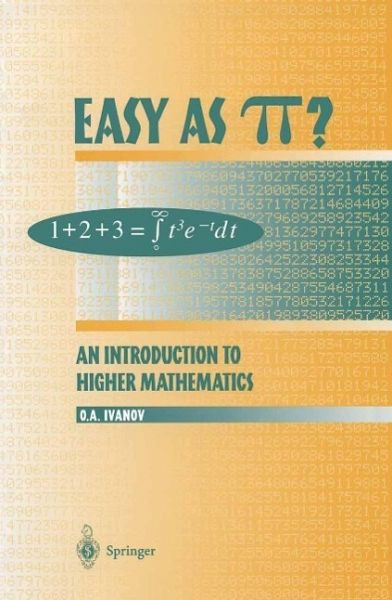
This book aims at introducing the reader possessing some high school mathematics, to both the higher and the more fundamental developments of the basic themes of elementary mathematics. To this end most chapters begin with a series of elementary problems, behind whose diverting formulation more advanced mathematical ideas lie hidden. These are then made explicit and further developments explored, thereby deepening and broadening the reader's understanding of mathematics -- enabling him or her to see mathematics as a hologram.
This book aims at introducing the reader possessing some high school mathematics, to both the higher and the more fundamental developments of the basic themes of elementary mathematics. To this end most chapters begin with a series of elementary problems, behind whose diverting formulation more advanced mathematical ideas lie hidden. These are then made explicit and further developments explored, thereby deepening and broadening the reader's understanding of mathematics -- enabling him or her to see mathematics as a hologram.
Dieser Download kann aus rechtlichen Gründen nur mit Rechnungsadresse in A, B, BG, CY, CZ, D, DK, EW, E, FIN, F, GR, HR, H, IRL, I, LT, L, LR, M, NL, PL, P, R, S, SLO, SK ausgeliefert werden.
Die Herstellerinformationen sind derzeit nicht verfügbar.
Inhaltsangabe
1 Induction.- 1.1 Principle or method?.- 1.2 The set of integers.- 1.3 Peano's axioms.- 1.4 Addition, order, and multiplication.- 1.5 The method of mathematical induction.- 2 Combinatorics.- 2.1 Elementary problems.- 2.2 Combinations and recurrence relations.- 2.3 Recurrence relations and power series.- 2.4 Generating functions.- 2.5 The numbers ?e, and n-factorial.- 3 Geometric Transformations.- 3.1 Translations, rotations, and other symmetries, in the context of problem-solving.- 3.2 Problems involving composition of transformations.- 3.3 The group of Euclidean motions of the plane.- 3.4 Ornaments.- 3.5 Mosaics and discrete groups of motions.- 4 Inequalities.- 4.1 The means of a pair of numbers.- 4.2 Cauchy's inequality and the a.m.-g.m. inequality.- 4.3 Classical inequalities and geometry.- 4.4 Integral variants of the classical inequalities.- 4.5 Wirtinger's inequality and the isoperimetric problem.- 5 Sets, Equations, and Polynomials.- 5.1 Figures and their equations.- 5.2 Pythagorean triples and Fermat's last theorem.- 5.3 Numbers and polynomials.- 5.4 Symmetric polynomials.- 5.5 Discriminants and resultants.- 5.6 The method of elimination and Bézout's theorem.- 5.7 The factor theorem and finite fields.- 6 Graphs.- 6.1 Graphical reformulations.- 6.2 Graphs and parity.- 6.3 Trees.- 6.4 Euler's formula and the Euler characteristic.- 6.5 The Jordan curve theorem.- 6.6 Pairings.- 6.7 Eulerian graphs and a little more.- 7 The Pigeonhole Principle.- 7.1 Pigeonholes and pigeons.- 7.2 Poincaré's recurrence theorem.- 7.3 Liouville's theorem.- 7.4 Minkowski's lemma.- 7.5 Sums of two squares.- 7.6 Sums of four squares. Euler's identity.- 8 The Quaternions.- 8.1 The skew-field of quaternions, and Euler's identity.- 8.2 Division algebras. Frobenius'stheorem.- 8.3 Matrix algebras.- 8.4 Quaternions and rotations.- 9 The Derivative.- 9.1 Geometry and mechanics.- 9.2 Functional equations.- 9.3 The motion of a point-particle.- 9.4 On the number e.- 9.5 Contracting maps.- 9.6 Linearization.- 9.7 The Morse-Sard theorem.- 9.8 The law of conservation of energy.- 9.9 Small oscillations.- 10 The Foundations of Analysis.- 10.1 The rational and real number fields.- 10.2 Nonstandard number lines.- 10.3 "Nonstandard" statements and proofs.- 10.4 The reals numbers via Dedekind cuts.- 10.5 Construction of the reals via Cauchy sequences.- 10.6 Construction of a model of a nonstandard real line.- 10.7 Norms on the rationals.- References.
1 Induction.- 1.1 Principle or method?.- 1.2 The set of integers.- 1.3 Peano's axioms.- 1.4 Addition, order, and multiplication.- 1.5 The method of mathematical induction.- 2 Combinatorics.- 2.1 Elementary problems.- 2.2 Combinations and recurrence relations.- 2.3 Recurrence relations and power series.- 2.4 Generating functions.- 2.5 The numbers ?e, and n-factorial.- 3 Geometric Transformations.- 3.1 Translations, rotations, and other symmetries, in the context of problem-solving.- 3.2 Problems involving composition of transformations.- 3.3 The group of Euclidean motions of the plane.- 3.4 Ornaments.- 3.5 Mosaics and discrete groups of motions.- 4 Inequalities.- 4.1 The means of a pair of numbers.- 4.2 Cauchy's inequality and the a.m.-g.m. inequality.- 4.3 Classical inequalities and geometry.- 4.4 Integral variants of the classical inequalities.- 4.5 Wirtinger's inequality and the isoperimetric problem.- 5 Sets, Equations, and Polynomials.- 5.1 Figures and their equations.- 5.2 Pythagorean triples and Fermat's last theorem.- 5.3 Numbers and polynomials.- 5.4 Symmetric polynomials.- 5.5 Discriminants and resultants.- 5.6 The method of elimination and Bézout's theorem.- 5.7 The factor theorem and finite fields.- 6 Graphs.- 6.1 Graphical reformulations.- 6.2 Graphs and parity.- 6.3 Trees.- 6.4 Euler's formula and the Euler characteristic.- 6.5 The Jordan curve theorem.- 6.6 Pairings.- 6.7 Eulerian graphs and a little more.- 7 The Pigeonhole Principle.- 7.1 Pigeonholes and pigeons.- 7.2 Poincaré's recurrence theorem.- 7.3 Liouville's theorem.- 7.4 Minkowski's lemma.- 7.5 Sums of two squares.- 7.6 Sums of four squares. Euler's identity.- 8 The Quaternions.- 8.1 The skew-field of quaternions, and Euler's identity.- 8.2 Division algebras. Frobenius'stheorem.- 8.3 Matrix algebras.- 8.4 Quaternions and rotations.- 9 The Derivative.- 9.1 Geometry and mechanics.- 9.2 Functional equations.- 9.3 The motion of a point-particle.- 9.4 On the number e.- 9.5 Contracting maps.- 9.6 Linearization.- 9.7 The Morse-Sard theorem.- 9.8 The law of conservation of energy.- 9.9 Small oscillations.- 10 The Foundations of Analysis.- 10.1 The rational and real number fields.- 10.2 Nonstandard number lines.- 10.3 "Nonstandard" statements and proofs.- 10.4 The reals numbers via Dedekind cuts.- 10.5 Construction of the reals via Cauchy sequences.- 10.6 Construction of a model of a nonstandard real line.- 10.7 Norms on the rationals.- References.
Es gelten unsere Allgemeinen Geschäftsbedingungen: www.buecher.de/agb
Impressum
www.buecher.de ist ein Internetauftritt der buecher.de internetstores GmbH
Geschäftsführung: Monica Sawhney | Roland Kölbl | Günter Hilger
Sitz der Gesellschaft: Batheyer Straße 115 - 117, 58099 Hagen
Postanschrift: Bürgermeister-Wegele-Str. 12, 86167 Augsburg
Amtsgericht Hagen HRB 13257
Steuernummer: 321/5800/1497
USt-IdNr: DE450055826