Sie sind bereits eingeloggt. Klicken Sie auf 2. tolino select Abo, um fortzufahren.
Bitte loggen Sie sich zunächst in Ihr Kundenkonto ein oder registrieren Sie sich bei bücher.de, um das eBook-Abo tolino select nutzen zu können.
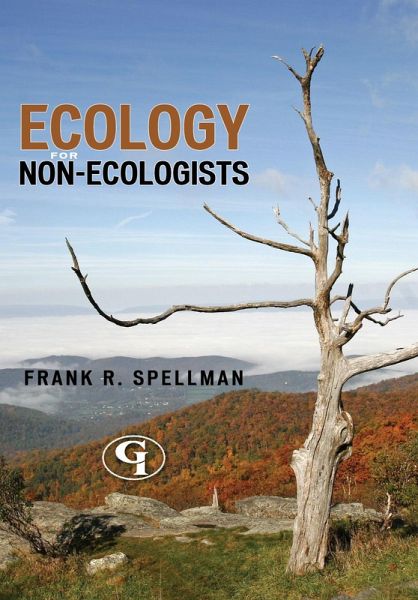
Written for anyone who works with chemicals or has a general interest in ecology, this book examines the interrelationship of life forms in our environment and provides straightforward explanations about the complicated interactions among nature and humans. Emphasizing basic concepts, definitions, and descriptions, the author presents illustrative problems in terms of commonly used ecological parameters to provide readers with enough information to make technical and personal decisions about ecology. Funneling the broad, multidisciplinary field of ecology, which incorporates aspects of…mehr
Written for anyone who works with chemicals or has a general interest in ecology, this book examines the interrelationship of life forms in our environment and provides straightforward explanations about the complicated interactions among nature and humans. Emphasizing basic concepts, definitions, and descriptions, the author presents illustrative problems in terms of commonly used ecological parameters to provide readers with enough information to make technical and personal decisions about ecology. Funneling the broad, multidisciplinary field of ecology, which incorporates aspects of biology, chemistry, physics, geology, meteorology, agriculture, forestry, and more into a single stream, the author provides those with backgrounds in only a handful, or even none, of these disciplines with an easy-to-read understanding of the functions and values of ecology and its interrelationships with other sciences, including ecology's direct impact on our lives. Organized into three parts, this book examines the fundamentals of ecology, the role of biodiversity, and the practical side of ecology. Readers will examine such topics as biogeochemical cycles, ecological pyramids, and the laws of population ecology. They will also examine species, terrestrial ecosystems, and aquatic systems. Each chapter ends with a Chapter Review Test.
Die Herstellerinformationen sind derzeit nicht verfügbar.
Autorenporträt
Frank R. Spellman, PhD, is a retired assistant professor of environmental health at Old Dominion University, Norfolk, Virginia, and the author of more than 136 books covering topics ranging from concentrated animal feeding operations (CAFOs) to all areas of environmental science and occupational health. Many of his texts are readily available online, and several have been adopted for classroom use at major universities throughout the United States, Canada, Europe, and Russia; two have been translated into Spanish for South American markets. Dr. Spellman has been cited in more than 550 publications. He serves as a professional expert witness for three law groups and as an incident/accident investigator for the U.S. Department of Justice and a northern Virginia law firm. In addition, he consults on homeland security vulnerability assessments for critical infrastructures including water/wastewater facilities nationwide and conducts pre-Occupational Safety and Health Administration (OSHA)/Environmental Protection Agency EPA audits throughout the country. Dr. Spellman lectures on sewage treatment, water treatment, and homeland security and lectures and safety topics throughout the country and teaches water/wastewater operator short courses at Virginia Tech (Blacksburg, Virginia). He surveyed the drinking water ancient distribution system at Machu Picchu and studied Darwin's Finches in the Galapagos Islands. In addition, he studied water pollution in Coco, Ecuador. He holds a BA, in public administration, a BS in business management, an MBA, and an MS and PhD in environmental engineering.
Es gelten unsere Allgemeinen Geschäftsbedingungen: www.buecher.de/agb
Impressum
www.buecher.de ist ein Internetauftritt der buecher.de internetstores GmbH
Geschäftsführung: Monica Sawhney | Roland Kölbl | Günter Hilger
Sitz der Gesellschaft: Batheyer Straße 115 - 117, 58099 Hagen
Postanschrift: Bürgermeister-Wegele-Str. 12, 86167 Augsburg
Amtsgericht Hagen HRB 13257
Steuernummer: 321/5800/1497
USt-IdNr: DE450055826