160,95 €
160,95 €
inkl. MwSt.
Sofort per Download lieferbar

80 °P sammeln
160,95 €
Als Download kaufen
160,95 €
inkl. MwSt.
Sofort per Download lieferbar
80 °P sammeln
Jetzt verschenken
Alle Infos zum eBook verschenken
160,95 €
inkl. MwSt.
Sofort per Download lieferbar
Alle Infos zum eBook verschenken
80 °P sammeln

Andere Kunden interessierten sich auch für
") The Becher Wetlands - A Ramsar Site (eBook, PDF)160,95 €
The Becher Wetlands - A Ramsar Site (eBook, PDF)160,95 €") Conservation of Faunal Diversity in Forested Landscapes (eBook, PDF)160,95 €
Conservation of Faunal Diversity in Forested Landscapes (eBook, PDF)160,95 €") The Energetics of Mangrove Forests (eBook, PDF)112,95 €
The Energetics of Mangrove Forests (eBook, PDF)112,95 €") Ecology and Decline of Red Spruce in the Eastern United States (eBook, PDF)72,95 €
Ecology and Decline of Red Spruce in the Eastern United States (eBook, PDF)72,95 €") Ecological Responses at Mount St. Helens: Revisited 35 years after the 1980 Eruption (eBook, PDF)72,95 €
Ecological Responses at Mount St. Helens: Revisited 35 years after the 1980 Eruption (eBook, PDF)72,95 €") Tropical Fire Ecology (eBook, PDF)272,95 €
Tropical Fire Ecology (eBook, PDF)272,95 €") History of Landscape Ecology in the United States (eBook, PDF)72,95 €
History of Landscape Ecology in the United States (eBook, PDF)72,95 €



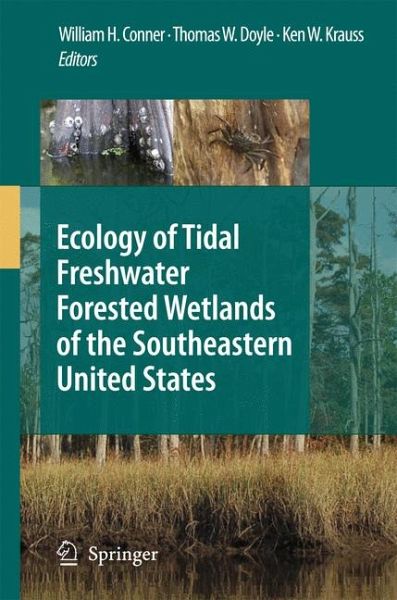
This book studies tidal freshwater swamps, unique wetland systems that are especially vulnerable to human development and climate change. Coverage targets hydrological processes, community organization, and stress physiology of freshwater, tidally influenced land-margin forests of the southeastern United States. It describes the land use history that has led to the restricted distribution of these swamps, followed by descriptions of the hydrology, soils, biogeochemistry, and physiological ecology of these systems with special attention on similarities shared among tidal freshwater swamps. Overviews of tidal swamps along the Pocomoke River, Chesapeake Bay, Waccamaw River, Savannah River, Suwannee River, and Waccasassa Bay are presented for more specific detail. In addition, micro-tidal swamps along the rapidly subsiding Louisiana coast in the Manchac Swamp and wetlands in the Barataria and Terrebonne regions of Louisiana are described as examples of heavily degraded wetlands.
Dieser Download kann aus rechtlichen Gründen nur mit Rechnungsadresse in A, B, BG, CY, CZ, D, DK, EW, E, FIN, F, GR, HR, H, IRL, I, LT, L, LR, M, NL, PL, P, R, S, SLO, SK ausgeliefert werden.
From the reviews:
"Tidal freshwater wetlands, upstream from saline coastal estuaries, present remarkable habitats now threatened by a variety of factors including climate change and sea level rise. The editors, along with 50 contributors ... here present recent, much-needed studies of these endangered areas. ... The volume offers good reviews of the current use and conservation of these forested wetlands, with ample suggestions about future research needs. ... This handbook is well referenced and illustrated throughout. Summing Up: Recommended. Upper-level undergraduate through professionals/practitioners." (C. Leck, CHOICE, Vol. 45 (5), January, 2008)
"The editors of this book have successfully brought together ecologists actively engaged in research on these systems ... and widely dispersed grey literature to provide a comprehensive review of research findings. ... For those interested in coastal wetlands, or systems that are driven by strong hydrological fluctuations, this book will be a valuable resource." (Siobhan Fennessy, Ecology, Vol. 89 (10), 2008)
"Tidal freshwater wetlands, upstream from saline coastal estuaries, present remarkable habitats now threatened by a variety of factors including climate change and sea level rise. The editors, along with 50 contributors ... here present recent, much-needed studies of these endangered areas. ... The volume offers good reviews of the current use and conservation of these forested wetlands, with ample suggestions about future research needs. ... This handbook is well referenced and illustrated throughout. Summing Up: Recommended. Upper-level undergraduate through professionals/practitioners." (C. Leck, CHOICE, Vol. 45 (5), January, 2008)
"The editors of this book have successfully brought together ecologists actively engaged in research on these systems ... and widely dispersed grey literature to provide a comprehensive review of research findings. ... For those interested in coastal wetlands, or systems that are driven by strong hydrological fluctuations, this book will be a valuable resource." (Siobhan Fennessy, Ecology, Vol. 89 (10), 2008)