112,95 €
inkl. MwSt.
Sofort per Download lieferbar
56 °P sammeln

Andere Kunden interessierten sich auch für
") Sustainable Forest Management (eBook, PDF)160,95 €
Sustainable Forest Management (eBook, PDF)160,95 €") The Computational Structure of Life Cycle Assessment (eBook, PDF)112,95 €
The Computational Structure of Life Cycle Assessment (eBook, PDF)112,95 €") Managing Forest Ecosystems: The Challenge of Climate Change (eBook, PDF)112,95 €
Managing Forest Ecosystems: The Challenge of Climate Change (eBook, PDF)112,95 €") Achieving the Sustainable Management of Forests (eBook, PDF)112,95 €
Achieving the Sustainable Management of Forests (eBook, PDF)112,95 €") Climate Change, Food Security and Natural Resource Management (eBook, PDF)96,95 €
Climate Change, Food Security and Natural Resource Management (eBook, PDF)96,95 €") Sustainable Future for Human Security (eBook, PDF)80,95 €
Sustainable Future for Human Security (eBook, PDF)80,95 €") The Future Use of Nordic Forests (eBook, PDF)72,95 €
The Future Use of Nordic Forests (eBook, PDF)72,95 €
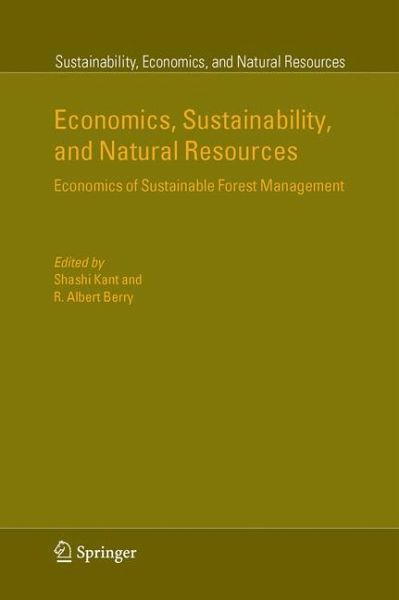
Forest resources are the ideal starting point for the complex economic analysis of sustainability. This book provides a systematic critique of neoclassical economic approaches and their limitations with respect to sustainability. Leading economists from different streams of economics discuss key economic aspects of sustainability and sustainable forest management including complexity, ethical issues, consumer choice theory, intergenerational equity, non-convexities, and multiple equilibria. A companion volume, 'Institutions, Sustainability, and Natural Resources: Institutions for Sustainable Forest Management', is also available.
Dieser Download kann aus rechtlichen Gründen nur mit Rechnungsadresse in A, B, BG, CY, CZ, D, DK, EW, E, FIN, F, GR, HR, H, IRL, I, LT, L, LR, M, NL, PL, P, R, S, SLO, SK ausgeliefert werden.
From the reviews:
"This book is very different from other literature regarding 'sustainability'. ... consists of 12 chapters covering a variety of perspectives on 'sustainability' in forest management. ... an excellent effort in terms of providing a broader picture of economics and its applications to sustainability. ... I would suggest that all economists and other professionals and practitioners who believe that the dominant contemporary economic paradigm is too narrow should read this book." (Yaoqi Zhang, International Forestry Review, Vol. 8, December, 2006)
"This book is very different from other literature regarding 'sustainability'. ... consists of 12 chapters covering a variety of perspectives on 'sustainability' in forest management. ... an excellent effort in terms of providing a broader picture of economics and its applications to sustainability. ... I would suggest that all economists and other professionals and practitioners who believe that the dominant contemporary economic paradigm is too narrow should read this book." (Yaoqi Zhang, International Forestry Review, Vol. 8, December, 2006)