55,95 €
inkl. MwSt.
Sofort per Download lieferbar
28 °P sammeln

Andere Kunden interessierten sich auch für
") Political Economy for Human Rights (eBook, ePUB)44,95 €
Political Economy for Human Rights (eBook, ePUB)44,95 €") The Economics of Human Rights (eBook, ePUB)82,95 €
The Economics of Human Rights (eBook, ePUB)82,95 €") Political Economy of Human Rights (eBook, ePUB)55,95 €
Political Economy of Human Rights (eBook, ePUB)55,95 €") Corporate Social Responsibility and Human Rights in Asia (eBook, ePUB)45,95 €
Corporate Social Responsibility and Human Rights in Asia (eBook, ePUB)45,95 €") Asia Pacific and Human Rights (eBook, ePUB)42,95 €
Asia Pacific and Human Rights (eBook, ePUB)42,95 €") The Right to Development in International Law (eBook, ePUB)39,95 €
The Right to Development in International Law (eBook, ePUB)39,95 €") Nonviolent Political Economy (eBook, ePUB)36,95 €
Nonviolent Political Economy (eBook, ePUB)36,95 €
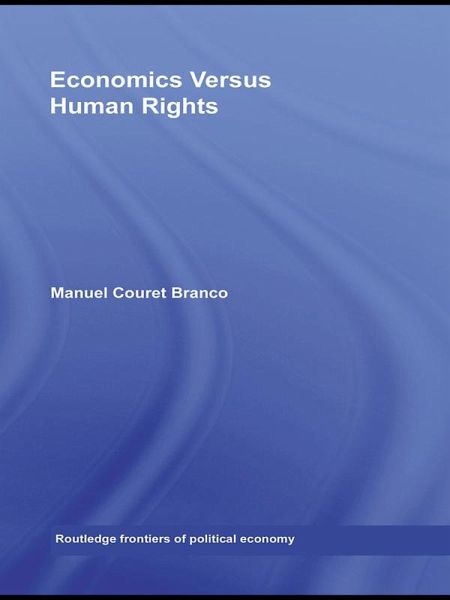
Human rights and economics are the concepts that have contributed the most to free human kind, the former from fear and the latter from need. Consequently, they should be complementing rather competing. Unfortunately it does not seem to be the case. In this book Manuel Couret Branco shows how mainstream economics discourse is intrinsically opposed to the promotion of human rights, especially economic, social and cultural rights.
Considering a variety of issues, this book looks at the conflict between economics and human rights at a theoretical level; how economics is opposed to the right to work; how economics, being a science concerned with the provision of goods and services for commercial purposes, conflicts with the idea of providing those same goods and services as rights, using as examples the right to water and the right to social security; the opposition of economics to cultural freedom, supported by the argument that economics tends to homogenize cultures on the basis of the idea that there is only one best culture to fulfil economic objectives; how economics contributes to the erosion of the democratic idea; and, finally, the opposition of economic globalisation to democracy.
The main conclusion of the book is that enhancing human rights in the global economy era demands a radical transformation of economics and
of the economy. This transformation should be characterised by reinstating the primacy of the person over the economy, by replacing economics at the service of human dignity. One of the aspects of this transformation concerns the need for a democratic control of the market. This democratic control means that people affected by economic decisions should be able to participate in the making of those decisions. In other words, the book proposes the recognition of economics as essentially a political science, and, thereby, the rehabilitation of politics within economics' discourse.
Considering a variety of issues, this book looks at the conflict between economics and human rights at a theoretical level; how economics is opposed to the right to work; how economics, being a science concerned with the provision of goods and services for commercial purposes, conflicts with the idea of providing those same goods and services as rights, using as examples the right to water and the right to social security; the opposition of economics to cultural freedom, supported by the argument that economics tends to homogenize cultures on the basis of the idea that there is only one best culture to fulfil economic objectives; how economics contributes to the erosion of the democratic idea; and, finally, the opposition of economic globalisation to democracy.
The main conclusion of the book is that enhancing human rights in the global economy era demands a radical transformation of economics and
of the economy. This transformation should be characterised by reinstating the primacy of the person over the economy, by replacing economics at the service of human dignity. One of the aspects of this transformation concerns the need for a democratic control of the market. This democratic control means that people affected by economic decisions should be able to participate in the making of those decisions. In other words, the book proposes the recognition of economics as essentially a political science, and, thereby, the rehabilitation of politics within economics' discourse.
Dieser Download kann aus rechtlichen Gründen nur mit Rechnungsadresse in A, B, BG, CY, CZ, D, DK, EW, E, FIN, F, GR, HR, H, IRL, I, LT, L, LR, M, NL, PL, P, R, S, SLO, SK ausgeliefert werden.