Sie sind bereits eingeloggt. Klicken Sie auf 2. tolino select Abo, um fortzufahren.
Bitte loggen Sie sich zunächst in Ihr Kundenkonto ein oder registrieren Sie sich bei bücher.de, um das eBook-Abo tolino select nutzen zu können.
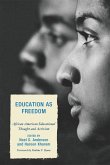
Before the founding of the United States, enslaved Africans advocated literacy as a method of emancipation. During the Reconstruction period after the Civil War, blacks were at the forefront of the debates on the establishment of public schools in the South. In fact, a wealth of ideas about the role of education in American freedom and progress emerged from African American civic, political, and religious communities and was informed by the complexity of the Black experience in America. Education as Freedom: African American Educational Thought and Activism is a groundbreaking edited text that…mehr
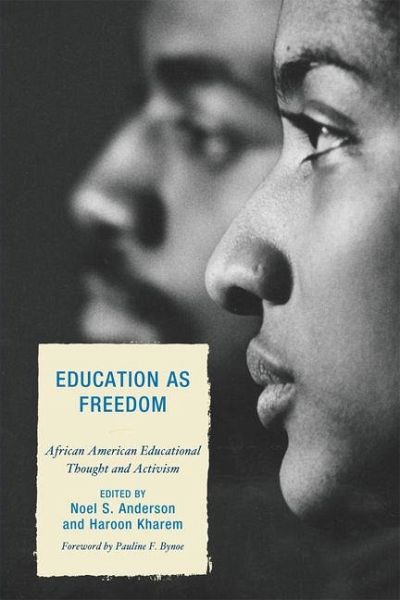
Before the founding of the United States, enslaved Africans advocated literacy as a method of emancipation. During the Reconstruction period after the Civil War, blacks were at the forefront of the debates on the establishment of public schools in the South. In fact, a wealth of ideas about the role of education in American freedom and progress emerged from African American civic, political, and religious communities and was informed by the complexity of the Black experience in America. Education as Freedom: African American Educational Thought and Activism is a groundbreaking edited text that documents and reexamines African-American empirical, methodological, and theoretical contributions to knowledge-making, teaching, and learning and American education from the nineteenth through the twenty-first century, the most dynamic period of African-American educational thought and activism. African-American thought and activism regarding education burgeoned from traditional academic disciplines, such as philosophy and art, mathematics and the natural sciences, and history and psychology; from the Black church as well as from grassroot political, social, cultural, and educational activism, with the desire to assess the stake of African Americans in modernity.
Die Herstellerinformationen sind derzeit nicht verfügbar.
Autorenporträt
Noel S. Anderson is associate professor in the Department of Political Science at Brooklyn College. Haroon Kharem is assistant professor in the School of Education at Brooklyn College.
Inhaltsangabe
Part 1 Introduction. Education as Freedom: African American Educational Thought and Activism Part 2 Section I. From Bondage to Freedom: Early African American Educational Thought and Activism Chapter 3 Chapter 1. Medical Doctor, Integrationist, and Black Nationalist: Dr. James McCune Smith and the Dilemma of Antebellum Intellectual Black Activist Chapter 4 Chapter 2. John Mercer Langston and the Shaping of African American Education in the Nineteenth Century Chapter 5 Chapter 3. On Classical vs. Vocational Training: The Educational Ideas of Anna Julia Cooper and Nannie Helen Burroughs Part 6 Section II. This Skin I'm In: African American Identity and Education Chapter 7 Chapter 4. Womanist Conceptualizations of African-Centered Critical Multiculturalism: Creating New Possibilities of Thinking about Social Justice Chapter 8 Chapter 5. The Performance Gap: Stereotype Threat, Assessment, and the Education of African American Children Chapter 9 Chapter 6. Katherine Dunham: Decolonizing Dance Education Part 10 Section III. Advancing the Race: African American Education and Social Progress Chapter 11 Chapter 7. Live the Truth: Politics and Pedagogy in the African-American Movement for Freedom and Liberation Chapter 12 Chapter 8. Black Schools, White Schools: Derrick Bell, Race, and the Failure of the Integration Ideal in Brown Chapter 13 Chapter 9. Research for Liberation: DuBois, the Chicago School, and the Development of Black Emancipatory Action Research
Es gelten unsere Allgemeinen Geschäftsbedingungen: www.buecher.de/agb
Impressum
www.buecher.de ist ein Internetauftritt der buecher.de internetstores GmbH
Geschäftsführung: Monica Sawhney | Roland Kölbl | Günter Hilger
Sitz der Gesellschaft: Batheyer Straße 115 - 117, 58099 Hagen
Postanschrift: Bürgermeister-Wegele-Str. 12, 86167 Augsburg
Amtsgericht Hagen HRB 13257
Steuernummer: 321/5800/1497
USt-IdNr: DE450055826