Reiner Westermeier
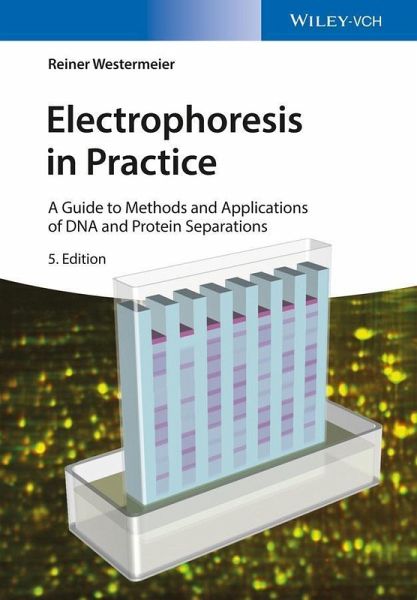
Electrophoresis in Practice (eBook, PDF)
A Guide to Methods and Applications of DNA and Protein Separations
108,99 €
108,99 €
inkl. MwSt.
Sofort per Download lieferbar
0 °P sammeln
108,99 €
Als Download kaufen
108,99 €
inkl. MwSt.
Sofort per Download lieferbar
0 °P sammeln
Jetzt verschenken
Alle Infos zum eBook verschenken
108,99 €
inkl. MwSt.
Sofort per Download lieferbar
Alle Infos zum eBook verschenken
0 °P sammeln
Reiner Westermeier
Electrophoresis in Practice (eBook, PDF)
A Guide to Methods and Applications of DNA and Protein Separations
- Format: PDF
- Merkliste
- Auf die Merkliste
- Bewerten Bewerten
- Teilen
- Produkt teilen
- Produkterinnerung
- Produkterinnerung

Bitte loggen Sie sich zunächst in Ihr Kundenkonto ein oder registrieren Sie sich bei
bücher.de, um das eBook-Abo tolino select nutzen zu können.
Hier können Sie sich einloggen
Sie sind bereits eingeloggt. Klicken Sie auf 2. tolino select Abo, um fortzufahren.

Bitte loggen Sie sich zunächst in Ihr Kundenkonto ein oder registrieren Sie sich bei bücher.de, um das eBook-Abo tolino select nutzen zu können.
"Electrophoresis in Practice" ist seit mehr als zwei Jahrzehnten das Standardwerk in der Elektrophorese. Die 5. Auflage wurde sorgfältig überarbeitet und beinhaltet nun ein erweitertes Kapitel zu Mikromethoden und der chipgebundenen Elektrophorese.
- Geräte: PC
- mit Kopierschutz
- eBook Hilfe
- Größe: 14.06MB
Andere Kunden interessierten sich auch für
Reiner WestermeierElectrophoresis in Practice (eBook, ePUB)108,99 €
Lorenzo A. PinnaProtein Kinase CK2 (eBook, PDF)183,99 €
G Protein-Coupled Receptors (eBook, PDF)94,99 €
Matrix Metalloproteinase Biology (eBook, PDF)132,99 €
Stefan BehmeManufacturing of Pharmaceutical Proteins (eBook, PDF)93,99 €
Therapeutic Proteins (eBook, PDF)129,99 €
Advanced Methods in Structural Biology (eBook, PDF)120,95 €-
-
-
"Electrophoresis in Practice" ist seit mehr als zwei Jahrzehnten das Standardwerk in der Elektrophorese. Die 5. Auflage wurde sorgfältig überarbeitet und beinhaltet nun ein erweitertes Kapitel zu Mikromethoden und der chipgebundenen Elektrophorese.
Dieser Download kann aus rechtlichen Gründen nur mit Rechnungsadresse in D ausgeliefert werden.
Produktdetails
- Produktdetails
- Verlag: Wiley-VCH
- Erscheinungstermin: 16. März 2016
- Englisch
- ISBN-13: 9783527695164
- Artikelnr.: 44850619
- Verlag: Wiley-VCH
- Erscheinungstermin: 16. März 2016
- Englisch
- ISBN-13: 9783527695164
- Artikelnr.: 44850619
- Herstellerkennzeichnung Die Herstellerinformationen sind derzeit nicht verfügbar.
Reiner Westermeier worked after PhD graduation and Post-doc at the Technische Universität München for 30 years as a specialist for electrophoresis methods for leading bioanalytics and biotechnology companies. His area of responsibility included co-operation in product development, writing of scientic papers and method instructions, trouble shooting in customer laboratories, performing seminars and practical courses on electrophoresis and proteomics, as well as giving scientific talks at congresses on a world-wide basis. He is editor and author of several books, e.g. 'Electrophoresis in Practice' (in German and in English), 'Proteomics in Practice', and 'Difference Gel Electrophoresis'.
Contents Part I Fundamentals and History Introduction 1 Electrophoresis 1.0 General 1.1 Electrophoresis in non-restrictive gels 1.1.1 Agarose gel electrophoresis 1.1.2 Polyacrylamide gel electrophoresis of low-molecular weight substances 1.2 Electrophoresis in restrictive gels 1.2.1 The Ferguson plot 1.2.2 Agarose gel electrophoresis 1.2.3 Polyacrylamide gel electrophoresis of nucleic acids 1.2.4 Polyacrylamide gel electrophoresis of proteins 2 Isotachophoresis 2.1 Migration with the same speed 2.2 "Ion train" separation 2.3 Zone sharpening effect 2.4 Concentration regulation effect 3 Isoelectric focusing 3.1 Principles 3.2 Gels for IEF 3.3 Temperature 3.4 Controlling the pH gradient 3.5 The kinds of pH gradients 3.5.1 Free carrier ampholytes 3.5.2 Immobilized pH gradients 3.6 Protein detection in IEF gels 3.7 Preparative isoelectric focusing 3.8 Titration curve analysis 4 Blotting 4.1 Principle 4.2 Transfer methods 4.3 Blotting membranes 4.4 Buffers for electrophoretic transfers 4.5 General staining 4.6 Blocking 4.7 Specific detection 4.8 Protein sequencing 4.9 Transfer problems 5 Interpretation of electropherograms 5.1 Introduction 5.1.1 Purity control 5.1.2 Quantification prerequisites 5.2 Image analysis 5.2.1 Hardware for image analysis 5.2.2 Software for image analysis 6 Proteome Analysis 6.1 General 6.2 Sample preparation 6.3 Two-dimensional electrophoresis 6.4 Detection techniques 6.5 Image analysis 6.6 Protein spot identification 6.6.1 Mass spectrometry methods 6.6.2 Peptide mass fingerprinting 6.6.3 Protein characterization 6.7 Bioinformatics 6.8 Functional proteomics 7 Instrumentation 7.1 Current and voltage conditions 7.2 Power supply 7.3 Separation chambers 7.3.1 Vertical apparatus 7.3.2 Horizontal apparatus 7.4 Staining apparatus for gels and blots 7.5 Automated electrophoresis 7.6 Instruments for 2-D electrophoresis 7.6.1 Isoelectric focusing apparatus 7.6.2 Multiple slab gel apparatus 7.7 Safety measures 7.8 Environmental aspects Equipment for Part II Instrumentation Laboratory equipment Consumables Chemicals Part II Methods Method 1: PAGE of dyes 1 Sample preparation 2 Stock solutions 3 Preparing the casting cassette 4 Casting the ultrathin-layer gels 5 Electrophoretic separation Method 2: PAGE of DNA Fragments 1 Stock solutions 2 Preparing the gels 3 Sample preparation 4 Electrophoresis 5 Silver staining Method 3: Agarose and immuno electrophoresis 1 Sample preparation 2 Stock solutions 3 Preparing the gels 4 Electrophoresis 5 Protein detection Method 4: Titration curve analysis 1 Sample preparation 2 Stock solutions 3 Preparing the blank gels 4 Titration curve analysis 5 Coomassie and silver staining 6 Interpreting the curves Method 5: Native PAGE in amphoteric buffers 1 Sample preparation 2 Stock solutions 3 Preparing the empty gels 4 Electrophoresis 5 Coomassie and silver staining Method 6: Agarose IEF 1 Sample preparation 2 Preparing the agarose gel 3 Isoelectric focusing 5 Protein detection Method 7: PAGIEF in rehydrated gels 1 Sample preparation 2 Stock solutions 3 Preparing the blank gels 4 Isoelectric focusing 5 Coomassie and silver staining 6 Perspectives Method 8: Horizontal SDS-PAGE 1 Sample preparation 2 Stock solutions for the preparation of gels 3 Preparing the casting cassette 4 Gradient gel 5 Electrophoresis 6 Protein detection 7 Blotting 8 Perspectives Method 9: Vertical PAGE 1 Sample preparation 2 Stock solutions 3 Single gel casting 4 Multiple gel casting 5 Electrophoresis 6 SDS electrophoresis of small peptides 7 Two-dimensional electrophoresis 8 DNA electrophoresis 9 Long shelflife gels 10 Protein detection Method 10: Semi-dry blotting of proteins 1 Transfer buffers 2 Technical procedure 3 Staining of blotting membranes Method 11: IEF in immobilized pH gradients 1 Sample preparation 2 Stock solutions 3 Immobiline recipes 4 Preparing the casting cassette 5 Preparing the pH gradient gels 6 Isoelectric focusing 7 Staining 8 Strategies for IPG focusing Method 12: High-resolution 2D electrophoresis 1 Sample preparation 2 Stock solutions 3 Preparing the gels 4 Separation conditions 5 Staining procedures 6 DIGE Appendix A Trouble-shooting guide A1 Isoelectric focusing A1.1 PAGIEF with carrier ampholytes A1.2 Agarose IEF with carrier ampholytes A1.3 Immobilized pH gradients A2 SDS electrophoresis A3 Vertical PAGE A4 Semi-dry blotting A5 2-D electrophoresis A6 DNA electrophoresis B References Index