72,95 €
72,95 €
inkl. MwSt.
Sofort per Download lieferbar

36 °P sammeln
72,95 €
Als Download kaufen
72,95 €
inkl. MwSt.
Sofort per Download lieferbar
36 °P sammeln
Jetzt verschenken
Alle Infos zum eBook verschenken
72,95 €
inkl. MwSt.
Sofort per Download lieferbar
Alle Infos zum eBook verschenken
36 °P sammeln

- Format: PDF
- Merkliste
- Auf die Merkliste
- Bewerten Bewerten
- Teilen
- Produkt teilen
- Produkterinnerung
- Produkterinnerung

Bitte loggen Sie sich zunächst in Ihr Kundenkonto ein oder registrieren Sie sich bei
bücher.de, um das eBook-Abo tolino select nutzen zu können.
Hier können Sie sich einloggen
Sie sind bereits eingeloggt. Klicken Sie auf 2. tolino select Abo, um fortzufahren.

Bitte loggen Sie sich zunächst in Ihr Kundenkonto ein oder registrieren Sie sich bei bücher.de, um das eBook-Abo tolino select nutzen zu können.
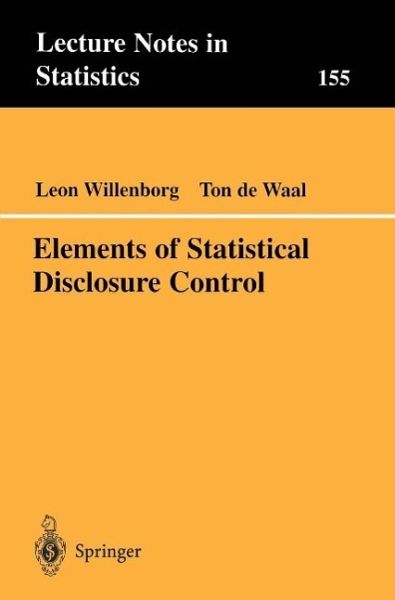
Statistical disclosure control is the discipline that deals with producing confidential statistical data that are safe enough to be released to external researchers. The book will be useful for official, social, and medical statisticians and others who are involved in releasing personal or business data for statistical use.
- Geräte: PC
- ohne Kopierschutz
- eBook Hilfe
- Größe: 25.63MB
Andere Kunden interessierten sich auch für
Leon WillenborgStatistical Disclosure Control in Practice (eBook, PDF)72,95 €
Javier CabreraStatistical Consulting (eBook, PDF)72,95 €
David RuppertStatistics and Data Analysis for Financial Engineering (eBook, PDF)72,95 €
Bernd SchererModern Portfolio Optimization with NuOPT(TM), S-PLUS®, and S+Bayes(TM) (eBook, PDF)72,95 €
On Model Uncertainty and its Statistical Implications (eBook, PDF)40,95 €
Statistical Methods in Counterterrorism (eBook, PDF)72,95 €
Mathematical and Statistical Methods for Actuarial Sciences and Finance (eBook, PDF)56,95 €-
-
-
Statistical disclosure control is the discipline that deals with producing confidential statistical data that are safe enough to be released to external researchers. The book will be useful for official, social, and medical statisticians and others who are involved in releasing personal or business data for statistical use.
Dieser Download kann aus rechtlichen Gründen nur mit Rechnungsadresse in A, B, BG, CY, CZ, D, DK, EW, E, FIN, F, GR, HR, H, IRL, I, LT, L, LR, M, NL, PL, P, R, S, SLO, SK ausgeliefert werden.
Produktdetails
- Produktdetails
- Verlag: Springer US
- Seitenzahl: 261
- Erscheinungstermin: 6. Dezember 2012
- Englisch
- ISBN-13: 9781461301219
- Artikelnr.: 44179443
- Verlag: Springer US
- Seitenzahl: 261
- Erscheinungstermin: 6. Dezember 2012
- Englisch
- ISBN-13: 9781461301219
- Artikelnr.: 44179443
- Herstellerkennzeichnung Die Herstellerinformationen sind derzeit nicht verfügbar.
1 Overview of the Area.- 1.1 Introduction.- 1.2 Types of Variables.- 1.3 Types of Microdata.- 1.4 Types of Tabular Data.- 1.5 Introduction to SDC for Microdata and Tables.- 1.6 Intruders and Disclosure Scenarios.- 1.7 Information Loss.- 1.8 Disclosure Protection Techniques for Microdata.- 1.9 Disclosure Protection Techniques for Tables.- 2 Disclosure Risks for Microdata.- 2.1 Introduction.- 2.2 Microdata.- 2.3 Disclosure Scenario.- 2.4 Predictive Disclosure.- 2.5 Re-identification Risk.- 2.6 Risk Per Record and Overall Risk.- 2.7 Population Uniqueness and Unsafe Combinations.- 2.8 Modeling Risks with Discrete Key Variables.- 2.9 Disclosure Scenarios in Practice.- 2.10 Combinations to Check.- 3 Data Analytic Impact of SDC Techniques on Microdata.- 3.1 Introduction.- 3.2 The Variance Impact of SDC Procedures.- 3.3 The Bias Impact of SDC Procedures.- 3.4 Impact of SDC Procedures on Methods of Estimation.- 3.5 Information Loss Measures Based on Entropy.- 3.6 Alternative Information Loss Measures.- 3.7 MSP for Microdata.- 4 Application of Non-Perturbative SDC Techniques for Microdata.- 4.1 Introduction.- 4.2 Local Suppression.- 4.3 Global Recoding.- 5 Application of Perturbative SDC Techniques for Microdata.- 5.1 Introduction.- 5.2 Overview.- 5.3 Adding Noise.- 5.4 Rounding.- 5.5 Derivation of PRAM Matrices.- 5.6 Data Swapping.- 5.7 Adjustment Weights.- 6 Disclosure Risk for Tabular Data.- 6.1 Introduction.- 6.2 Disclosur e Risk for Tables of Magnitude Tables.- 6.3 Disclosure Risk for Frequency Count Tables.- 6.4 Linked Tables.- 6.5 Protection Intervals for Sensitive Cells.- 6.6 Sensitivity Rules for General Tables.- 7.2 Information Loss Based on Cell Weights.- 7.3 MSP for Tables.- 7.4 Entropy Considerations.- 8 Application of Non-Perturbative Techniques for Tabular Data.- 8.1 Introduction.- 8.2 Table Redesign.- 8.3 Cell Suppression.- 8.4 Some Additional Cell Suppression Terminology.- 8.5 Hypercube Method.- 8.6 Secondary Suppression as an LP-Problem.- 8.7 Secondary Suppression as a MIP.- 8.8 Cell Suppression in Linked Tables.- 8.9 Cell Suppression in General Two-Dimensional Tables.- 8.10 Cell Suppression in General Three-Dimensional Tables.- 8.11 Comments on Cell Suppression.- 9 Application of Perturbative Techniques for Tabular Data.- 9.1 Introduction.- 9.2 Adding Noise.- 9.3 Unrestricted Rounding.- 9.4 Controlled Rounding.- 9.5 Controlled Rounding by Means of Simulated Annealing.- 9.6 Controlled Rounding as a MIP.- 9.7 Linked Tables.- References.