Sie sind bereits eingeloggt. Klicken Sie auf 2. tolino select Abo, um fortzufahren.
Bitte loggen Sie sich zunächst in Ihr Kundenkonto ein oder registrieren Sie sich bei bücher.de, um das eBook-Abo tolino select nutzen zu können.
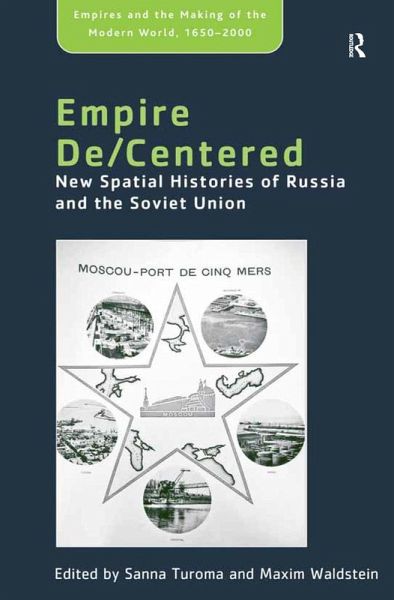
In 1991 the Soviet empire collapsed, at a stroke throwing the certainties of the Cold War world into flux. Yet despite the dramatic end of this 'last empire', the idea of empire is still alive and well, its language and concepts feeding into public debate and academic research. Bringing together a multidisciplinary and international group of authors to study Soviet society and culture through the categories empire and space, this collection demonstrates the enduring legacy of empire with regard to Russia, whose history has been marked by a particularly close and ambiguous relationship between…mehr
In 1991 the Soviet empire collapsed, at a stroke throwing the certainties of the Cold War world into flux. Yet despite the dramatic end of this 'last empire', the idea of empire is still alive and well, its language and concepts feeding into public debate and academic research. Bringing together a multidisciplinary and international group of authors to study Soviet society and culture through the categories empire and space, this collection demonstrates the enduring legacy of empire with regard to Russia, whose history has been marked by a particularly close and ambiguous relationship between nation and empire building, and between national and imperial identities. Parallel with this discussion of empire, the volume also highlights the centrality of geographical space and spatial imaginings in Russian and Soviet intellectual traditions and social practices; underlining how Russia's vast geographical dimensions have profoundly informed Russia's state and nation building, both in practice and concept. Combining concepts of space and empire, the collection offers a reconsideration of Soviet imperial legacy by studying its cultural and societal underpinnings from previously unexplored perspectives. In so doing it provides a reconceptualization of the theoretical and methodological foundations of contemporary imperial and spatial studies, through the example of the experience provided by Soviet society and culture.
Dieser Download kann aus rechtlichen Gründen nur mit Rechnungsadresse in A, B, BG, CY, CZ, D, DK, EW, E, FIN, F, GR, HR, H, IRL, I, LT, L, LR, M, NL, PL, P, R, S, SLO, SK ausgeliefert werden.
Die Herstellerinformationen sind derzeit nicht verfügbar.
Autorenporträt
Dr Sanna Turoma, Research Fellow at the Aleksanteri Institute, University of Helsinki, Finland. Dr Maxim Waldstein, Amsterdam University College, The Netherlands.
Inhaltsangabe
Contents: Introduction: empire and space: Russian and the Soviet Union in focus, Sanna Turoma and Maxim Waldstein; Part I Eurasianism and Intellectual Construction of Space: The empire of language: space and structuralism in Russia's Eurasianism, Sergey Glebov; Between Russia, Ukraine and Eurasia: Georgii Vernadskii's search for identity, Igor Torbakov; Space as a destiny: legitimizing the Russian empire through geography and cosmos, Marlène Laruelle. Part II Spatial Science and Geographical Knowledge: The mapping of illiberal modernity: spatial science, ideology and the state in early 20th-century Russia, Nick Baron; Regionalization, imperial legacy and the Soviet geographical tradition, Marina Loskutova. Part III Political and Cultural Economy of the (Post-)Soviet Space: The controlled space of socialist internationalism and its transgression: COMECON energy projects between 1970 and 1990, Ulrich Best; The rearrangement of the post-Soviet space and the representation of Russia as a Eurasian bridge, Katri Pynnöniemi; Debating Soviet imperialism in contemporary Poland: on the polish uses of postcolonial theory and their contexts, Tomasz Zarycki. Part IV Representing Empire: Media, Art, Literature: Playing games with Empire: Finnish political imaginaries on the early Soviet state, Anni Kangas; Imperiia re/constructed: narratives of space and nation in 1960s Soviet Russian culture, Sanna Turoma; Picturing infinity: space race and the cosmic landscape, Iina Kohonen; Eccentric orbit: mapping Russian culture in the near abroad, Kevin M.F. Platt; Bibliography; Index.
Es gelten unsere Allgemeinen Geschäftsbedingungen: www.buecher.de/agb
Impressum
www.buecher.de ist ein Internetauftritt der buecher.de internetstores GmbH
Geschäftsführung: Monica Sawhney | Roland Kölbl | Günter Hilger
Sitz der Gesellschaft: Batheyer Straße 115 - 117, 58099 Hagen
Postanschrift: Bürgermeister-Wegele-Str. 12, 86167 Augsburg
Amtsgericht Hagen HRB 13257
Steuernummer: 321/5800/1497
USt-IdNr: DE450055826