36,99 €
36,99 €
inkl. MwSt.
Sofort per Download lieferbar

0 °P sammeln
36,99 €
Als Download kaufen
36,99 €
inkl. MwSt.
Sofort per Download lieferbar
0 °P sammeln
Jetzt verschenken
Alle Infos zum eBook verschenken
36,99 €
inkl. MwSt.
Sofort per Download lieferbar
Alle Infos zum eBook verschenken
0 °P sammeln

Andere Kunden interessierten sich auch für
") The Role of Public Libraries in the Transformation of African Society (eBook, PDF)13,99 €
The Role of Public Libraries in the Transformation of African Society (eBook, PDF)13,99 €") Empowered Youths. Drivers of Nigeria's Socio-Economic Growth and Development (eBook, PDF)13,99 €
Empowered Youths. Drivers of Nigeria's Socio-Economic Growth and Development (eBook, PDF)13,99 €") African Philosophy. The Compatibility of Africa and the Christian Practice (eBook, PDF)13,99 €
African Philosophy. The Compatibility of Africa and the Christian Practice (eBook, PDF)13,99 €Building a National Identity by Renaming Places in South Africa (eBook, PDF)") (Re-)Building a National Identity by Renaming Places in South Africa (eBook, PDF)13,99 €
(Re-)Building a National Identity by Renaming Places in South Africa (eBook, PDF)13,99 €") The Western Arrogance Christened Neo-Colonialism. Its Challenges in Nigeria (eBook, PDF)6,99 €
The Western Arrogance Christened Neo-Colonialism. Its Challenges in Nigeria (eBook, PDF)6,99 €") The Igbo Women and their Traditional Dignity in Contradistinction to Latter-Day Value Aberrations for Women (eBook, PDF)6,99 €
The Igbo Women and their Traditional Dignity in Contradistinction to Latter-Day Value Aberrations for Women (eBook, PDF)6,99 €") Bekwarra Proverbs, Oral Literature, Indigenous Knowledge and Culture Sustenance (eBook, PDF)15,99 €
Bekwarra Proverbs, Oral Literature, Indigenous Knowledge and Culture Sustenance (eBook, PDF)15,99 €
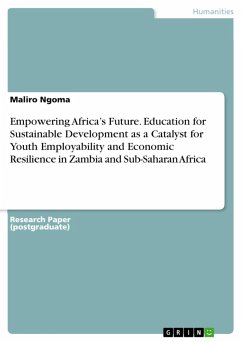
Research Paper (postgraduate) from the year 2025 in the subject African Studies - Miscellaneous, grade: PhD, , course: Education Management and Administration, language: English, abstract: This study investigates the role of Education for Sustainable Development (ESD) in enhancing youth employability and economic resilience in Zambia, with comparative insights from Sub-Saharan Africa. Grounded in Human Capital Theory, the Sustainable Livelihoods Framework, and the Capability Approach, the research adopts a pragmatic paradigm and a convergent parallel mixed methods design. Quantitative data were collected through surveys of 412 youth across Lusaka, Copperbelt, and Eastern Provinces, while qualitative insights were drawn from interviews, focus groups, and document analysis. Findings reveal that ESD participation significantly correlates with improved employment outcomes, higher income levels, and stronger entrepreneurial intent. Youth described ESD as practical and empowering, linking education to real-life challenges and opportunities. Female participants, despite facing greater barriers, demonstrated high engagement and leadership within ESD programs. Institutional support emerged as a critical factor, with better-resourced regions showing stronger outcomes. The study concludes that ESD fosters multidimensional resilience by equipping youth with marketable skills, adaptive capacities, and agency. However, disparities in access, gender equity, and institutional readiness limit its full potential. Policy recommendations include integrating ESD into national curricula, expanding access to marginalized groups, linking ESD to green job creation, and strengthening institutional capacity. This research contributes to the growing body of literature on sustainable education and youth development in Africa, offering actionable insights for policymakers, educators, and development practitioners committed to inclusive and transformative learning.
Dieser Download kann aus rechtlichen Gründen nur mit Rechnungsadresse in A, B, BG, CY, CZ, D, DK, EW, E, FIN, F, GR, HR, H, IRL, I, LT, L, LR, M, NL, PL, P, R, S, SLO, SK ausgeliefert werden.