Sie sind bereits eingeloggt. Klicken Sie auf 2. tolino select Abo, um fortzufahren.
Bitte loggen Sie sich zunächst in Ihr Kundenkonto ein oder registrieren Sie sich bei bücher.de, um das eBook-Abo tolino select nutzen zu können.
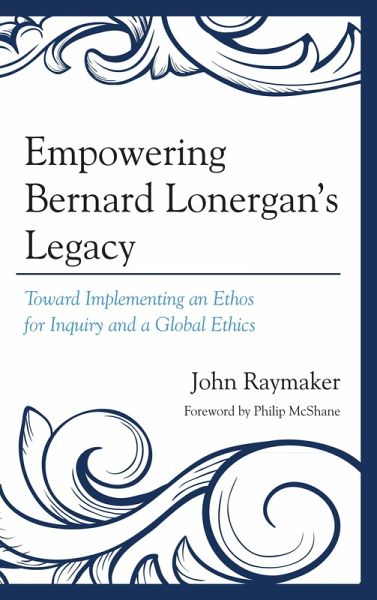
Empowering Bernard Lonergan's Legacy offers an interdisciplinary approach to Lonergan's work. It presents a series of five "feedback matrices" to situate his work within a historical context. The matrices also serve to establish foundations for an interdisciplinary ethics and a method for interreligious dialogue. "Feedback" and "matrix" are key, but previously unstressed, notions in Lonergan's work. The book's final two collaborative feedback matrices could best be implemented in a proposed international Lonergan association. Raymaker argues that without such an association, Lonergan's…mehr
Empowering Bernard Lonergan's Legacy offers an interdisciplinary approach to Lonergan's work. It presents a series of five "feedback matrices" to situate his work within a historical context. The matrices also serve to establish foundations for an interdisciplinary ethics and a method for interreligious dialogue. "Feedback" and "matrix" are key, but previously unstressed, notions in Lonergan's work. The book's final two collaborative feedback matrices could best be implemented in a proposed international Lonergan association. Raymaker argues that without such an association, Lonergan's breakthrough method cannot reach its interdisciplinary and collaborative potential. One of Lonergan's most important achievements was his development of foundations for the sciences, ethics, and interreligious dialogue. One can best empower Lonergan's legacy through a correct understanding and implementation of how the data of human consciousness affects all human knowledge and activities.
Die Herstellerinformationen sind derzeit nicht verfügbar.
Autorenporträt
John Raymaker spent twenty-five years as a missionary in Japan where he worked at the Tokyo Oriens Institute for Religious Research. He taught cultural anthropology and biblical studies at Junshin and Hosei Universities in Tokyo. He is the author of Pope Francis, Conscience of the World: Building Needed Bridges in a Troubled World.
Inhaltsangabe
List of Illustrations Foreword By Philip McShane Introduction xv Part I Historical And Intercultural Backgrounds Lonergan's Notions of "Matrix" and "Feedback" Chapter 1 Generalized Empirical Method (GEM) as Possible "Feedback Matrices" First Historical Feedback Matrix: Situating GEM's Mediating, Transformative Roles Chapter 2 Two Further Feedback Matrices: Historical Implications Metaphysical Equivalence and the Limitations of Various Analyses A Second Historical Feedback Matrix: How Lonergan (GEM) Goes Beyond Aquinas Third Historical Feedback Matrix: How Lonergan (GEM) Reconciles Galileo, Pascal, and Einstein Part II An Ethically Empowering Foreground Coordinating Lonergan's Legacy Chapter 3 Transitional Issues in Evaluating Holistic-GEM-FS Collaboration Chapter 4 Implementing the Functional Specialties in Two Phases Fourth GEM-Fs Feedback Matrix: Functional Collaboration And Grounding Ethics A First Complementarity-Dialectical Phase: Grounding GEM Operations Transition to Fig. 3b's Second Cooperative Dialectical Phase Chapter 5 Fifth Feedback Matrix: A Structured IGEMA Operating as a Collaborative FS Feedback Matrix to Implement the Human Good Conclusion Appendix I: GEM-Buddhist Dialectical Foundations Appendix II: GEM Economics Appendix III: Feedback Matrices' Transformative Roles and Mathematical Analogies Index
List of Illustrations Foreword By Philip McShane Introduction xv Part I Historical And Intercultural Backgrounds Lonergan's Notions of "Matrix" and "Feedback" Chapter 1 Generalized Empirical Method (GEM) as Possible "Feedback Matrices" First Historical Feedback Matrix: Situating GEM's Mediating, Transformative Roles Chapter 2 Two Further Feedback Matrices: Historical Implications Metaphysical Equivalence and the Limitations of Various Analyses A Second Historical Feedback Matrix: How Lonergan (GEM) Goes Beyond Aquinas Third Historical Feedback Matrix: How Lonergan (GEM) Reconciles Galileo, Pascal, and Einstein Part II An Ethically Empowering Foreground Coordinating Lonergan's Legacy Chapter 3 Transitional Issues in Evaluating Holistic-GEM-FS Collaboration Chapter 4 Implementing the Functional Specialties in Two Phases Fourth GEM-Fs Feedback Matrix: Functional Collaboration And Grounding Ethics A First Complementarity-Dialectical Phase: Grounding GEM Operations Transition to Fig. 3b's Second Cooperative Dialectical Phase Chapter 5 Fifth Feedback Matrix: A Structured IGEMA Operating as a Collaborative FS Feedback Matrix to Implement the Human Good Conclusion Appendix I: GEM-Buddhist Dialectical Foundations Appendix II: GEM Economics Appendix III: Feedback Matrices' Transformative Roles and Mathematical Analogies Index
Es gelten unsere Allgemeinen Geschäftsbedingungen: www.buecher.de/agb
Impressum
www.buecher.de ist ein Internetauftritt der buecher.de internetstores GmbH
Geschäftsführung: Monica Sawhney | Roland Kölbl | Günter Hilger
Sitz der Gesellschaft: Batheyer Straße 115 - 117, 58099 Hagen
Postanschrift: Bürgermeister-Wegele-Str. 12, 86167 Augsburg
Amtsgericht Hagen HRB 13257
Steuernummer: 321/5800/1497
USt-IdNr: DE450055826