0,00 €
inkl. MwSt.
Sofort per Download lieferbar
0 °P sammeln

Andere Kunden interessierten sich auch für
") Engendering Democracy in Africa (eBook, ePUB)0,00 €
Engendering Democracy in Africa (eBook, ePUB)0,00 €") Gender, Development and Globalization (eBook, PDF)49,95 €
Gender, Development and Globalization (eBook, PDF)49,95 €") African Women and Intellectual Leadership (eBook, PDF)45,95 €
African Women and Intellectual Leadership (eBook, PDF)45,95 €") Routledge Handbook of Contemporary African Women (eBook, PDF)51,95 €
Routledge Handbook of Contemporary African Women (eBook, PDF)51,95 €") Gender, Peace and Security in Africa (eBook, PDF)48,95 €
Gender, Peace and Security in Africa (eBook, PDF)48,95 €") Sindiwe Magona and the Power of Paradox (eBook, PDF)45,95 €
Sindiwe Magona and the Power of Paradox (eBook, PDF)45,95 €") Women, Men, and Elections (eBook, PDF)40,95 €
Women, Men, and Elections (eBook, PDF)40,95 €
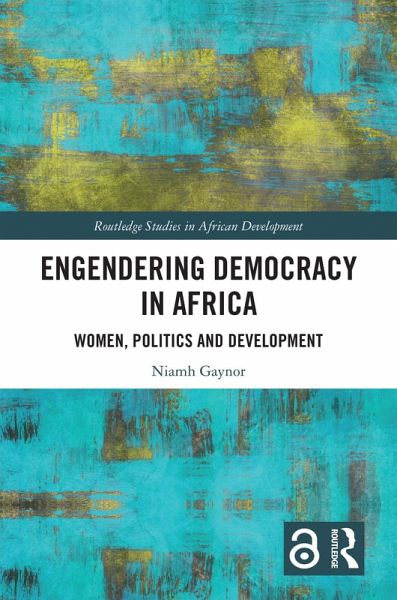
This book investigates women's political participation in Africa. Going beyond the formal institutions of electoral politics, it explores a range of spaces where everyday politics take place, at national and at local levels.
In recent years there have been significant improvements in the number of women elected to parliament in Africa. However, there is little indication that this is translating into better developmental outcomes, and indeed there is mounting evidence that it could in fact help to bolster some authoritarian regimes. Starting from the premise that politics is a far broader project than securing a seat in national or local legislatures alone, this book explores the opportunities for women's political participation across a number of informal spaces where women and men gather, organise and interact in a more regular and systematic manner. Combining insights from political science, sociology and feminist theory and drawing on detailed cases from the Congo, Kenya, Malawi, Nigeria and Rwanda, it examines how power in its multiple dimensions circulates across a range of everyday political spaces, while drawing attention to the links between domestic gender inequalities and the global political economy.
Inviting scholars, practitioners and activists to broaden their focus beyond formal electoral institutions if they want to support women to become more politically active, this book provides fresh insights into major issues at the heart of African studies, development studies, gender and development, democratisation, and international relations.
In recent years there have been significant improvements in the number of women elected to parliament in Africa. However, there is little indication that this is translating into better developmental outcomes, and indeed there is mounting evidence that it could in fact help to bolster some authoritarian regimes. Starting from the premise that politics is a far broader project than securing a seat in national or local legislatures alone, this book explores the opportunities for women's political participation across a number of informal spaces where women and men gather, organise and interact in a more regular and systematic manner. Combining insights from political science, sociology and feminist theory and drawing on detailed cases from the Congo, Kenya, Malawi, Nigeria and Rwanda, it examines how power in its multiple dimensions circulates across a range of everyday political spaces, while drawing attention to the links between domestic gender inequalities and the global political economy.
Inviting scholars, practitioners and activists to broaden their focus beyond formal electoral institutions if they want to support women to become more politically active, this book provides fresh insights into major issues at the heart of African studies, development studies, gender and development, democratisation, and international relations.
Dieser Download kann aus rechtlichen Gründen nur mit Rechnungsadresse in A, B, BG, CY, CZ, D, DK, EW, E, FIN, F, GR, HR, H, IRL, I, LT, L, LR, M, NL, PL, P, R, S, SLO, SK ausgeliefert werden.
"This book is a much needed antidote to the national level focus of most studies of democratisation and development. Drawing on a rich empirical base, it looks at the sites of everyday politics, showing how they are gendered. The chapters explore a wide range of spaces, ranging from the fast growing 'Lion Economies' in Africa to decentralisation practices, NGOs, the media, community associations and traditional authorities. This timely book uncovers new opportunities, challenges and lessons for women's empowerment."
Professor Aili Mari Tripp, Wangari Maathai Professor of Political Science & Gender and Women's Studies, Co-Editor, American Political Science Review, Department of Political Science, University of Wisconsin-Madison, USA
"This book transcends the WID/GAD development literature to incorporate different bodies of theory, such as post-structuralism and discourse theory. It connects theoretical premises with varied empirical research in Africa, weaving a rich tapestry of insights and novel understandings. It deftly navigates different aspects of gender politics such as substantive representation, informal networks, protest and institutional politics, looking to Asia for solutions. I look forward to using it with my students."
Professor Amanda Gouws, SARChI Chair in Gender Politics, Department of Political Science, Stellenbosch University, South Africa
Professor Aili Mari Tripp, Wangari Maathai Professor of Political Science & Gender and Women's Studies, Co-Editor, American Political Science Review, Department of Political Science, University of Wisconsin-Madison, USA
"This book transcends the WID/GAD development literature to incorporate different bodies of theory, such as post-structuralism and discourse theory. It connects theoretical premises with varied empirical research in Africa, weaving a rich tapestry of insights and novel understandings. It deftly navigates different aspects of gender politics such as substantive representation, informal networks, protest and institutional politics, looking to Asia for solutions. I look forward to using it with my students."
Professor Amanda Gouws, SARChI Chair in Gender Politics, Department of Political Science, Stellenbosch University, South Africa