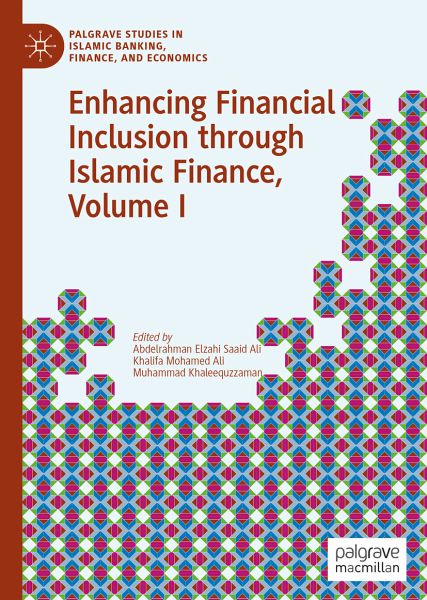
Enhancing Financial Inclusion through Islamic Finance, Volume I (eBook, PDF)
Redaktion: Elzahi Saaid Ali, Abdelrahman; Khaleequzzaman, Muhammad; Ali, Khalifa Mohamed
72,95 €
72,95 €
inkl. MwSt.
Sofort per Download lieferbar

36 °P sammeln
72,95 €
Als Download kaufen
72,95 €
inkl. MwSt.
Sofort per Download lieferbar
36 °P sammeln
Jetzt verschenken
Alle Infos zum eBook verschenken
72,95 €
inkl. MwSt.
Sofort per Download lieferbar
Alle Infos zum eBook verschenken
36 °P sammeln

Enhancing Financial Inclusion through Islamic Finance, Volume I (eBook, PDF)
Redaktion: Elzahi Saaid Ali, Abdelrahman; Khaleequzzaman, Muhammad; Ali, Khalifa Mohamed
- Format: PDF
- Merkliste
- Auf die Merkliste
- Bewerten Bewerten
- Teilen
- Produkt teilen
- Produkterinnerung
- Produkterinnerung

Bitte loggen Sie sich zunächst in Ihr Kundenkonto ein oder registrieren Sie sich bei
bücher.de, um das eBook-Abo tolino select nutzen zu können.
Hier können Sie sich einloggen
Sie sind bereits eingeloggt. Klicken Sie auf 2. tolino select Abo, um fortzufahren.

Bitte loggen Sie sich zunächst in Ihr Kundenkonto ein oder registrieren Sie sich bei bücher.de, um das eBook-Abo tolino select nutzen zu können.
Provides a clear analysis of Islamic finance as a vehicle for social inclusion and improving access to financial inclusion Tackles challenges such as gender, income and wealth inequality in relation to access to finance Combines empirical evidence, theory and modelling to demonstrate how Islamic microfinance can be used to improve financial inclusion
- Geräte: PC
- ohne Kopierschutz
- eBook Hilfe
- Größe: 4.08MB
Andere Kunden interessierten sich auch für
Enhancing Financial Inclusion through Islamic Finance, Volume II (eBook, PDF)72,95 €
Taiwo O. SoetanFinancial Services in Nigeria (eBook, PDF)112,95 €
Financial Sector Development in Ghana (eBook, PDF)120,95 €
Revitalization of Waqf for Socio-Economic Development, Volume I (eBook, PDF)128,95 €
Islamic Social Finance (eBook, PDF)34,95 €
Balancing Islamic and Conventional Banking for Economic Growth (eBook, PDF)44,95 €
Islamic Finance Practices (eBook, PDF)72,95 €-
-
-
Provides a clear analysis of Islamic finance as a vehicle for social inclusion and improving access to financial inclusion
Tackles challenges such as gender, income and wealth inequality in relation to access to finance
Combines empirical evidence, theory and modelling to demonstrate how Islamic microfinance can be used to improve financial inclusion
Dieser Download kann aus rechtlichen Gründen nur mit Rechnungsadresse in A, B, BG, CY, CZ, D, DK, EW, E, FIN, F, GR, HR, H, IRL, I, LT, L, LR, M, NL, PL, P, R, S, SLO, SK ausgeliefert werden.
Produktdetails
- Produktdetails
- Verlag: Springer International Publishing
- Seitenzahl: 245
- Erscheinungstermin: 1. Juli 2020
- Englisch
- ISBN-13: 9783030399351
- Artikelnr.: 59800022
- Verlag: Springer International Publishing
- Seitenzahl: 245
- Erscheinungstermin: 1. Juli 2020
- Englisch
- ISBN-13: 9783030399351
- Artikelnr.: 59800022
- Herstellerkennzeichnung Die Herstellerinformationen sind derzeit nicht verfügbar.
Abdelrahman Elzahi Saaid Ali is a Senior Economist at the Islamic Research and Training Institute (IRTI) of the Islamic Development Bank (IsDB). Before joining IRTI, he was Associate Professor of Economics at Sudan University of Science and Technology. Abdelrahman has written and edited a number of academic publications including Revitalization of Waqf for Socio-Economic Development (Palgrave, 2019). Khalifa Mohamed Ali is a Senior Economist at IRTI. Before this, he was Associate Professor of Economics at the United Arab Emirates University and taught economics at Iowa State University, USA. Khalifa is the Editor of the Arabic edition of Islamic Economic Studies, one of IRTI's flagship publications, and has published extensively in the area of Islamic finance. Muhammad Khaleequzzaman studied Economics at the University of Illinois at UrbanäChampaign, USA, and Islamic Banking and Finance at the International Islamic University Islamabad, Pakistan. Muhammad is a certified Islamic banker from the State Bank of Pakistan.
Part I. Enhancing Financial Inclusion through Islamic Finance.- 1. Introduction; Abdelrahman Elzahi Saaid Ali, Khalifa Mohamed Ali and Muhammad Khaleequzzaman.- 2. Empowering the Poor and Enhancing Financial Inclusion from a Multi-dimensional Perspective; Hazik Mohamed.- 3. Causes of Income and Wealth Inequalities: Perspectives of Economists from the Fields of Conventional and Islamic Economics; Muhammad Imran Ejaz.- 4. How Islamic Microfinance Can Contribute to Achieving the Sustainable Development Goals; Murniati Mukhlisin, Luqyan Tamanni, Toseef Azid and Rifka Mustafida.- 5. Islamic Finance and its Impact on Financial Inclusion; Wissal Msellek.- 6. A Critical Review of Takaful Companies' Contributions to Economic Developments in Fulfillment of Maqasid al-Shariah: Evidence from Malaysia; Abu Umar Faruq Ahmad and Rashedul Hasan.- Part II. Islamic Financial Inclusion: Cases and Modeling.- 7. Making Islamic Finance a Vehicle for SocialInclusion: A Case for Revisiting the Liquidity Management Practices by Islamic Banks; Muhammad Ayub.- 8. Improving Access to Financial Services: Theory and Practice around the Globe; Muhammad Azeem Qureshi and Toseef Azid.- 9. Fintech and Financial Inclusion in Pakistan: An Exploratory Study; Hassnian Ali and Rose Abdullah.- 10. Financial Inclusion for Farmers through Appropriate Financing Products: Analytic Network Process Approach; Dika Megantara and Anita Priantina.- 11. A Skill-based and Interest-free Microfinance Model of Entrepreneurship is the Most Sustainable Model; Farhat Mahmood and Adeeba Ishaq.