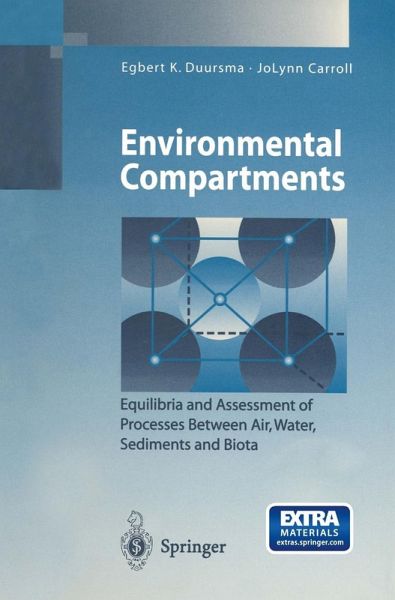
Egbert K. Duursma, Jolynn Carroll
Environmental Compartments (eBook, PDF)
Equilibria and Assessment of Processes Between Air, Water, Sediments and Biota
40,95 €
inkl. MwSt.
Sofort per Download lieferbar

20 °P sammeln

Egbert K. Duursma, Jolynn Carroll
Environmental Compartments (eBook, PDF)
Equilibria and Assessment of Processes Between Air, Water, Sediments and Biota
- Format: PDF
- Merkliste
- Auf die Merkliste
- Bewerten Bewerten
- Teilen
- Produkt teilen
- Produkterinnerung
- Produkterinnerung

Bitte loggen Sie sich zunächst in Ihr Kundenkonto ein oder registrieren Sie sich bei
bücher.de, um das eBook-Abo tolino select nutzen zu können.
Hier können Sie sich einloggen
Sie sind bereits eingeloggt. Klicken Sie auf 2. tolino select Abo, um fortzufahren.

Bitte loggen Sie sich zunächst in Ihr Kundenkonto ein oder registrieren Sie sich bei bücher.de, um das eBook-Abo tolino select nutzen zu können.
This book explains how to identify compartmental links, evaluate distributions and predict movements of natural and anthropogenic substances in the environment. It is directed toward university education and is also intended as a resource for environmental professionals. The book contains exercises/answers and a disk.
- Geräte: PC
- ohne Kopierschutz
- eBook Hilfe
- Größe: 24.07MB
Andere Kunden interessierten sich auch für
Cadmium (eBook, PDF)72,95 €
Air Pollution (eBook, PDF)72,95 €
Polychlorinated Dibenzo-p-dioxins and -furans (PCDDs/PCDFs): Sources and Environmental Impact, Epidemiology, Mechanisms of Action, Health Risks (eBook, PDF)40,95 €
Water Pollution (eBook, PDF)40,95 €
Managed Ecosystems and CO2 (eBook, PDF)160,95 €
George W. WareReviews of Environmental Contamination and Toxicology (eBook, PDF)40,95 €
Francis A. GuntherResidue Reviews (eBook, PDF)72,95 €-
-
-
This book explains how to identify compartmental links, evaluate distributions and predict movements of natural and anthropogenic substances in the environment. It is directed toward university education and is also intended as a resource for environmental professionals. The book contains exercises/answers and a disk.
Dieser Download kann aus rechtlichen Gründen nur mit Rechnungsadresse in A, B, BG, CY, CZ, D, DK, EW, E, FIN, F, GR, HR, H, IRL, I, LT, L, LR, M, NL, PL, P, R, S, SLO, SK ausgeliefert werden.
Produktdetails
- Produktdetails
- Verlag: Springer Berlin Heidelberg
- Seitenzahl: 279
- Erscheinungstermin: 6. Dezember 2012
- Englisch
- ISBN-13: 9783642801891
- Artikelnr.: 53085359
- Verlag: Springer Berlin Heidelberg
- Seitenzahl: 279
- Erscheinungstermin: 6. Dezember 2012
- Englisch
- ISBN-13: 9783642801891
- Artikelnr.: 53085359
- Herstellerkennzeichnung Die Herstellerinformationen sind derzeit nicht verfügbar.
1 Introduction.- 2 Processes and equilibria between compartments.- 2.1 Principles.- 2.2 Phases or compartments.- 2.3 Processes and equilibria.- 3 Complexing metal- and radionuclide-sediment reactions.- 3.1 Complexation of metals by dissolved organic matter.- 3.2 Results on radionuclide sorption by marine sediments.- 4 Diffusion principles.- 4.1 Theories.- 4.2 Simple methods of determining diffusion coefficients.- 4.3 Experiments on hindrance of diffusing ions in sediments.- 4.4. Summary on effects on molecular diffusion in bottom sediments.- 5 Organochlorines.- 5.1 Introduction.- 5.2 PCB and DDT behaviour in water, PM and sediment compartments.- 5.3 The eel case.- 5.4 Pesticide use and contamination with Tambak (Indonesian brackish-water) aquaculture.- 5.5 Possible DDT and PCB partitioning between air and man.- 6 Competitive reactions and effects of conservativity.- 6.1 Introduction.- 6.4 Principles of conservativity.- 6.3 Model study of competitive processes in an estuary containing a turbidity maximum.- 6.4 Residence times of metals in an estuary.- 6.5 Sources and sinks of chemical constituents in estuaries.- 7 Examples of distribution patterns in estuaries and seas.- 7.1 Budget of plutonium and some other nuclides in an estuary.- 7.2 Metals in the Western Mediterranean.- 7.3 PCB budgets.- 7.4 The food chain accumulation paradox.- 8 Nuclear waste in the Kara Sea.- 8.1 Introduction.- 8.2 History of radioactive waste dumping in the Kara Sea.- 8.3 Inventory of dumped objects.- 8.4 Environmental concentrations of radionuclides.- 8.5 Predicting future radionuclide releases.- 8.6 Modelling radionuclide dispersion.- 8.7 Impact assessment.- 9 Globel oceanic and atmospheric stability of oxygen.- 9.1 Oxygen budgets.- 9.2 Relation to CO2 budgets.- 9.3 Time-dependent process.- 9.4 Future limit(s) of ocean pH due to fossil-fuel produced CO2.- 10 Case studies on Environmental Impact Assessment (EIA).- 10.1 Introduction.- 10.2 Techniques.- 10.3 A Delta-case EIA study.- 10.4 Assessment of diffusion of radionuclides from potential HLW disposal.- 10.5 Amoeba assessment.- 10.6 COSMO-BIO assessment.- Appendix I: Answers to a question and exercises.- Appendix II: Kara Sea box model user information.- Appendix Ills COSMO-BIO assessment.- References.