41,95 €
41,95 €
inkl. MwSt.
Sofort per Download lieferbar

21 °P sammeln
41,95 €
Als Download kaufen
41,95 €
inkl. MwSt.
Sofort per Download lieferbar
21 °P sammeln
Jetzt verschenken
Alle Infos zum eBook verschenken
41,95 €
inkl. MwSt.
Sofort per Download lieferbar
Alle Infos zum eBook verschenken
21 °P sammeln

Andere Kunden interessierten sich auch für
") Environmental Humanities and the Uncanny (eBook, PDF)41,95 €
Environmental Humanities and the Uncanny (eBook, PDF)41,95 €") Routledge Handbook of Ecocriticism and Environmental Communication (eBook, ePUB)47,95 €
Routledge Handbook of Ecocriticism and Environmental Communication (eBook, ePUB)47,95 €") Writing a New Environmental Era (eBook, ePUB)39,95 €
Writing a New Environmental Era (eBook, ePUB)39,95 €") Quest for the Unity of Knowledge (eBook, ePUB)39,95 €
Quest for the Unity of Knowledge (eBook, ePUB)39,95 €") The Anthropocenic Turn (eBook, ePUB)42,95 €
The Anthropocenic Turn (eBook, ePUB)42,95 €") Global Ecologies and the Environmental Humanities (eBook, ePUB)46,95 €
Global Ecologies and the Environmental Humanities (eBook, ePUB)46,95 €") American Environmental Fiction, 1782-1847 (eBook, ePUB)38,95 €
American Environmental Fiction, 1782-1847 (eBook, ePUB)38,95 €






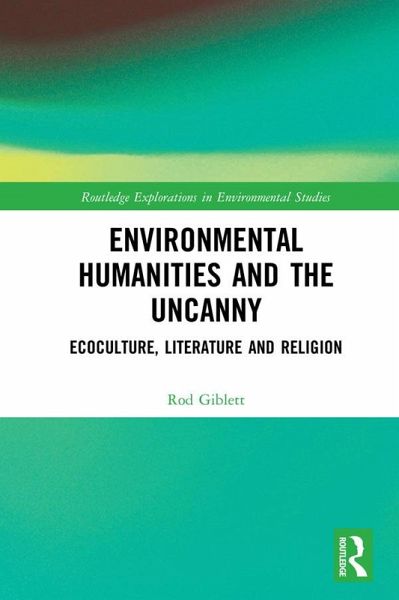
Sigmund Freud's essay 'The Uncanny' is celebrating a century since publication. It is arguably his greatest and most fruitful contribution to the study of culture and the environment. Environmental Humanities and the Uncanny brings into the open neglected aspects of the uncanny in this famous essay in its centenary year and in the work of those before and after him, such as Friedrich Schelling, Walter Benjamin, E. T. A. Hoffmann and Bram Stoker.
This book does so by focussing on religion, especially at a time and for a world in which some sectors of the monotheisms are in aggressive, and sometimes violent, contention against those of other monotheisms, and even against other sectors within their own monotheism. The chapter on Schelling's uncanny argues that monotheisms come out of polytheism and makes the plea for polytheism central to the whole book. It enables rethinking the relationships between mythology and monotheistic and polytheistic religions in a culturally and politically liberatory and progressive way. Succeeding chapters consider the uncanny cyborg, the uncanny and the fictional, and the uncanny and the Commonwealth, concluding with a chapter on Taoism as a polytheistic religion.
Building on the author's previous work in Environmental Humanities and Theologies in bringing together theories of religion and the environment, this book will be of great interest to students and scholars of the environmental humanities, ecocultural studies and religion.
This book does so by focussing on religion, especially at a time and for a world in which some sectors of the monotheisms are in aggressive, and sometimes violent, contention against those of other monotheisms, and even against other sectors within their own monotheism. The chapter on Schelling's uncanny argues that monotheisms come out of polytheism and makes the plea for polytheism central to the whole book. It enables rethinking the relationships between mythology and monotheistic and polytheistic religions in a culturally and politically liberatory and progressive way. Succeeding chapters consider the uncanny cyborg, the uncanny and the fictional, and the uncanny and the Commonwealth, concluding with a chapter on Taoism as a polytheistic religion.
Building on the author's previous work in Environmental Humanities and Theologies in bringing together theories of religion and the environment, this book will be of great interest to students and scholars of the environmental humanities, ecocultural studies and religion.
Dieser Download kann aus rechtlichen Gründen nur mit Rechnungsadresse in A, B, BG, CY, CZ, D, DK, EW, E, FIN, F, GR, HR, H, IRL, I, LT, L, LR, M, NL, PL, P, R, S, SLO, SK ausgeliefert werden.